Ternstroemia
Credits
Article from Bean's Trees and Shrubs Hardy in the British Isles
Article from New Trees by John Grimshaw & Ross Bayton
Recommended citation
'Ternstroemia' from the website Trees and Shrubs Online (treesandshrubsonline.
Family
- Ternstroemiaceae (or Pentaphylacaceae)
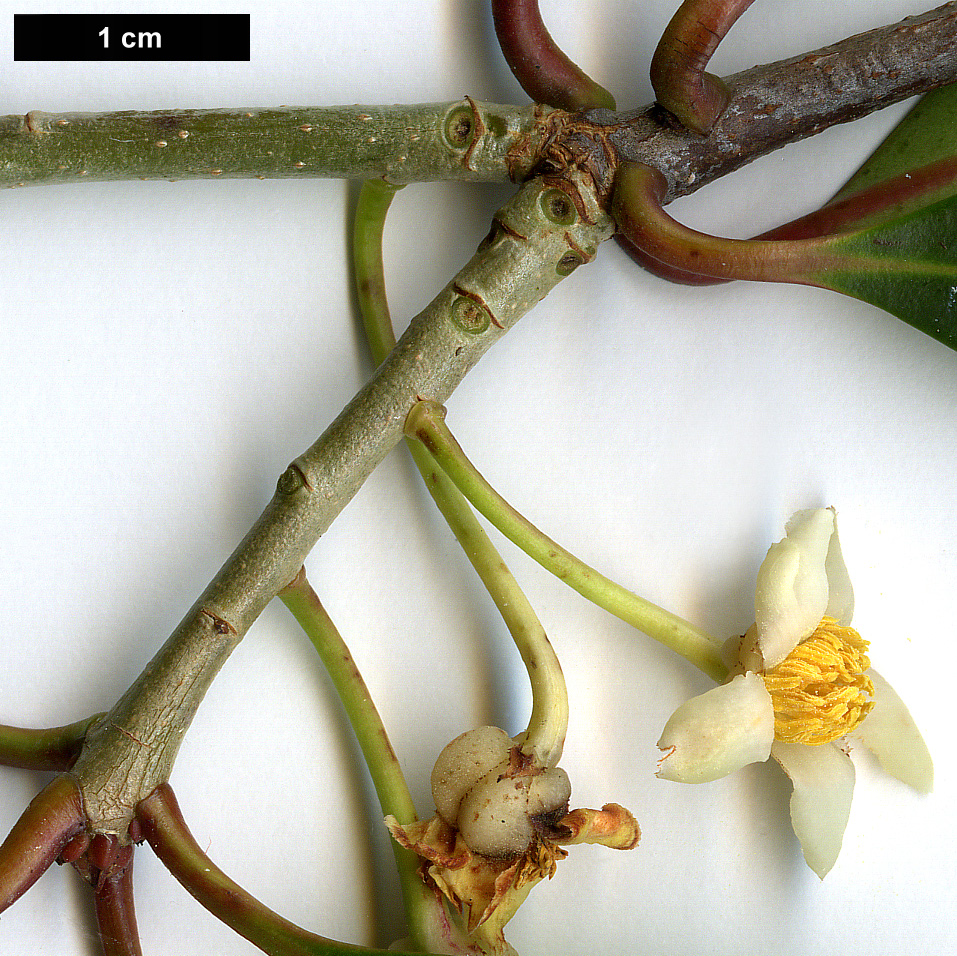
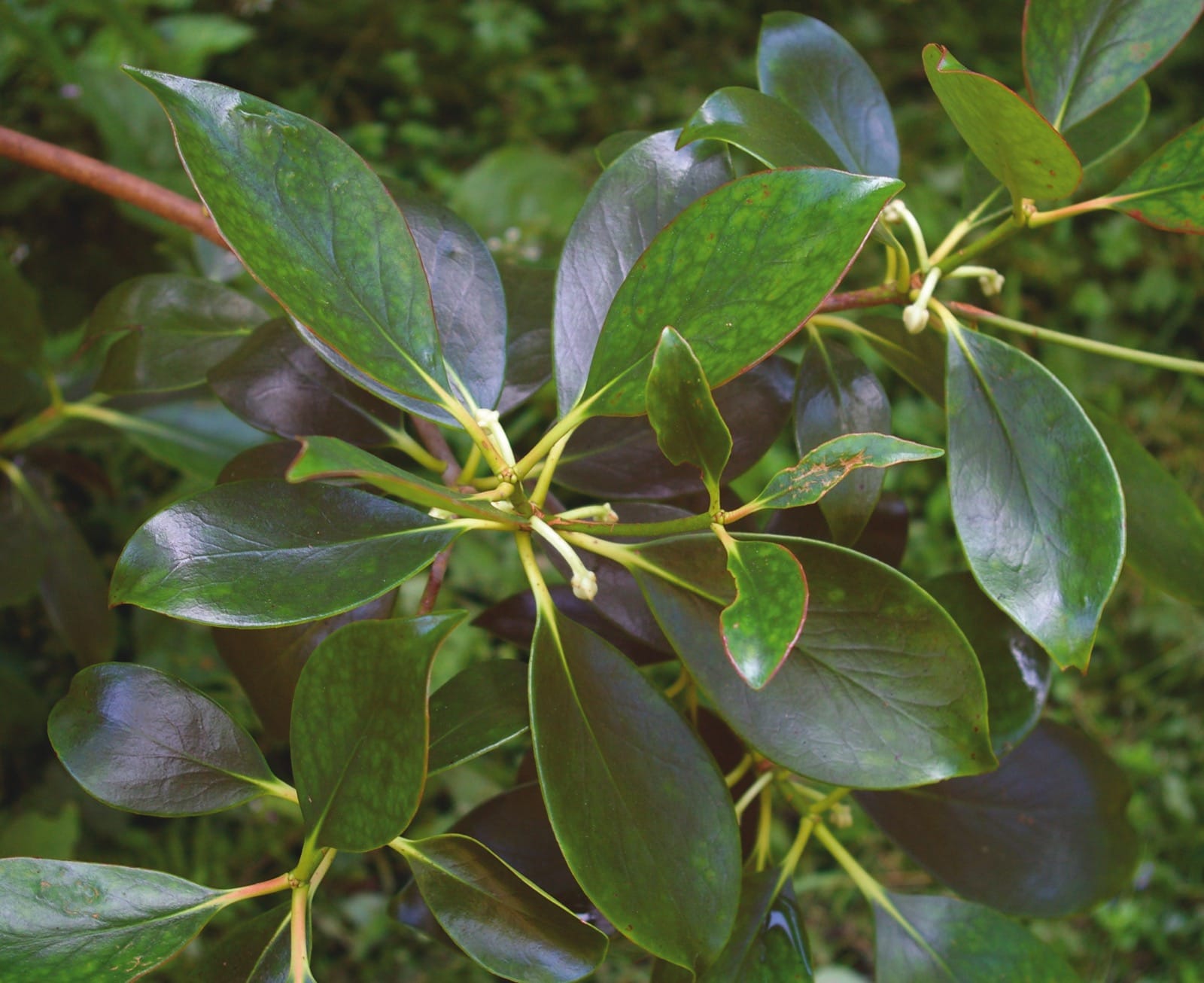
There are over 90 species of Ternstroemia, distributed across tropical and subtropical Asia, Africa and the Americas. They are evergreen trees or shrubs with alternate, petiolate, entire (rarely serrate) leaves. Ternstroemia flowers are axillary and solitary, though it is not unusual to find several flowers clustered together on leafless branchlets. They are subtended by two bracteoles, which remain close to the sepals and are persistent or caducous. The flowers are 5-merous; the sepals imbricate, their margins glandular-serrate, the petals imbricate, slightly fused at the base, with 30–50 stamens in one to two (to three) whorls, filaments fused to the base of the petals. The fruit is a berry, which may be indehiscent or irregularly dehiscent, with pendulous seeds. The seeds are kidney-shaped with a red fleshy outer layer (Weitzman et al. 2004, Ming & Bartholomew 2006). Ternstroemia and its allies (for example, Eurya Thunb., Cleyera Thunb.) were previously classified as a subfamily of the Theaceae, but DNA evidence indicates that they should be recognised as a separate family, or in combination with Pentaphylacaceae (Prince & Parks 2001, APG 2003).
As a largely tropical genus, Ternstroemia does not impinge much on temperate gardens – with the conspicuous exception of T. gymnanthera. This evergreen shrub or small tree was said by Bean (1981b) to be ‘not of much ornamental value’, but has become an important landscaping evergreen in the southeastern United States, where numerous cultivars have been selected (Dirr 1998). Propagation is by seed or by cuttings taken in late summer.
Bean’s Trees and Shrubs
Ternstroemia
A genus of almost 100 species of evergreen trees and shrubs, mostly in the tropics and subtropics of Asia and America. Flowers bisexual or some functionally male, solitary or clustered. Sepals five, imbricated. Petals five, imbricated, connate at the base. Stamens numerous, with glabrous anthers (hairy in the allied Cleyera). Fruit a leathery berry with a few large seeds suspended from the top of the central column.