Taxodium Rich.

TSO logo

Sponsor

In memory of Robin Herbert CBE VMH

Credits

Owen Johnson (2026)

Recommended citation
Johnson, O. (2026), 'Taxodium' from the website Trees and Shrubs Online (treesandshrubsonline.org/articles/taxodium/). Accessed 2026-07-11.

Family

  • Cupressaceae

Common Names

  • Swamp Cypress
  • Bald Cypress
  • White Cypress
  • Red Cypress
  • Tidewater Red Cypress
  • Gulf Cypress
  • Cyprès Chauve
  • Ahuehuete
  • Ciprés
  • Baldcypress

Synonyms

  • Cuprespinnata J.Nelson
  • Schubertia Mirb.
  • ×Taxodiomeria Z.J.Ye, J.J.Zhang & S.H.Pan

Glossary

Critically Endangered
IUCN Red List conservation category: ‘facing an extremely high risk of extinction in the wild’.
family
A group of genera more closely related to each other than to genera in other families. Names of families are identified by the suffix ‘-aceae’ (e.g. Myrtaceae) with a few traditional exceptions (e.g. Leguminosae).
Least Concern
IUCN Red List conservation category: ‘does not qualify for Critically Endangered Endangered Vulnerable or Near Threatened. Widespread and abundant taxa are included in this category.’ ‘Lower Risk’ was formerly used and many tree species are still so-categorised in the Red List.
alluvial
Sediments deposited by rivers or soils derived from such material.
disjunct
Discontinuous; (of a distribution pattern) the range is split into two or more distinct areas.
endemic
(of a plant or an animal) Found in a native state only within a defined region or country.
hybrid
Plant originating from the cross-fertilisation of genetically distinct individuals (e.g. two species or two subspecies).
intergeneric
(of hybrids) Formed by fertilisation between species of different genera.
monospecific
(of a genus) Including only one species (as e.g. Aextoxicon).
taxon
(pl. taxa) Group of organisms sharing the same taxonomic rank (family genus species infraspecific variety).
taxonomy
Classification usually in a biological sense.
variety
(var.) Taxonomic rank (varietas) grouping variants of a species with relatively minor differentiation in a few characters but occurring as recognisable populations. Often loosely used for rare minor variants more usefully ranked as forms.

Credits

Owen Johnson (2026)

Recommended citation
Johnson, O. (2026), 'Taxodium' from the website Trees and Shrubs Online (treesandshrubsonline.org/articles/taxodium/). Accessed 2026-07-11.

One species of tree, often very large and long lived; more or less adapted to sporadic flooding and often with a flared lower bole and sometimes with stalagmite-shaped pneumatophores (‘knees’) arising from the lateral roots. Bark pale grey to rufous, quickly developing criss-cross stringy ridges. Shoots dimorphic, with annual growth comprising a persistent long shoot which bears short lateral shoots (side shoots) that are winter-deciduous with the leaves in temperate climates, or else shed in spring as the next year’s side-shoots develop, or in the dry season. Leaves and side shoots carried alternately. Leaves linear to narrowly lanceolate to deltate, generally flattened, the free portion c. 3–17 mm long, appressed to the young permanent shoots but in some forms spreading in 2 flat ranks from the deciduous shoots. Seed cones globular, maturing in one season, with 5–10 thinly woody scales; usually borne at the base of the deciduous shoots in pendent panicles, more rarely singly or in racemes. Seeds 2 (rarely 1) per scale, irregularly 3-angled, not winged. (Watson & Eckenwalder 1993).

Taxodium distichum (L.) Rich. is one of around fourteen conifer species, spread across five genera, which is characteristically deciduous (Rowland 2024), and is one of very few conifers to show strong adaptations for growing in waterlogged and even much-flooded habitats. Like many members of the Cypress Family (Cupressaceae), these are often giant trees and can claim several arboreal superlatives: they are the longest-lived plants in the eastern half of North America, while one individual, growing in Mexico’s Oaxaca province near the southern extremity of the range, has a very good claim to be Earth’s largest-girthed tree. ‘The Senator’, a specimen of T. distichum var. distichum growing at Longwood, Florida, was estimated to have been 3500 years old, by correlating its girth to that of trees whose annual rings have been counted by core sampling and which are known to be more than 2600 years old, when it was accidentally burned down by a homeless woman in 2012 (Wikipedia 2024). The ‘Arbole de Tule’, in the town of Santa Maria Del Tule (var. mexicanum) has a very irregularly shaped but single short bole with a girth of 58 m (Creech 2016).

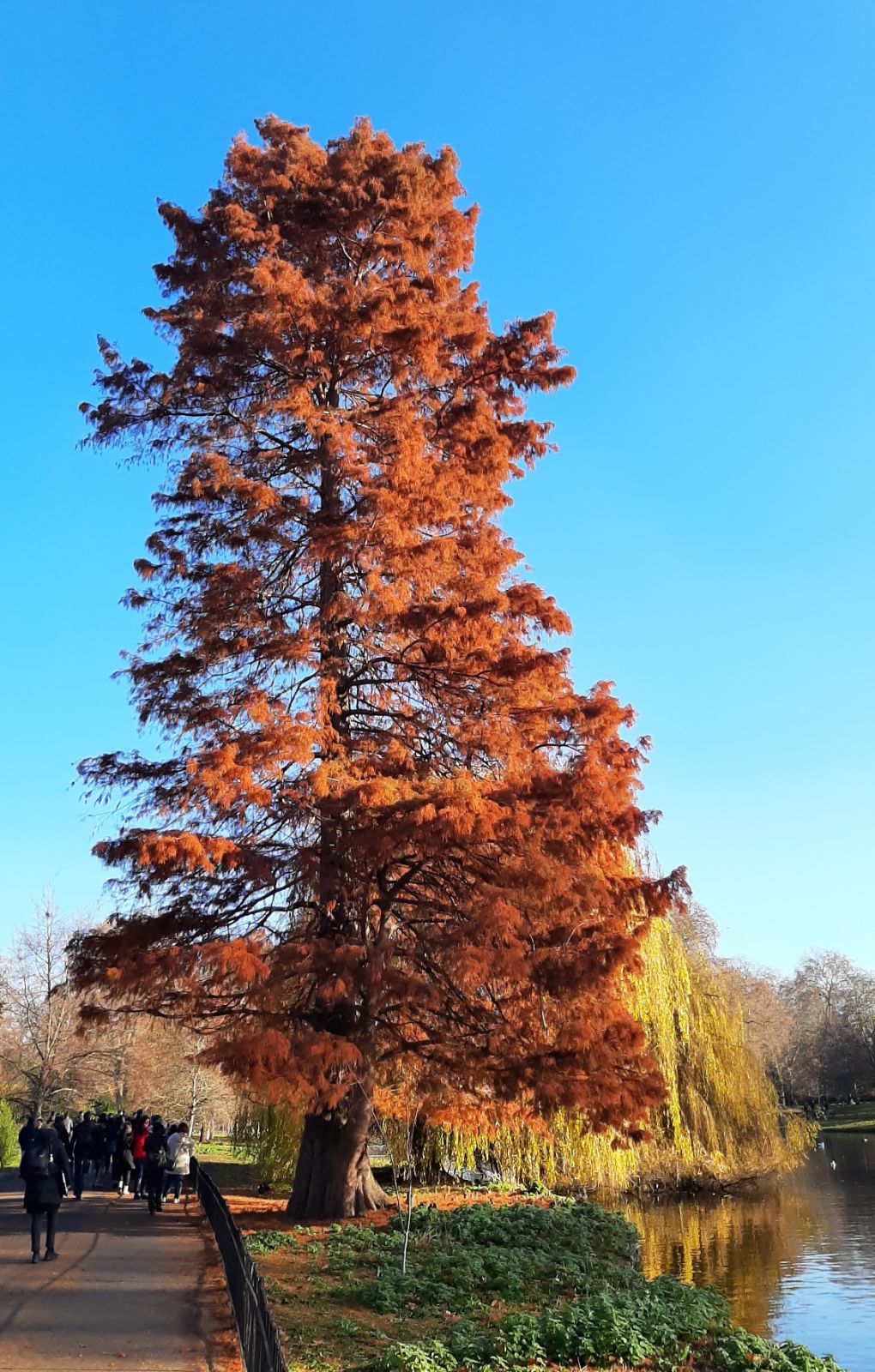
Swamp or Bald Cypresses are also much loved ornamentals, their ability to tolerate wetter conditions more than almost any other hardy tree recommending them for some particularly difficult sites. Their leaves, which are never held for more than a year and are often shed in autumn, are variously and brilliantly grass-green and their fine and delicate texture exquisitely counterpoints the ultimately monumental stature of the tree itself. The deciduous forms show bright autumn colours, ranging from gold through fox-red to a deep mahogany brown. The slender and close-set nature of the leaves means that Swamp Cypresses can trap more dew and raindrops in their foliage than perhaps any other tree, and the glint of these droplets set off by the bright emerald background is one of the special pleasures the genus has to offer.

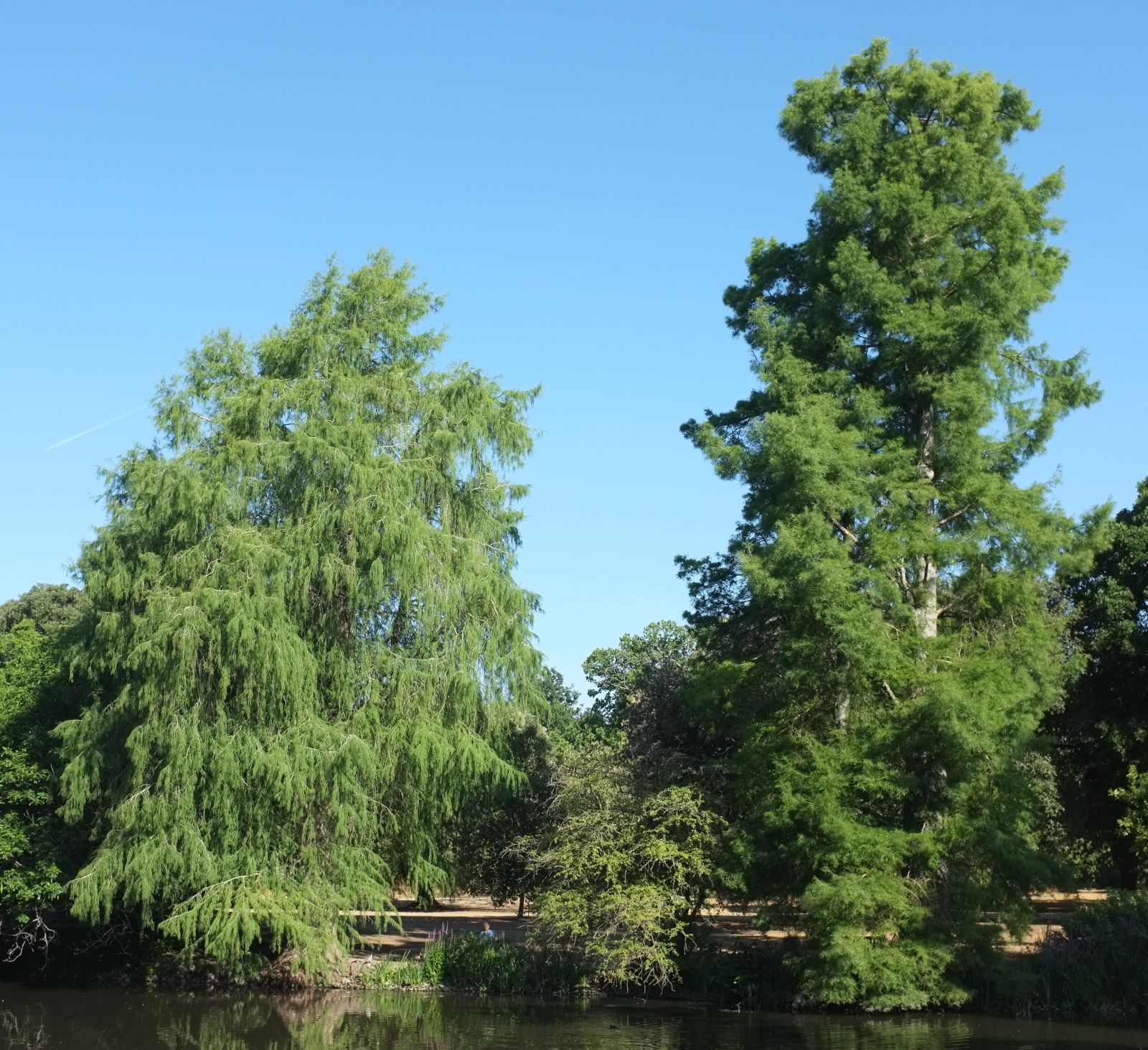
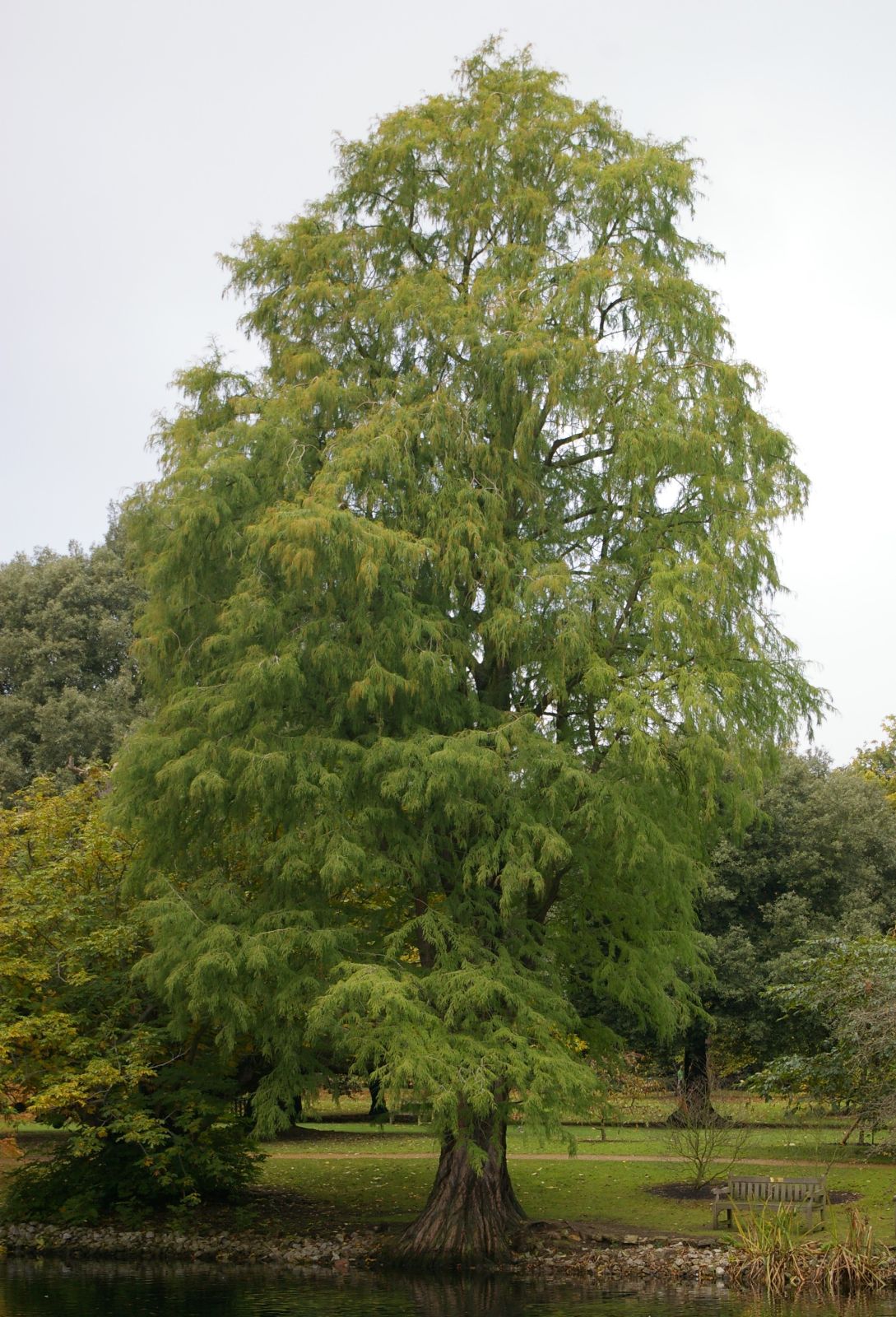
Various authors have opted to divide the genus into three species, but this account follows the majority of contemporary botanists in recognising just one species and three varieties (var. distichum, var. imbricarium, and var. mexicanumAdams et al. 2012). Varieties distichum and imbricarium share a more or less continuous natural range which extends along the south-eastern coasts of the United States from central Texas north-east to New Jersey, and which runs inland along major river systems, as far up the Mississippi as southern Illinois in the case of var. distichum. These varieties can be distinguished both by their appearance and their ecology: var. imbricarium is slightly slower-growing and less massive than var. distichum, and its leaves are more or less adpressed to the deciduous as well as to the permanent shoots; it can be found growing in stagnant water, in bogs and along watercourses where the soil is seldom enriched by annual deposits of silt. Var. distichum carries its leaves in two flattened ranks along its deciduous side shoots; it favours river soils which are annually enriched by alluvial deposits. The two trees differ strikingly in appearance in summer although much less so in winter; intermediate plants also exist, both in the wild and in cultivation (Watson & Eckenwalder 1993). Louis Claude Richard’s name for the genus, which means ‘like a yew’, is therefore appropriate to the characteristic foliage of var. distichum (and of var. mexicanum), but much less so to var. imbricarium. The differences in the foliage are less likely to be apparent in saplings, in late season growth and coppice sprouts, or on fertile shoots (Watson & Eckenwalder 1993).

The third accepted variety, var. mexicanum (Carrière) Gordon & Glend., survives in a series of discrete populations extending from the far south of Texas and New Mexico (USA), through Mexico into western Guatemala. These populations become more nearly evergreen as they reach the tropics, but the side shoots and their foliage never persist for more than a full year. In its foliage and its vigour, var. mexicanum closely resembles var. distichum, but it lacks some of the latter tree’s adaptations for growing in standing water and its roots seldom produce the characteristic ‘knees’ of var. distichum. Planted in very mild conditions, var. distichum may become semi-evergreen, while var. mexicanum can shed its foliage in colder winters (or in the dry season, which coincides with temperate winter in tropical southern Mexico); the disjunct natural range is therefore the only reliable point of distinction between var. distichum and var. mexicanum (Watson & Eckenwalder 1993). In China, plants of var. mexicanum and var. distichum have been hybridised to create fast-growing new ornamental clones.

If treated as separate species, the rules of botanical nomenclature require, rather confusingly, that the names of both the varieties have to change: var. imbricarium becomes T. ascendens Brongn., and var. mexicanum becomes T. mucronatum Ten. (Royal Botanic Gardens, Kew 2025), names by which they have long been familiar to many dendrologists.

Meanwhile, an analysis of the terpenoids found in various populations of Taxodium by Adams et al. (2012) has suggested that trees of var. mexicanum from the far south of the natural range, in Guatemala and in Mexico’s Oaxaca and Chiapas Provinces, form an evolutionary lineage which appears distinct from that of var. mexicanum in the northern parts of its range, and from var. distichum and var. imbricarium. A taxonomy has yet to be proposed which could reflect the existence of these two lineages, and it is not yet clear whether the genetic distinctiveness of the southern population(s?) of var. mexicanum is indicated by any macroscopic features. Trees as long-lived as Taxodium are likely to evolve very slowly, and so it is possible or indeed likely that some of the fragmented populations of var. mexicanum will have been genetically isolated from one another over very long periods, perhaps millions of years.

It is worth noting a considerable strength of feeling that persists in some quarters in support of the ‘three species’ view; the distinct distributions and ecologies of the three (varieties, as treated here) are a major pillar of that argument. Nevertheless there is now a significant body of evidence that the morphological and molecular differences between the three are too minor to warrant recognition beyond the rank of variety (Farjon 2017). Speaking of var. imbricarium in particular, Chris Earle characterises the ‘persistent popular recognition’ of this taxon as a species in its own right as ‘a cultural phenomenon that persists despite abundant biological evidence to the contrary’ (Earle 2026).

Aesthetically, the three varieties of Taxodium distichum, in their purest forms, can be distinguished more reliably than is the case, within other genera, for many quite genetically distinct species: var. mexicanum will not provide the concentrated autumn colour of the other varieties, while var. imbricarium, in contrast to var. distichum in cultivation at least, is a tree of modest stature whose slenderly-clad shoots make for a more delicate and feathery aspect. This monospecific genus therefore becomes a dendrological anomaly, and it has seemed appropriate to describe all of the features which are shared across the varieties of the species within this generic introduction.

In cultivation, Taxodium is likeliest to be confused with Metasequoia, another monospecific genus of giant, long-lived, water-loving conifers with deciduous side shoots, this time endemic to central China. The easiest way to distinguish these trees lies in the more of less opposite distribution of the leaves of Metasequoia on its decidous shoots, and the opposite distribution of these shoots on the persistent twigs: in Taxodium both are carried alternately. Younger plants of Metasequoia also show stronger apical dominance, especially in areas with warm summers where they typically remain neatly spire-shaped until 30 m tall or more. Taxodium is, in fact, more closely related to Glyptostrobus, a less adaptable ‘Chinese Swamp Cypress’ which is consequently much less familiar in western gardens, and which is assessed as Critically Endangered in the wild. Taxodium is also closer to Cryptomeria than it is to Metasequoia (Yang et al. 2022), confounding any expectations that might derive from the very different appearance of these two genera.

An intergeneric hybrid between Taxodium and Cryptomeria, ×Taxodiomeria, was described from cultivation in China in 2003, but nothing in the appearance or genetics of the claimed hybrids has so far suggested that they are in reality anything other than pure Taxodium distichum (Creech 2017). Hybrids of Taxodium and Sequoia were also reported from Communist-era Russia (Fowells 1965), but are even less likely to have been genuine.

The timber of Taxodium is remarkably light but very rot resistant, due to the presence of a sesquiterpene called cypressene; unlike the wood of most members of the Cypress Family, it is odourless. Prehistoric and partly mineralised timber dug out of swamps as far north as Connecticut in the United States is much prized for carving (Wikipedia 2024). However, old-growth stands have been exploited less ruthlessly by lumberjacks than is true for many conifers, thanks to the inhospitable and frequently inundated sites where these trees grow, but there are worrying signs that these hitherto safe forests are coming under increasing pressure (Earle 2025). Partly for this reason, Taxodium distichum has been assessed as a species of Least Concern, but rising sea levels pose a threat to the species’ extensive coastal forests (Allen, Reza Pezeshki & Chambers 1996).

Swamp Cypress is quite easy to raise from seed, and despite its ecology as a wild plant seed needs no special treatment to germinate, but seedlings should neither be permitted to dry out nor to become saturated; cuttings taken from the permanent shoots in late summer will also root readily (Bean 1981). The species suffers from few significant pests and diseases; in the United States, the fungus Lauriliella taxodii attacks the heartwood of living trees, sometimes fatally. A leafroller moth, Archips goyerana, can cause defoliation, as can the Cypress Flea Beetle Systena marginalis. The Mexican var. mexicanum is more susceptible to Cercosporidium needle blight (Wikipedia 2024; Creech et al. 2011).

For all the species’ adaptations to flooded ground, young plants need well-watered soil while establishing but will not tolerate complete inundation; if they are to be planted in water they need to be grown on until tall enough to stand above the water level. They can be set bare-rooted in the muddy bed of a pond, and trimming the roots will make this easier (Stanturf et al. 2004). They can also be partially submerged within planters that are sunk into water, so long as the planter is biodegradeable (a wooden box, for example) and will not constrict the growing root-system.