Kindly sponsored by
Peter Hoffmann
Owen Johnson (2024)
Recommended citation
Johnson, O. (2024), 'Symplocos paniculata' from the website Trees and Shrubs Online (treesandshrubsonline.
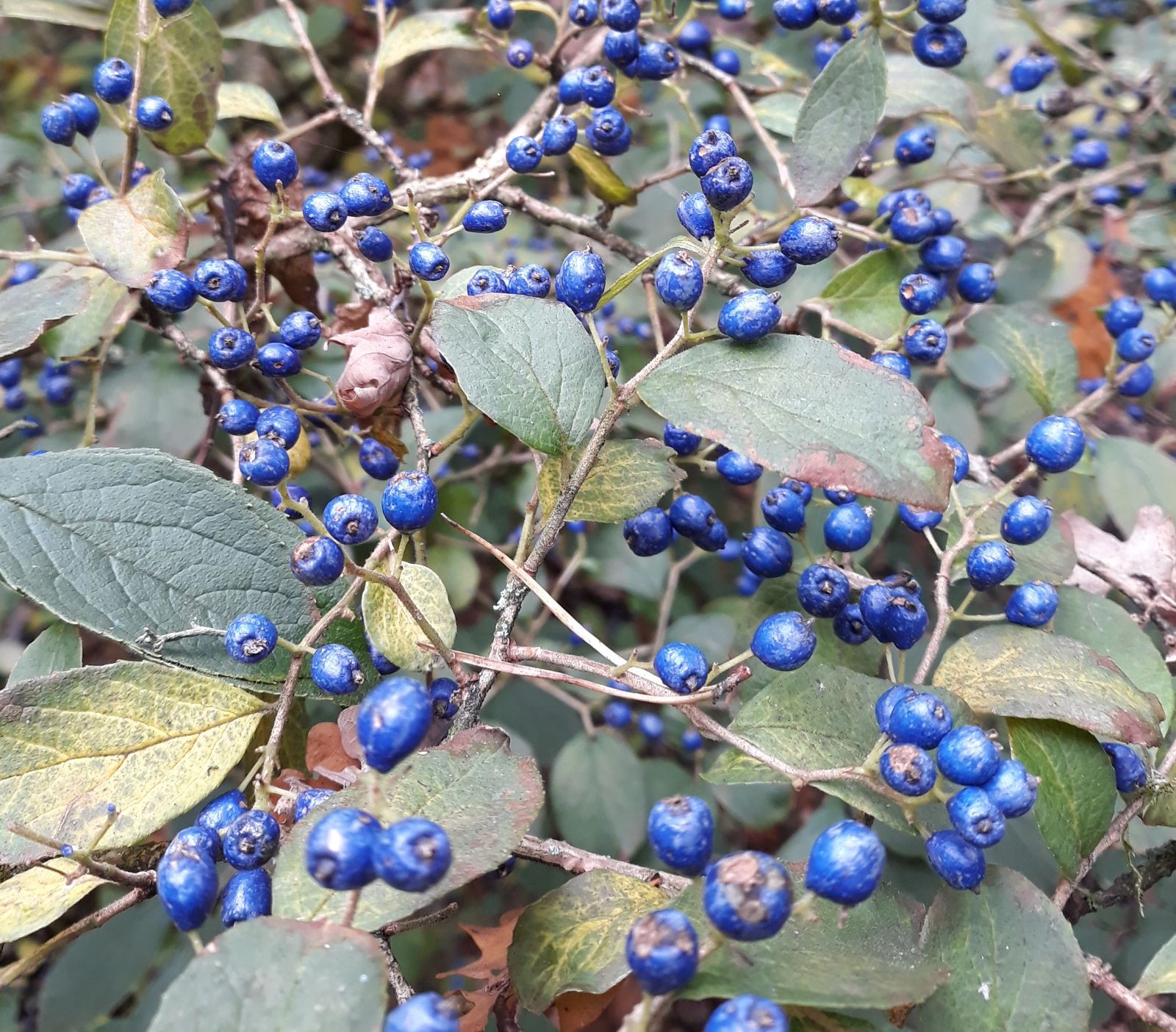
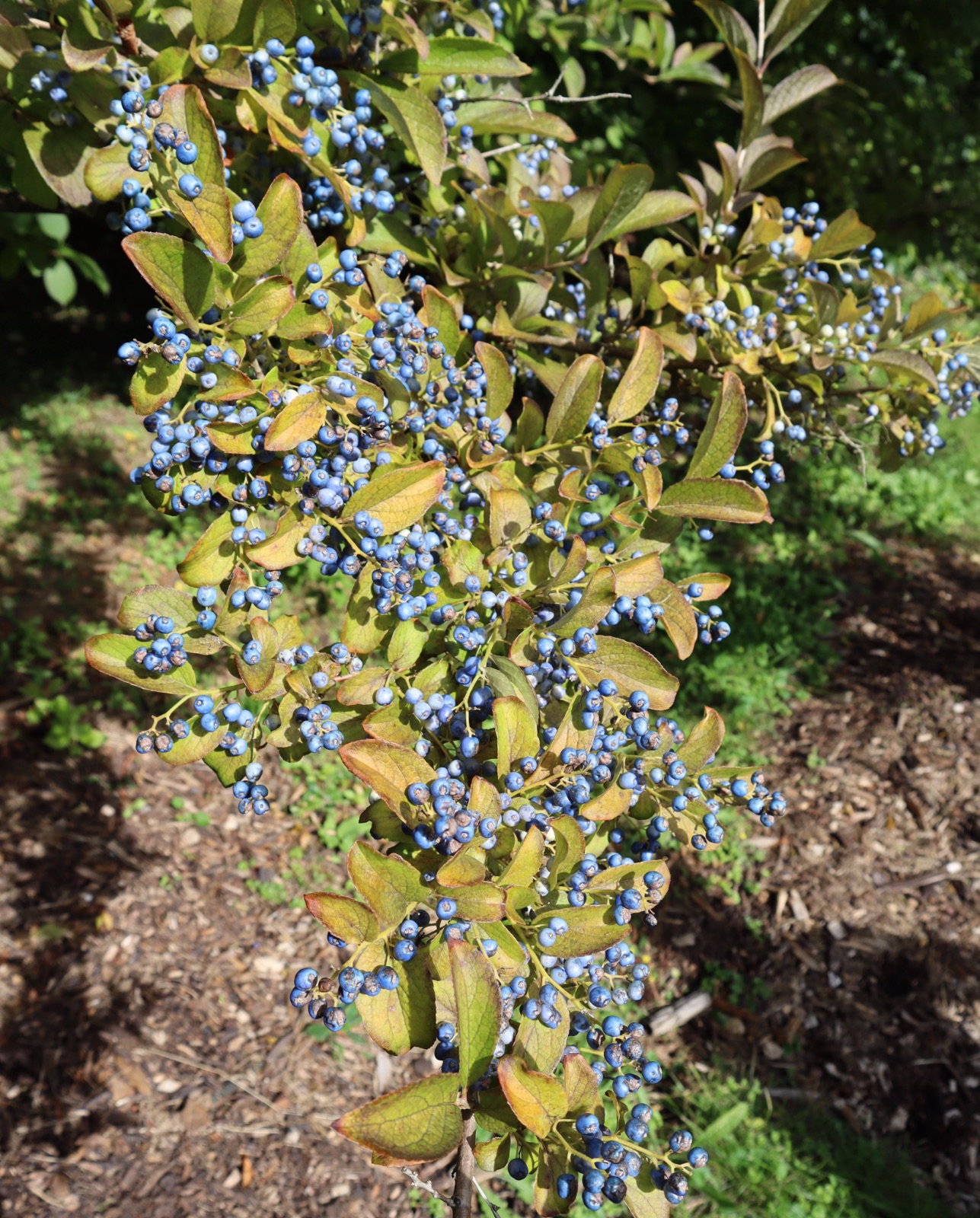
Shrub or small spreading tree, deciduous. Bark greyish, sometimes developing largely vertical, flat but slightly stringy ridges between darker fissures. Leaf ovate to obovate, 2–11 × 1–5 cm, tapered at both ends, hairy or not, often rugose, margin with sharp glandular teeth; petiole short (3–7 mm long). Flowers fragrant, in panicles (formed of racemes of cymose corymbs) 2–10 cm tall, terminal or axillary; in the latter case the stalk is united to the shoot for some distance above the axil, so that the panicle appears interaxillary. Corolla white, 3–6 mm wide; stamens 25–60. Fruit blue or turquoise or black, rarely grey or white, ovate to globose, 3–8 mm long. Flowers (China) April–June, fruits September–November. (Wu & Nooteboom 1996; Bean 1981; Dirr 2009).
Distribution Bhutan Myanmar In northern mountains China Anhui, Fujian, Guangdong, Guangxi, Guizhou, Hainan, Hebei, Heilongjiang, Henan, Hubei, Hunan, Jiangsu, Jiangxi, Jilin, Liaoning, Nei Mongol, Ningxia, Shaanxi, Shandong, Shanxi, Sichuan, Yunnan, Xizang, Zhejiang India In the Himalayas Japan North Korea South Korea Laos In northern mountains Nepal Pakistan In the eastern Himalaya Vietnam In northern mountains Taiwan
Habitat Forests to 2500 m asl; rocky mountains; valleys; swamps.
USDA Hardiness Zone 4
RHS Hardiness Rating H6
Conservation status Not evaluated (NE)
Symplocos paniculata, in the very wide sense adopted here, is the only deciduous member of its large and largely tropical genus, and the only one whose flowerheads can appear to spring from the twig between the leaves, rather than from the leaf-junction itself (Almeda & Fritsch 2009). Across its vast natural range, such a species is almost bound to be highly variable: the first introduction to Europe was as a black-fruited tree from the Himalayas, while the intense blue of the fruit of some east Asian populations is the most sought after; in China, grey- and white-fruited forms are also reported (Bean 1981; Wu & Nooteboom 1996; Liu et al. 2017). Plants from Korea and northern China are very hardy, while those from the mountains of Laos and Myanmar would be expected to be tender. Some variants occur on dry hillsides, while others are characteristic marshland plants (Nagamasu 1993).
Symplocos paniculata has also suffered more than most plants from a history of nomenclatural instability. It was first described from Japan – as a plant resembling the St Lucie Cherry Prunus mahaleb – by Carl Peter Thunberg in 1784, but the vagueness of Thunberg’s description has led many authors to favour the name S. chinensis (Lour.) Druce, which derives from João de Loureiro’s 1790 descripton of Myrtus chinensis from the Canton area in China. Himalayan material was first introduced to Britain under the name S. crataegoides Buch.-Ham. ex D. Don; this was the earliest description of the species within Symplocos, but English-speaking students of the genus are likely until recently to have leant this via W.J. Bean’s Trees and Shrubs Hardy in the British Isles, in which as an exceedingly rare error that name appears as ‘S. crataegifolia’. Various other names have been published for deciduous Symplocos in different regions, such as Hector Léveillé’s Cotoneaster coreanus from Jeju Do island in South Korea (1912) and Takenoshin Nakai’s S. tanakana from Japan (1918). In 1993, Hidetoshi Nagamasu (Nagamasu 1993) thoroughly revised the treatment of Symplocos in Japan, recycling Thunberg’s name to describe a population of black-fruited pubescent plants endemic to marshy areas in southern Honshu (Thunberg’s original description was of a glabrous plant, but said nothing about its habitat, or even its fruit colour). Nagamasu also published a new name, S. sawafugati, for the common blue-berried form growing in Japan, and used the name S. chinensis to distinguish comparable plants across China, with which he was not familiar.
Few gardeners will have much interest in taxonomic ramifications of this sort. Name changes like this, however, can have knock-on effects which serve to make garden plants much less familiar, and less easy to source, than they perhaps deserve to be: in 2005, the Royal Horticultural Society in the UK decided to differentiate Symplocos paniculata and S. sawafugati (D. Edwards pers. comm. to J. Grimshaw), the assumption being that most cultivated blue-berried plants, which had long been known as S. paniculata, were Japanese in origin. ‘Sawafugati’ derives from the Japanese vernacular name for this plant (translating as ‘the tree that fills the valleys’) but beside being new it was perhaps not an easy word for English speakers to master; by the time that the RHS reverted to treating the UK cultivated population as S. paniculata in 2012, the number of nurseries attempting to sell these pretty plants had dwindled almost to nothing (Royal Horticultural Society 2012–24). As of 2024, the name S. sawafugati still seemed scarcely to be known ouside Japan and the UK.
As of 2024, Plants of the World Online (Royal Botanic Gardens Kew 2024) continued to recognise S. sawafugati as a valid species (along with S. coreana and S. tanakana), while placing S. chinensis in synonymy with S. paniculata. In a note added to Jeffrey & Nooteboom (1977), the late Dutch botanist Hans Nooteboom pertinently observed that some of the species recognised by Nagamasu, such as S. tanakana, are phenotypes differing only in minor features such as the way the bark cracks, while others, such as S. coreana, are more nearly ecotypes, described as growing on rocky hillsides rather than fertile valleys. It is also probably worth observing that, were the Japanese model of distinguishing multiple species to be applied across the huge natural range of deciduous Symplocos, a much larger number of species would result. Purely for convenience (and since the original provenance of cultivated plants is in most cases not known) this account treats all of these forms together under the earliest available name, S. paniculata.
A deciduous Symplocos was first cultivated at the Royal Botanic Garden Edinburgh by Francis Buchanan-Hamilton around 1824, as a collection from Thankot, Nepal (Bean 1981; Don 1825); such a provenance may not have been fully hardy here and was dismissed sweepingly by W.J. Bean as ‘not of any horticultural importance, the fruits being black’. Thomas Hogg first sent seeds of blue-berried Japanese trees to Parson’s nursery at Flushing, New York, at a date described in 1921 as ‘at least fifty years ago’, and similar plants reached Britain in the 1890s (Bean 1981).
Ever since then, Symplocos paniculata has been commoner in cultivation – or less uncommon – in the United States than in Europe. Deriving from a continental climate with warm summers and cold but quite short winters, the Japanese plant is very hardy and grown in North America has withstood 36°C of frost undamaged (Dirr 2009), but it fruits best where summers are long and sunny (Bean 1981). A flourishing population of plants up to 9 m wide in the Arnold Arboretum, Massachusetts, has acted as a conspicuous ambassador for the species since 1880 (Arnold Arboretum 1921; Bean 1981); this was enriched with wild-collected material from China in 1948 and from South Korea in 2009 (Arnold Arboretum 2024). S. paniculata is also grown in the harsher montane conditions of Denver Botanic Gardens (Royal Botanic Garden Edinburgh 2024), and flourishes on the west coast in Salem Park, Oregon (Oregon State University 2024). One note of caution needs to be sounded: like all too many plants from north-eastern Asia, S. paniculata is starting to show aggressively invasive behaviour in New York State at least, readily self-seeding into native woodland and forming suckering thickets which are difficult to eradicate (Capital Region Partnership for Regional Invasive Species Management (PRISM) 2024). Self-sown seedlings can also occur in cooler conditions in Europe: they appear regularly in small numbers in Ray Wood, Castle Howard, North Yorkshire, originating from a small group of parents (J. Grimshaw pers. comm. 2024).
Across Europe, Symplocos paniculata remains more of a collector’s plant. In Britain, a good display of fruit is only likely to follow a warm summer, while, in the climate of the early 20th century at least, the fruit could be spoiled by an early autumn air frost (Bean 1981); although described as a long-lived plant in the United States (Dirr 2009), this does not seem to be the case even in southern England (Tree Register 2024), where the maximum height is unlikely to exceed 6 m. The stock cultivated in Europe may also represent a less hardy provenance than is grown in North America: there is a mature tree at the Glinna Dendrological Garden in the far northwest of Poland (whose microclimate approximates to the North American Hardiness Zone 7B) but elsewhere in that country winter protection is recommended (Związku Szkółkarzy Polskich 2024).
Symplocos paniculata tends to be a plant of graceful habit, pretty in late spring with its soft masses of scented white blossom but most striking in autumn as the berries ripen to glittering sky-blue and the leaves drop. In the United States at least, this single deciduous member of an evergreen genus is described as showing little autumn colour (Dirr 2009), but in strongly acid conditions at Leonardslee Gardens in England, a bush used to turn pale yellow, perfectly offsetting the display of fruit (pers. obs.). Although Symplocos are monoecious plants, it is recommended to grow more than one seedling – not cuttings – together, since this species is quite strictly self-incompatible. Once it colours, the fruit never lasts very long before birds strip it.
This pretty tree is occasionally described as ‘always in high demand but rarely if ever available’ (Broken Arrow Nursery 2024), although it is also claimed to be easy to raise from seed and from softwood cuttings (Dirr 2009). In reality it is probably a representative of that large group of desirable garden plants which nurseries are reluctant to go to the trouble of propagating because too few customers will ask for it (whether or not it is sold under a name such as Symplocos sawafugati, which they may not be able to spell or pronounce either).
Although the species – in the broad sense adopted here – is so variable in terms of fruit colour at least, there have so far been no attempts in the west to select for this feature. Clones marketed in China now include ‘Lan Jingling’, selected from the Daweishan National Park in Hunan, with sapphire-blue fruit and narrow leaves, and ‘Zi Qiu’, selected at the Hunan Academy of Forestry as a dwarf form with abundant grey fruit (Liu et al. 2017), although it shoud be borne in mind that clonal populations will not pollinate themselves. As a demonstration of the species’ natural variability, it is perhaps illuminating that Liu et al. 2017 also describe these Hunanese trees as evergreen, with a ‘yellowish-brown and corky bark’. (Given the authors’ credentials, this is more likely to be an example of nuances lost in their translation, rather than of confused identity.)
Symplocos coreana was first described (as a species of Cotoneaster) by Hector Léveillé in 1912 and was treated by Nagamasu 1993 as a specific ecotype, growing on mountain slopes rather than in rich valley soils, and with indigo or black fruit; despite its name, its Korean distribution seems restricted to Jeju-do island, while Nagamasu considered it common across Japan. Among the various deciduous Japanese Symplocos which have been described at species level, this may be the only one that can be confidently traced in cultivation in the west. It is grown as far north at Bergen Arboretum and Botanical Garden in Norway, from a Japanese wild source (Bergen Arboretum and Botanical Garden 2024); material collected on Jeju-do in 1993 is also cultivated at the Royal Botanic Garden Edinburgh, but no longer as a living plant in the garden (Royal Botanic Garden Edinburgh 2024).