
Skimmia japonica
Credits
Article from Bean's Trees and Shrubs Hardy in the British Isles
Recommended citation
'Skimmia japonica' from the website Trees and Shrubs Online (treesandshrubsonline.
Genus
Synonyms
- Skimmia oblata T. Moore
Infraspecifics
Other taxa in genus

An evergreen bush of dense habit, usually 3 or 4 ft high, sometimes much taller. Leaves mostly in a cluster towards the end of the shoot, aromatic when crushed, usually 3 to 4 in. long, 3⁄4 to 11⁄4 in. wide, pale or yellowish green, narrowly obovate or oval, thickly specked beneath with transparent glands; leaf-stalk short, stout. Flowers in terminal panicles 2 to 3 in. long, male and female flowers normally on different plants, fragrant, 1⁄3 in. across; petals usually four, sometimes five, dull white. Stamens four or sometimes five in the male plant, absent or very much aborted in the female. Fruits globular, or depressed at the top like an orange, bright red, 1⁄3 in. wide. Bot. Mag., t. 8038.
Native of Japan, the Ryukyus and the Philippines, with variants as far North as Sakhalin and the southern Kuriles; perhaps also of China and Formosa. Cultivated at Kew as long ago as 1838, this species did not obtain any general attention from horticulturists until it was introduced from Japan by Fortune in 1861 to Standish’s nursery. It received a First Class Certificate when exhibited in fruit in 1864, and was then named S. oblata by Moore, under the impression that the plant now known as S. reevesiana was the true S. japonica. But the acclaim with which the Japanese skimmia was first greeted faded away when it was found that the plants sent out did not bear the expected beautiful fruits. A few knowledgeable gardeners were aware of the dioeciousness of S. japonica but it was not until Dr Masters published his study of the skimmias in 1889 that it came to be generally realised. Even Charles Noble, Standish’s former partner, confessed in a letter to Masters that he had never had fruits off his “S. oblata” and had never heard of male plants, though they had been available, as S. fragrams and S. fragrantissima, for many years before 1889.cv. ‘Foremanii’. – See below, under .cv. ‘Fructo-Albo’. – under this name Messrs Hillier offer an attractive white-fruited clone of dwarf habit.
Footnotes
It later emerged that the plant in question must have borne hermaphrodite flowers in that year, since no other skimmia was in flower with Standish at the same time. In later years it bore only female flowers, but in the meantime another plant of the original batch had flowered, which was male and was named S. fragrantissima in 1867. The origin of the male plant named S. fragrans by Carrière in 1869 was not stated, but some of the plants brought from Japan by Fortune were auctioned by Standish in autumn 1864 and it must have been one of these that the nurseryman William Bull exhibited as S. fragrans in the following year.
So far as is known, no plant of S. japonica is constantly hermaphrodite but it is likely that most females produce a few flowers in which the stamens are fertile. The mere presence of stamens in female flowers is of no significance, since close examination will show that these usually have abortive anthers.
From the Supplement (Vol. V)
See Philip Brown’s survey, referred to above, for numerous cultivars of this species which he has found in gardens but which are not at present in general commerce, though stocks are being built up by one nurseryman and will be released in due course. Some of these are already in cultivation at Kew.
† cv. ‘Bronze Knight’. – Put into commerce by Messrs Waterer, this is a male clone with flowers similar to those of ‘Rubella’, but with glossier, dark green, more sharply pointed leaves.
cv. ‘Nymans’. – Philip Brown considers this to be the best berrying clone for general planting.
cv. ‘Rubella’. – An improvement on this is ‘Ruby Dome’, not yet in general commerce, which will also serve as a good pollinator for ‘Nymans’. Producing little pollen, ‘Rubella’ is not satisfactory for this purpose (op. cit., pp. 243–4).
cv. ‘Veitchii’. – It is very likely that plants in commerce as ‘Foremanii’ are really the true ‘Veitchii’.
S. × foremanii – The original account (1881) of the breeding of this skimmia could be misinterpreted. Knight gave the parentage of the original cross as S. japonica × S. oblata. But at that time the first name was in general use for S. reevesiana, which had been mis-identified as S. japonica by Lindley and others, while S. oblata was the name applied to the true S. japonica. However, it is arguable that the name S. × foremanii, although accepted by Rehder, is not properly established, being unsupported by any description. There is therefore much to be said for taking up the next available name for S. japonica × S. reevesiana, which is S. × rogersii Masters, and this is the name used by Brown in his study.
The hybrid cultivars raised by Rogers at the Chandlers Ford nursery were propagated, but cannot now be identified. The two clones distributed by Messrs Hillier as ‘Rogersii’ and ‘Rogersii Nana’ derive from plants raised by that nursery from the original Rogers’ clones in the 1920s. The first is a low-growing female with undulated leaves and a large, many-flowered, rounded inflorescence. The name ‘Rogersii’ for this clone is obviously incorrect, implying as it does that it derives from the original Rogers cross described by Dr Masters. Brown uses for it the name S. × rogersii ‘Nana Femina’. The other Hillier clone (‘Rogersii Nana’) is a male of dwarfer habit, less twisted leaves, and rounded heads of solid-white flowers. The cultivar ‘Helen Goodall’ is of interest as an example of a self-sown, first generation hybrid between the two species (Brown, op. cit., pp. 234–5).
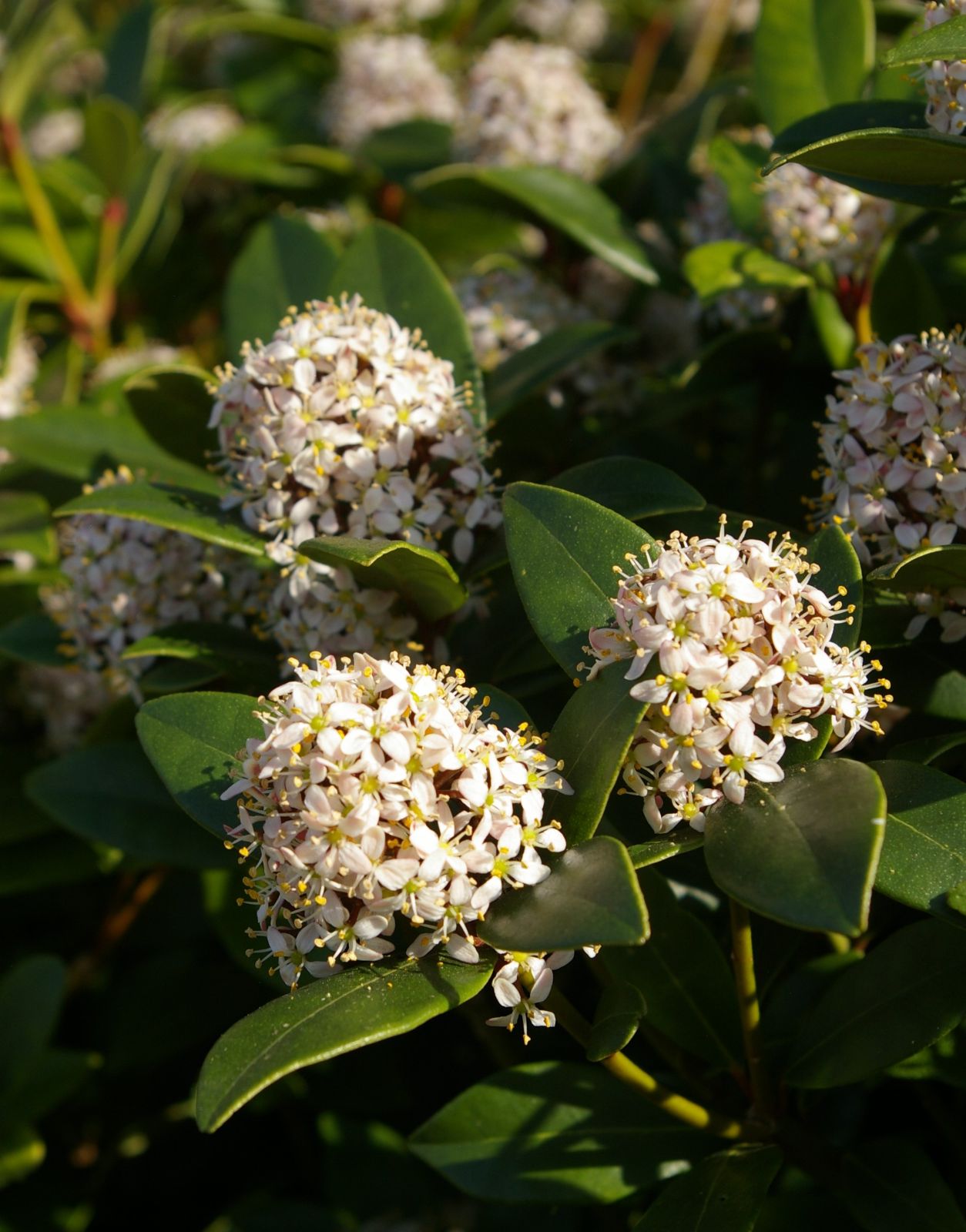
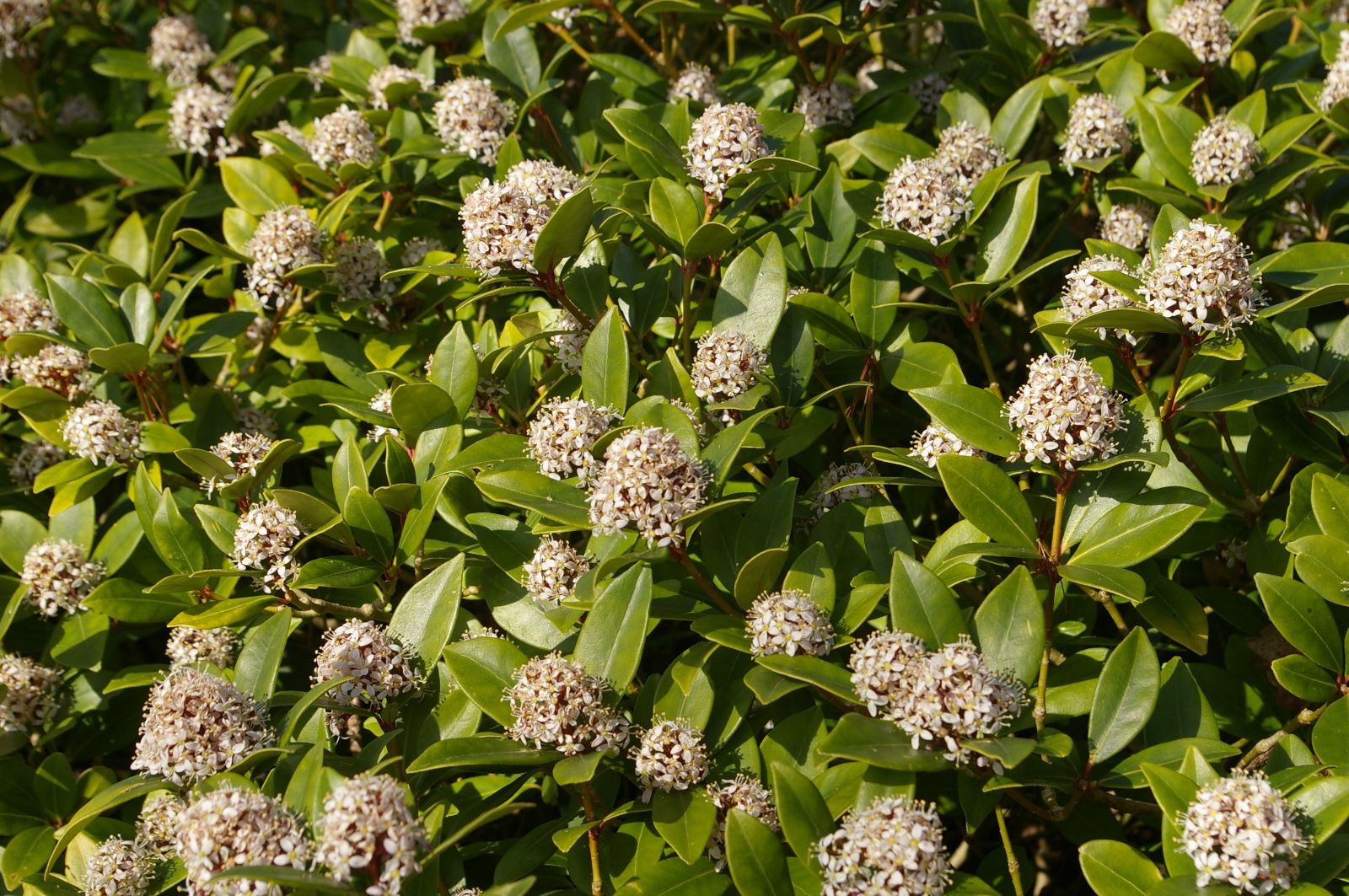


'Nymans'
A free-fruiting female clone, first exhibited from Nymans in 1934. Leaves mostly oblanceolate, obtuse or bluntly pointed; petioles tinged with red.'Rogersii'
See under S. × foremanii.'Rubella'
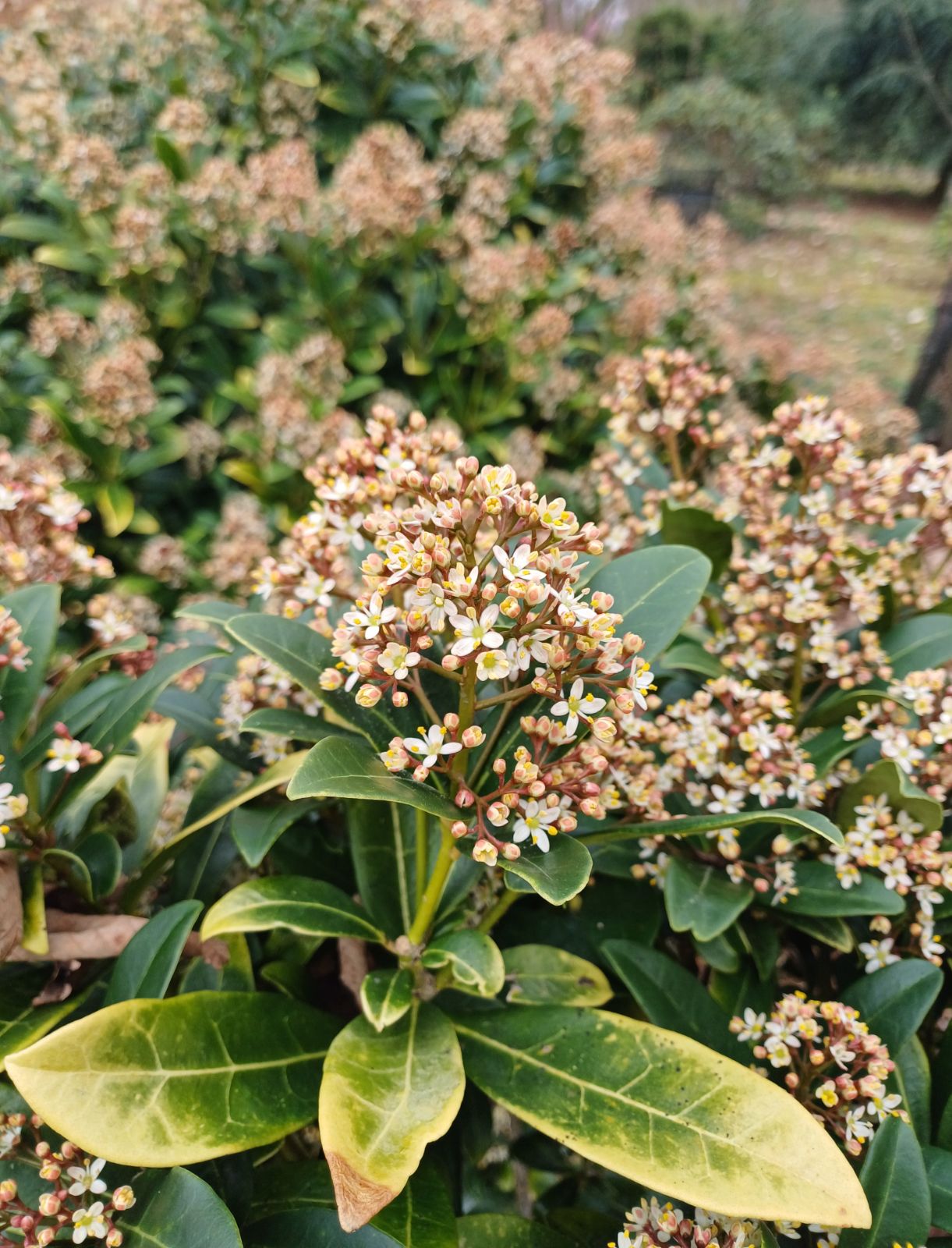
A bushy shrub to about 4 ft high. Leaves darkish green, elliptic to oblanceolate, mostly 3 to 4 in. long (to 5 in. in some seasons), acute or subacute at the apex (rarely obovate and obtuse); petioles dark red. A male clone. Flowers very fragrant, pink in the bud, borne in a fine panicle about 3 in. long and 2{1/2} in. wide at the base; peduncles and rachis deep bronzy red, rendering the inflorescences conspicuous long before the flowers expand. Petals and stamens four (S. rubella Carr.; ? S. intermedia Carr.; S. reevesiana f. rubella (Carr.) Rehd.; S. japonica ‘Rubella’, Journ. R.H.S., Vol. 87 (1962), p. 328).This skimmia was introduced to France from China in 1865 by Eugène Simon and to Britain before the end of the century. Its taxonomic position is uncertain, but it seems to agree better with S. japonica than with S. reevesiana, under which it was placed by Rehder. In flower, ‘Rubella’ is the finest of the skimmias, and received an Award of Merit in 1962. It needs a half-shaded position and will flower from every terminal bud even under a dense canopy, provided the soil is not too rooty. There are other males in commerce. One, sent out as ‘Fragrans’, may not be the skimmia originally named S. fragrans but it is a fine ornamental, dwarfer than ‘Rubella’, with unusually glossy leaves and also differing from it in having no trace of a red infusion in any part.
var. repens (Nakai) Ohwi
Synonyms
S. repens Nakai