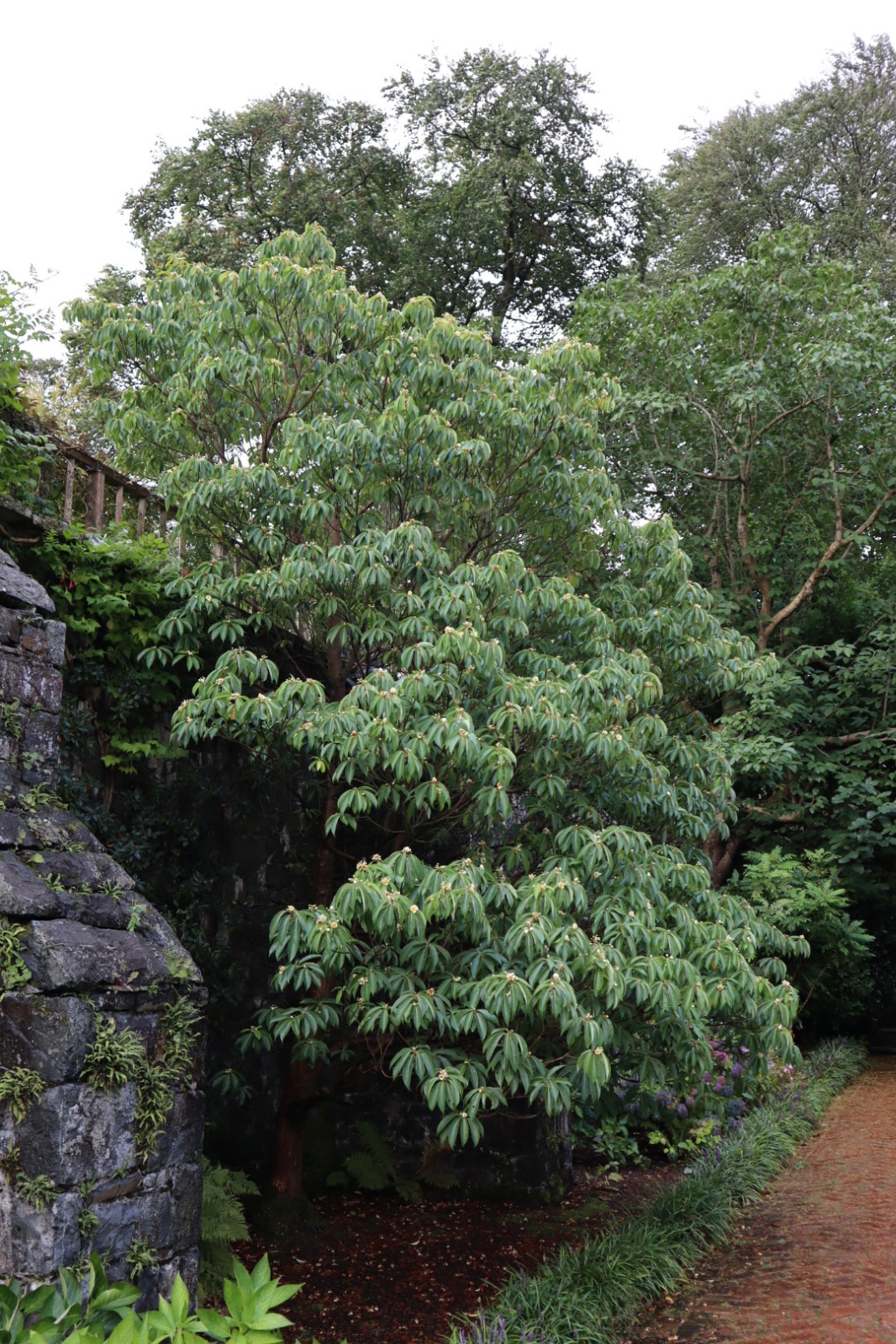
Schima argentea
Credits
Article from Bean's Trees and Shrubs Hardy in the British Isles
Recommended citation
'Schima argentea' from the website Trees and Shrubs Online (treesandshrubsonline.
Genus
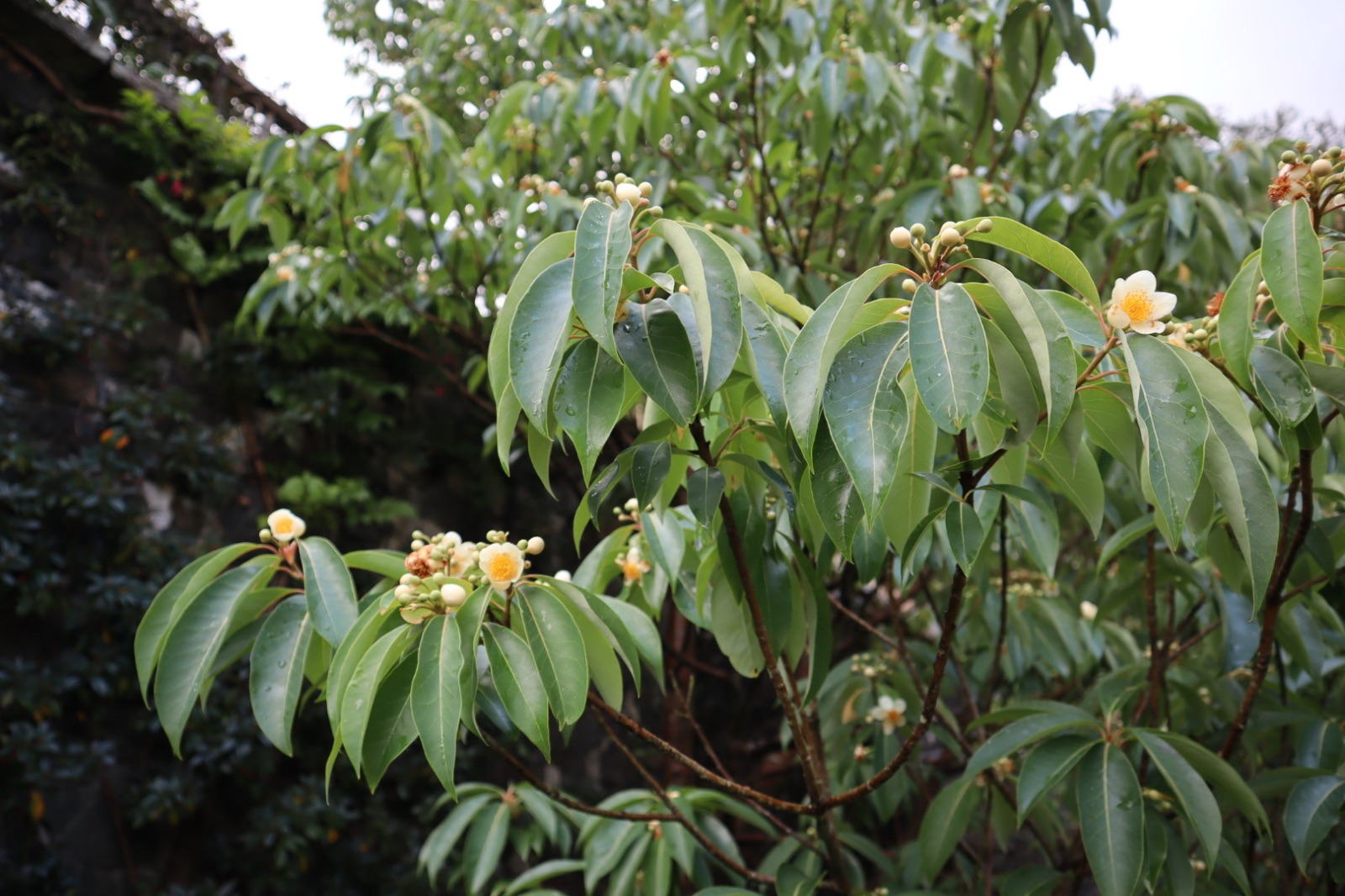
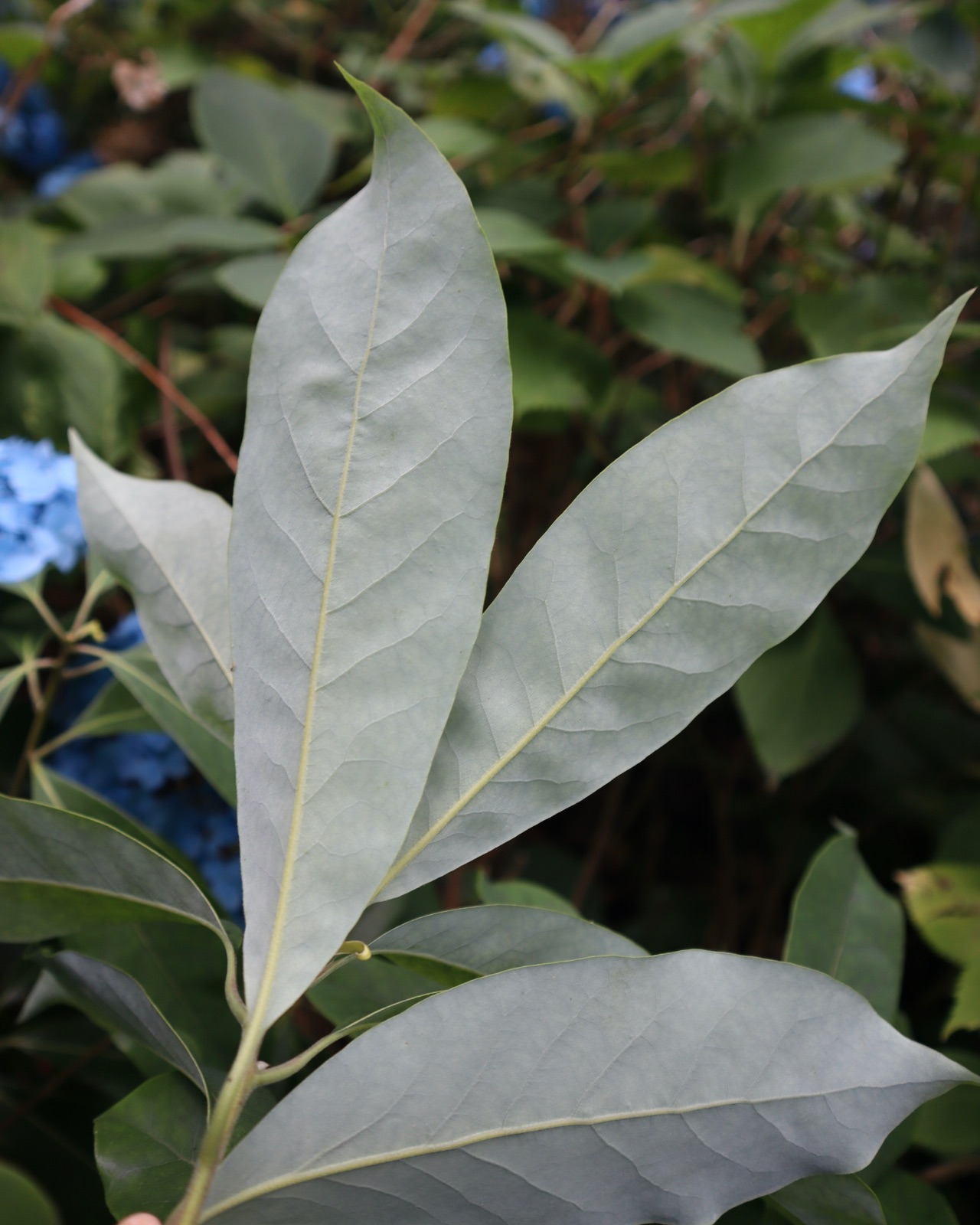
An evergreen shrub or tree found in the wild state up to 60 ft or more high, but, as seen in cultivation hitherto, a spreading bush 6 ft or more high and as much in width; young shoots dark purplish, minutely downy. Leaves alternate, 3 to 5 in. long, 3⁄4 to 2 in. wide, narrowly oval-lanceolate or oblanceolate, slender-pointed, tapering to a short stalk, entire, rather leathery, glabrous and deep shining green above, glaucous and minutely downy beneath. Flowers solitary or rarely in pairs, each on a silky-hairy stalk 1⁄2 to 1 in. long and produced as many as nine together from the terminal leaf-axils; they are 1 to 11⁄2 in. across he five-petalled corolla is ivory-white, camellia-like. Stamens fifty to sixty., Calyx five-lobed, long ciliate, sometimes downy on the back. Bot. Mag., t. 9558.
Species mainly of S. China; collected by Henry in Yunnan in 1898 and later by Forrest, who introduced it during his 1917–19 expedition, almost certainly under number F. 15029. The seed was collected in the Wei-Hsi valley in November 1917 at 8,000–9,000 ft, from trees 40 to 50 ft high, and distributed from the R.H.S. Garden at Wisley, where a plant was raised which was 8 ft high in 1936 but had died by 1953. The only plant known to have survived in S. England grows at Borde Hill in Sussex, 30 ft high; it flowers in most years but is not in the best of health. An example 36 ft high, its largest stem 23⁄4 ft in girth, grows at Trewithen in Cornwall (1971). It is evidently a species that needs the milder and rainier climate of the Atlantic zone. It received an Award of Merit when exhibited from Bodnant on October 4, 1955.
S. khasiana Dyer – This is a finer species than S. argentea, from which it differs in its larger and relatively broader leaves 5 to 7 in. long, 13⁄8 to 23⁄4 in. wide, toothed at the margin, green beneath, and in the larger bracteoles on the pedicels, these being short and inconspicuous in S. argentea but 7⁄8 in. long and 3⁄8 in. wide in S. khasiana. The pedicels are also distinctly longer, being 15⁄8 to 35⁄8 in. long; in this respect the cultivated plant and many Chinese specimens differ also from typical S. khasiana. The flowers, at least on the cultivated plants, are larger than in S. argentea. Bot. Mag., n.s., t. 143.
S. khasiana was described from the Khasi Hills of Assam, whence it extends through Burma into N.W. Yunnan and the former Indo-China. It was introduced by Forrest, probably under number F. 26026, collected November 1924 on the Shweli-Salween divide at 8,000 ft (the plant at Caerhays is under F. 24630, which belongs to a flowering specimen collected the same year in June in the same locality). The flowering material portrayed in the Botanical Magazine was received in September from Trewithen, where there are two fine specimens, the larger 52 × 43⁄4 ft (1971). Cut in hard winters they soon break into growth again and produce fertile seed. The tree at Caerhays measures 30 × 23⁄4 ft (1971), and there is another fine example at Trengwainton. S. khasiana received an Award of Merit when exhibited from Caerhays on October 20, 1953.
Both species can be propagated by cuttings.
From the Supplement (Vol. V)
The plant at Borde Hill, Sussex, died back almost to the ground after the drought of 1976, but has grown again and flowered. Apart from the example at Trewithen, there is another in Cornwall at Glendurgan, measuring 40 × 21⁄4 ft (1984).
S. khasiana – The tree at Caerhays, Cornwall, now measures 40 × 41⁄2 ft at 3 ft (1984).