
Rosa moyesii
Credits
Article from Bean's Trees and Shrubs Hardy in the British Isles
Recommended citation
'Rosa moyesii' from the website Trees and Shrubs Online (treesandshrubsonline.
Genus
Synonyms
- R. holodonta Stapf, in part
- R. fargesii Hort.
- R. moyesii var. fargesii Rolfe
- ? R. macrophylla var. rubrostaminea Vilm.
- R. alpina (pendulina) var. macrophylla (Lindl.) Boulenger, in part, not R. macrophylla Lindl.
Infraspecifics
Other taxa in genus
- Rosa acicularis
- Rosa × alba
- Rosa albertii
- Rosa anemoniflora
- Rosa arkansana
- Rosa arvensis
- Rosa banksiae
- Rosa beggeriana
- Rosa biebersteinii
- Rosa blanda
- Rosa bracteata
- Rosa brunonii
- Rosa californica
- Rosa canina
- Rosa carolina
- Rosa centifolia
- Rosa cerasocarpa
- Rosa chinensis
- Rosa corymbulosa
- Rosa damascena
- Rosa davidii
- Rosa 'Dupontii'
- Rosa ecae
- Rosa eglanteria
- Rosa elegantula
- Rosa elymaitica
- Rosa fedtschenkoana
- Rosa filipes
- Rosa foetida
- Rosa foliolosa
- Rosa × fortuniana
- Rosa × francofurtana
- Rosa gallica
- Rosa gigantea
- Rosa glauca
- Rosa glutinosa
- Rosa gymnocarpa
- Rosa × harisonii
- Rosa helenae
- Rosa hemisphaerica
- Rosa × hibernica
- Rosa hugonis
- Rosa × involuta
- Rosa jundzillii
- Rosa laevigata
- Rosa longicuspis
- Rosa 'Macrantha'
- Rosa macrophylla
- Rosa majalis
- Rosa maximowicziana
- Rosa mulliganii
- Rosa multibracteata
- Rosa multiflora
- Rosa nitida
- Rosa nutkana
- Rosa palustris
- Rosa pendulina
- Rosa persica
- Rosa pimpinellifolia
- Rosa pisocarpa
- Rosa × polliniana
- Rosa prattii
- Rosa pulverulenta
- Rosa × reclinata
- Rosa × reversa
- Rosa × richardii
- Rosa roxburghii
- Rosa rubiginosa
- Rosa rubus
- Rosa rugosa
- Rosa sempervirens
- Rosa sericea
- Rosa setigera
- Rosa setipoda
- Rosa sicula
- Rosa soulieana
- Rosa stellata
- Rosa tomentosa
- Rosa villosa
- Rosa virginiana
- Rosa 'Watsoniana'
- Rosa webbiana
- Rosa wichuraiana
- Rosa willmottiae
- Rosa xanthina
R. holodonta Stapf, in part; R. fargesii Hort.; R. moyesii var. fargesii Rolfe; ? R. macrophylla var. rubrostaminea Vilm.; R. alpina (pendulina) var. macrophylla (Lindl.) Boulenger, in part, not R. macrophylla Lindl.
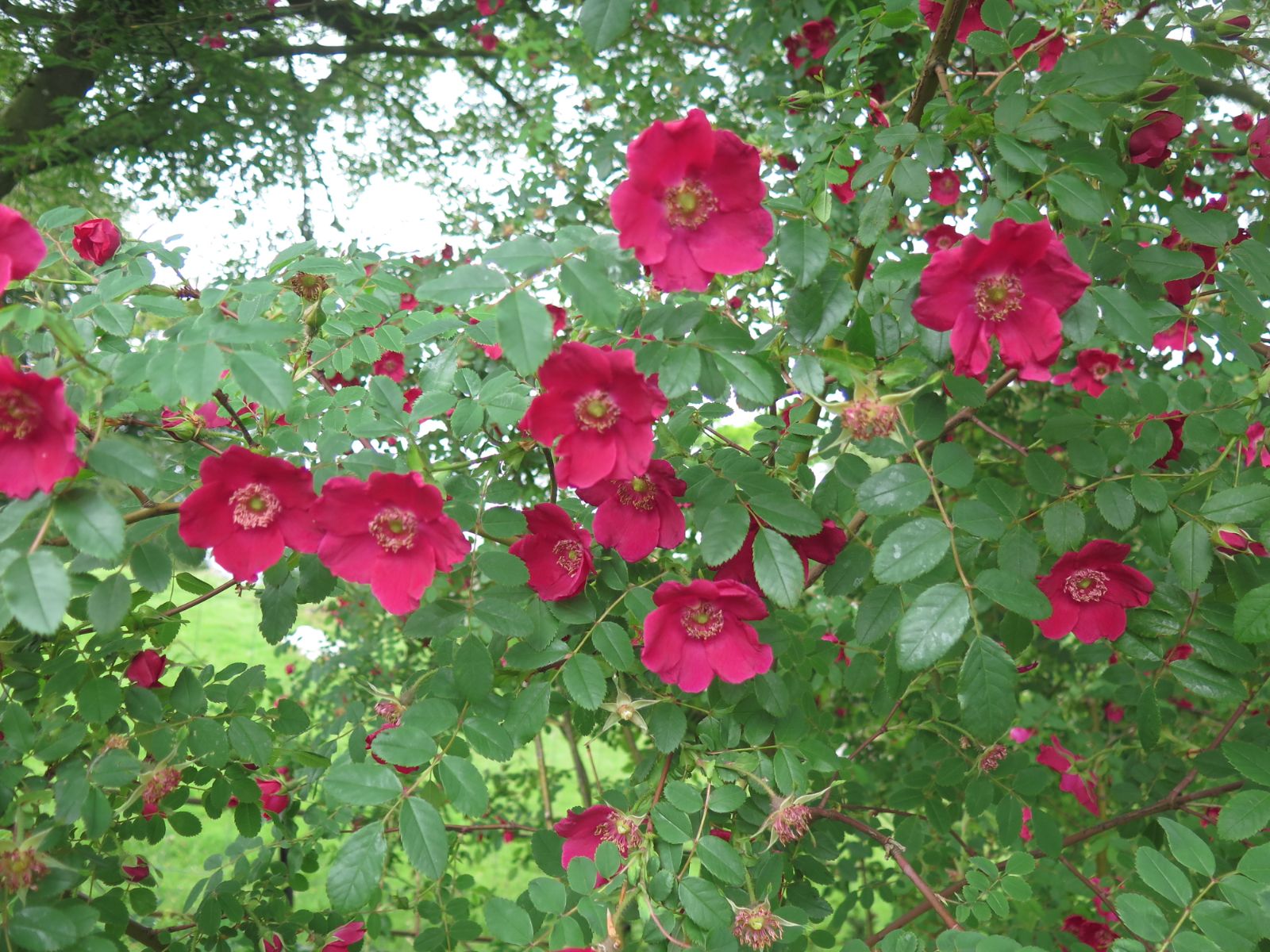
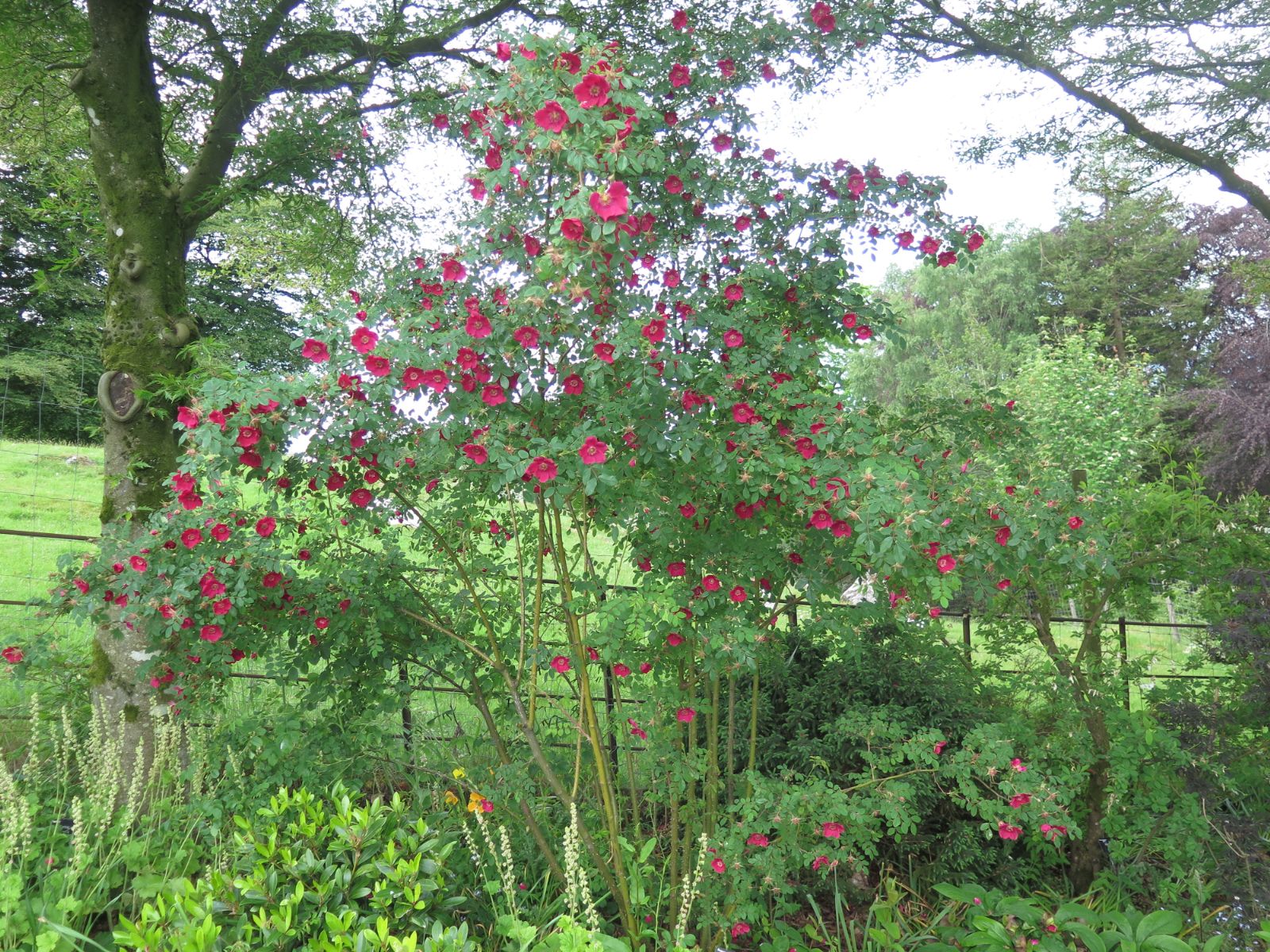
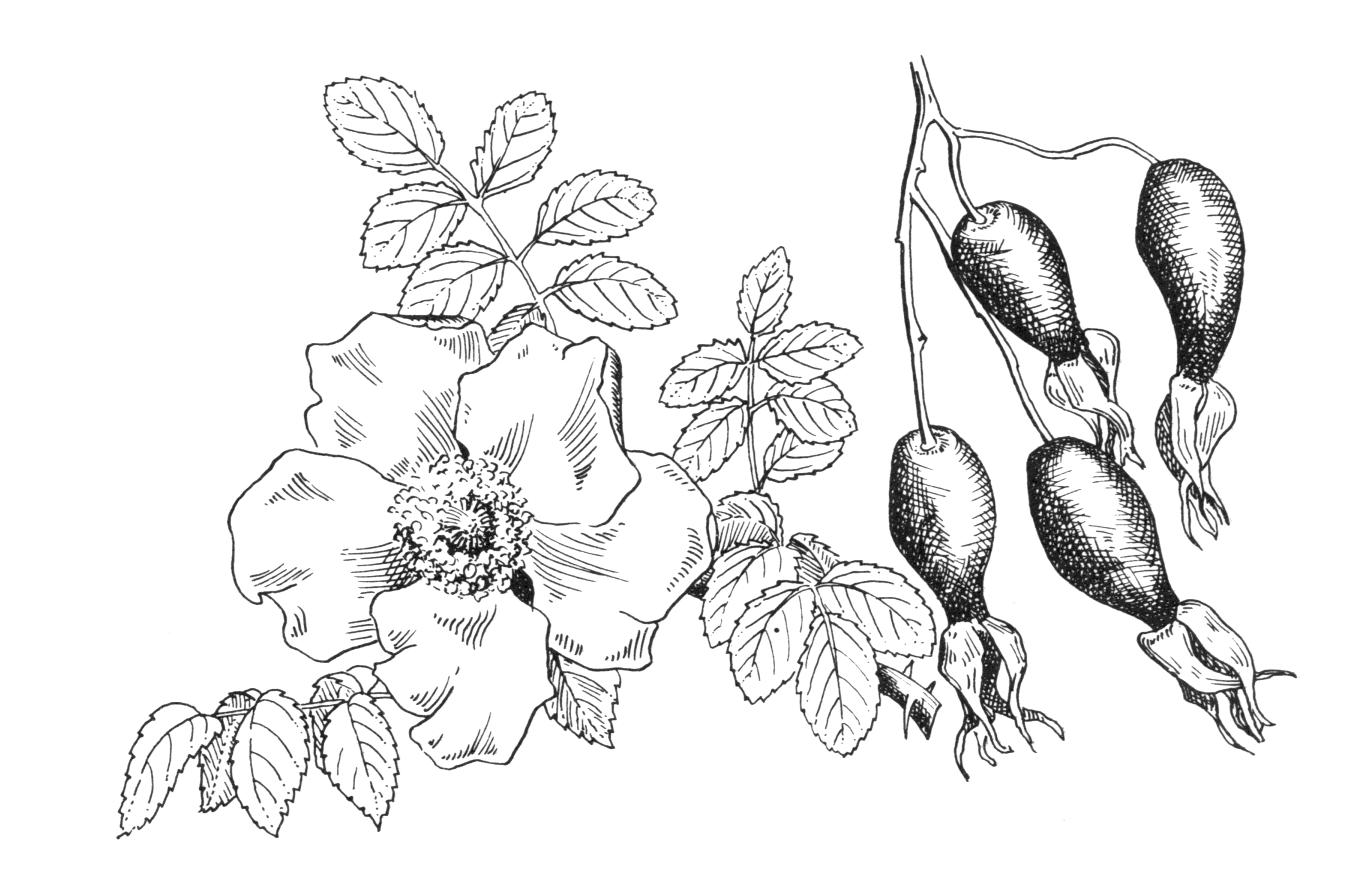
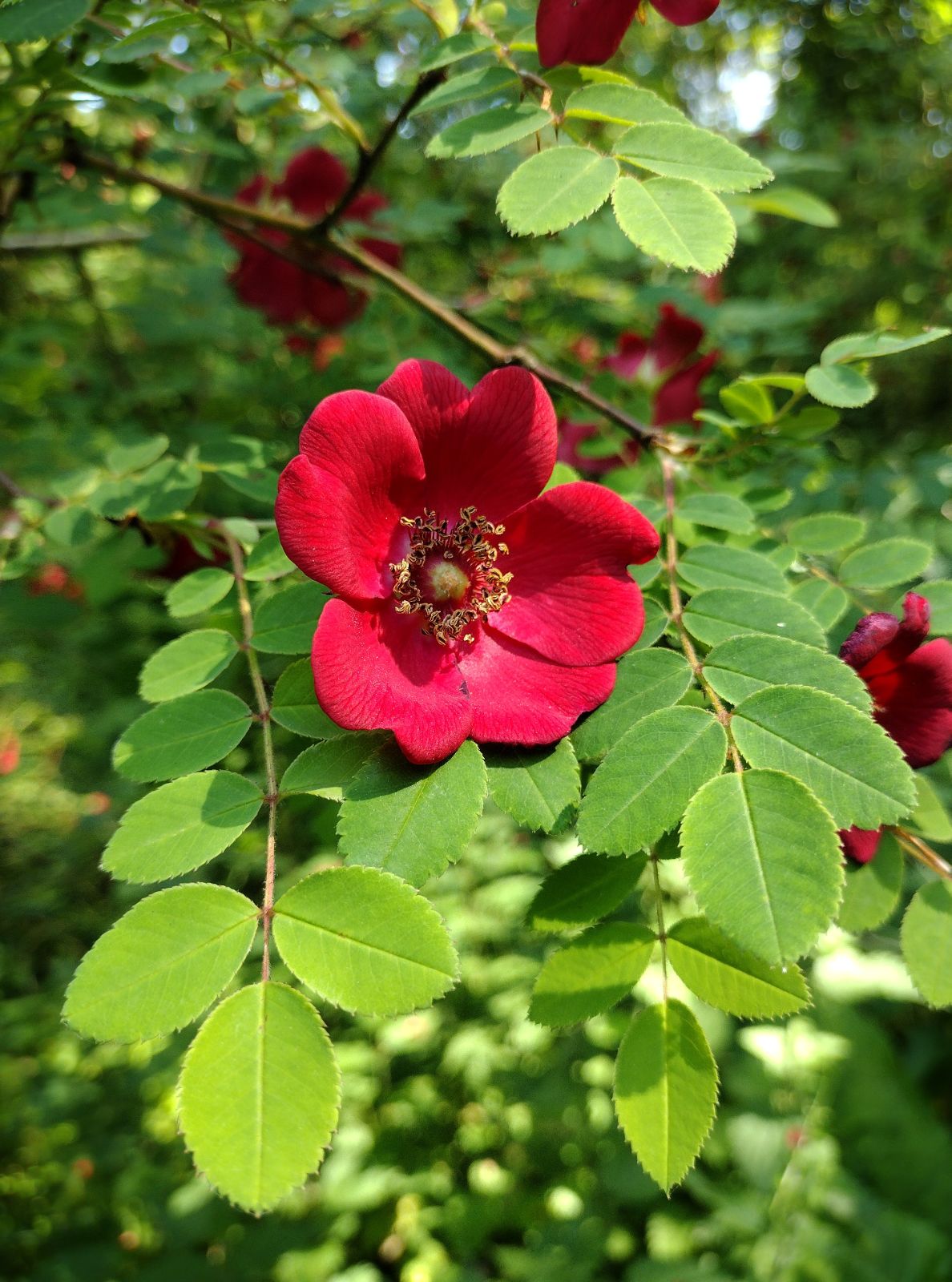
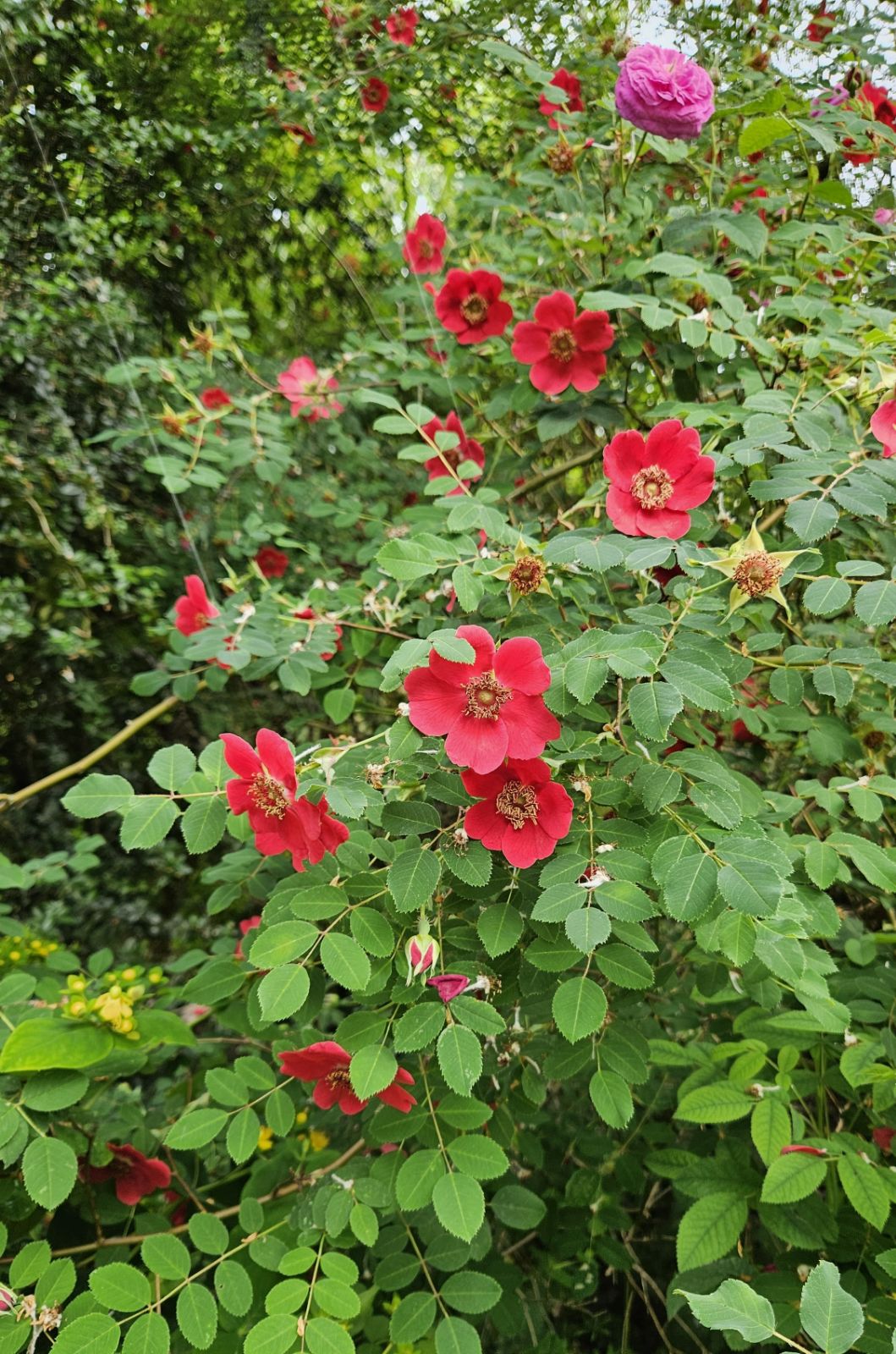
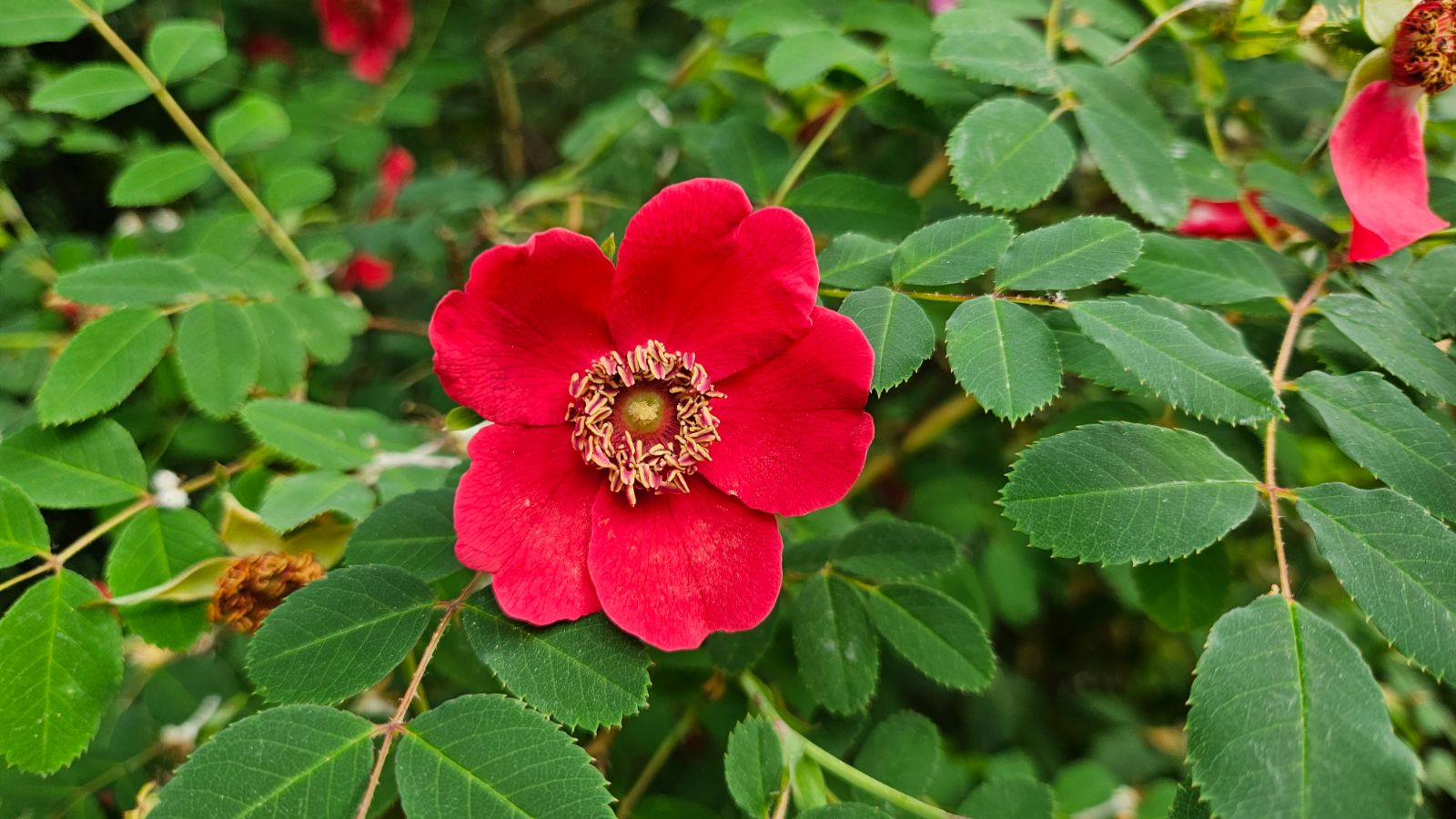
A shrub 6 to 10 ft high, of sturdy habit; stems erect, armed with stout, pale, scattered, broad-based spines, very abundant on the barren shoots, the lower part of which is also abundantly furnished with fine needle-like prickles; flowering shoots much less prickly. Leaves 3 to 6 in. long, with from seven to thirteen leaflets, which are ovate to roundish oval, 3⁄4 to 11⁄2 in. long, simply or doubly toothed, glabrous except on the midrib beneath, which is downy and sometimes prickly, dark green above, pale or somewhat glaucous beneath; common stalk glandular and prickly. Flowers an intense blood-red, 2 to 21⁄2 in. across, mostly solitary or in pairs; stalk and receptacle glandular-bristly. Sepals 1 in. or more long, with expanded tips and a few glands outside, downy inside. Fruits red, flagon-shaped, 11⁄2 in. or more long, crowned by the erect, persisting sepals, glandular-hairy towards the base, or sometimes all over. Bot. Mag., t. 8338.
Native of W. Szechwan, China; first found by A. E. Pratt in 1893 growing near Kangting (Tatsien-lu); Wilson found it in the same area in 1903 and introduced it, sending seed again during his second expedition for the Arnold Arboretum in 1911. The name commemorates the Rev. J. Moyes, a missionary in W. China. R. moyesii was first exhibited in flower by Messrs Veitch in June 1908 and has since become one of the most admired and widely grown of rose species. It is interesting that the blood-red flowers that make it so distinct among wild roses are not a constant feature of the species in the wild, or even in the type-locality. Plants with pink flowers were raised by Veitch from the original Wilson seeds and predominate among garden seedlings, ‘Geranium’ (see below) being a fortunate exception. R. moyesii is a perfectly hardy shrub of rather gaunt habit, becoming almost a small tree in some gardens.
Footnotes
R. moyesii was described from two specimens, both from the vicinity of Tatsien-lu (Kangting) – Pratt 172 (collected 1893) and Wilson 3543 (collected 1903). Both had the deep red flowers characteristic of typical R. moyesii, but the Pratt specimen has broad-ovate, oblong-ovate or broad-elliptic leaflets, obtuse or at the most subacute at the apex and a serration of mostly compound or bicuspid teeth, while in the Wilson specimen the leaflets are longer, relatively narrower, acute, and simply toothed. In the article accompanying plate 9248 of the Botanical Magazine (1931) Stapf argued that the specimens represented two distinct species. For reasons explained in that article he adopted the Pratt specimen as the type of R. moyesii, and made the Wilson specimen the type of a new species – R. holodonta Stapf. However, in Plantae Wilsonianae (1915), Rehder and Wilson took the Wilson specimen to be the type of R. moyesii and made no mention of the Pratt specimen. It is assumed here that the two specimens represent states of the same species; but cultivated plants agree better with the Pratt specimen.
Although founded on the Wilson co-type of R. moyesii, Stapf’s R. holodonta also included R. moyesii f. rosea (q.v.) and specimens of R. sweginzowii (q.v.) with simply toothed leaflets.
From the Supplement (Vol. V)
This species was reintroduced by Roy Lancaster in 1981 from the area where Wilson had collected seeds early this century – near Kangding (Tatsien-lu) in western Szechwan. The plants have reached 6 ft (1986) and borne flowers, which at least in two gardens are deep pink, as were most of those from Wilson’s original sending.
f. rosea Rehd. & Wils.
Synonyms
R. holodonta Stapf, in part only
'Fargesii'
Plants cultivated by Messrs Veitch in their Coombe Wood nursery as “R. Fargesii” reached gardens, including Kew, through the winding-up sale of 1913–4, and were found to differ in no way from cultivated forms of R. moyesii except that the flowers were pink. However, they were given botanical status by Rolfe as R. moyesii var. fargesii. One plant of ‘Fargesii’ has been found to be tetraploid, which would make this variant more useful for breeding than the Wilson introduction, if it is really true that all the plants raised from the seeds he sent are hexaploid. ‘Fargesii’ received an Award of Merit in 1922 as a fruiting shrub.No explanation has been found for the name R. fargesii. Presumably Veitch obtained his stock from Vilmorin, who certainly received seeds of many Chinese plants from Père Farges, but R. moyesii does not occur in the area where he collected (N.E. Szechwan and the Tapashan of bordering Shensi). However, the rose named R. macrophylla var. rubrostaminea by Vilmorin, which is thought to be R. moyesii, was raised from seed said to have come from ‘Tibet’, which suggests a collection in the area of Tatsien-lu, capital of a semi-independent principality then usually regarded as part of Tibet. The sender of the seed was not stated by Vilmorin, but is likely to have been Père Soulié, who collected in that area 1890–4 (the seeds of rubrostaminea germinated with Vilmorin in 1894).In the current edition of Render’s Manual (Ed. 2) R. moyesii var. fargesii Rolfe is recognised and is described as having obtuse, broad-oval to suborbicular leaflets 1 to 2 cm. long, against ovate or elliptic to oblong-ovate and acute, 1 to 4 cm. long in typical R. moyesii. By that reckoning all cultivated forms of R. moyesii would be referable to var. fargesii. See further in footnote to R. moyesii.'Geranium'
Of more compact and bushy habit than normal, with lighter green foliage. Flowers clear geranium-red. Fruits relatively wider than is usual in R. moyesii, with a shorter neck. Raised in the R.H.S. Garden, Wisley, shortly before 1937; selected and named by Brian Mulligan, then Assistant to the Director. If there is room only for a single plant of R. moyesii this should be chosen. It received an Award of Merit in 1950 for its fruits when exhibited by A. T. Johnson, who did much to popularise it in his writings.
R sweginzowii Koehne
Synonyms
R. moyesii sens . Stapf, in part, not Hemsl. & Wils.
R. holodonta Stapf, in part
R. alpina (pendulina) var. macrophylla (Lindl.) Boulenger, in part, not R. macrophylla Lindl
R wardii Mulligan
Synonyms
R. sweginzowii var. inermis Marquand & Shaw