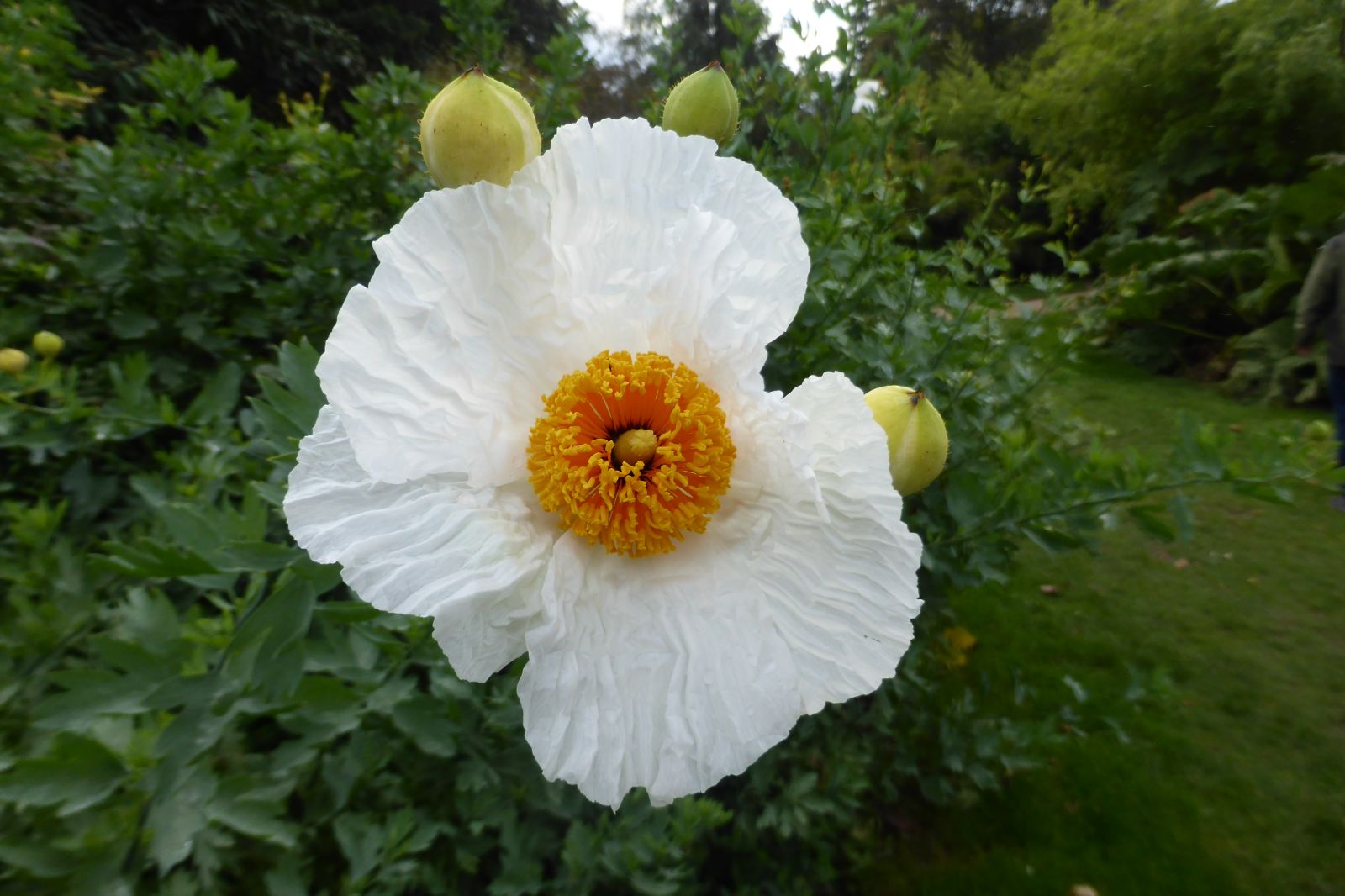
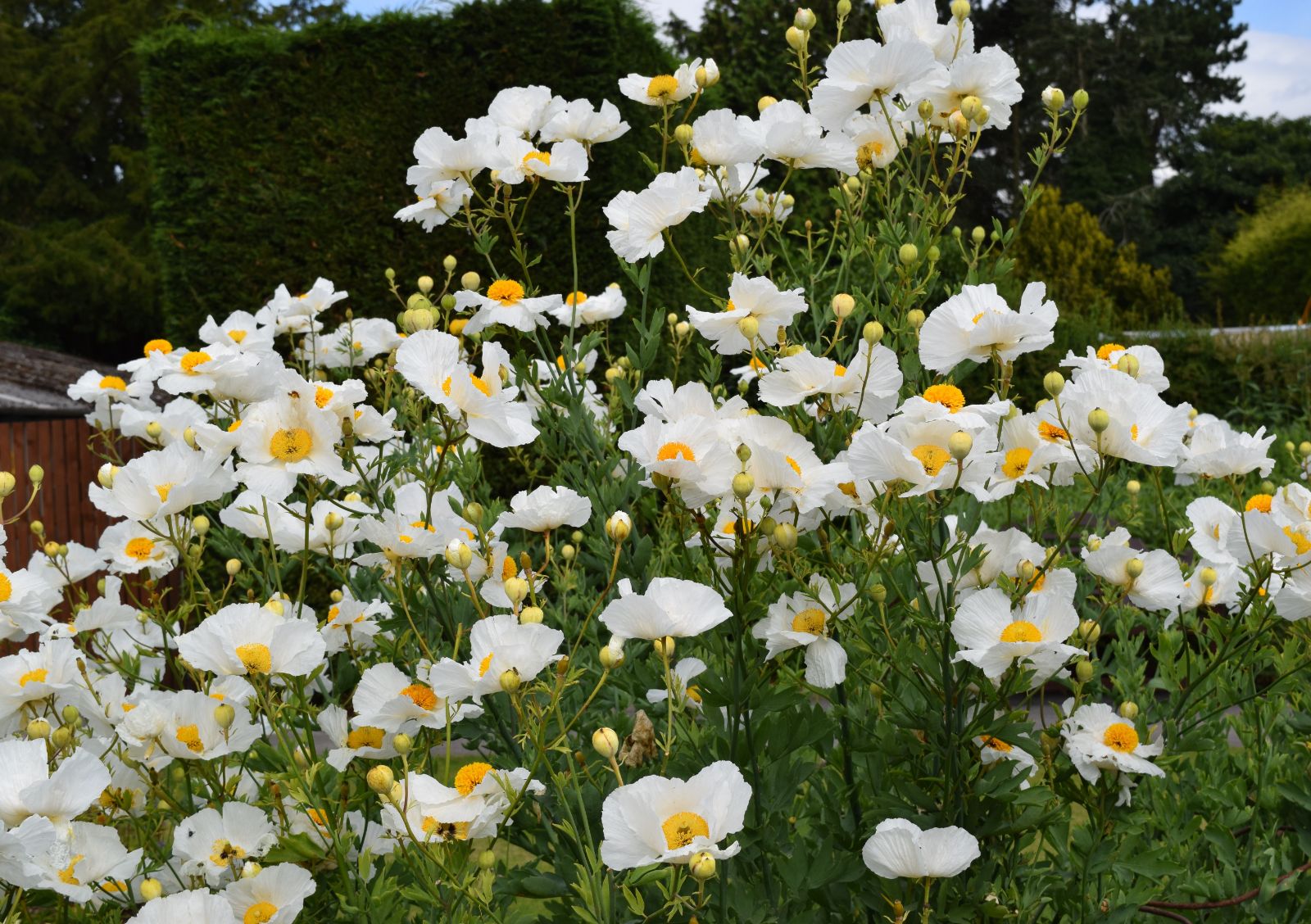
A semi-shrubby plant, with succulent herbaceous stems 4 to 8 ft high, according to the mildness of the climate in which it grows, spreading by suckers. Leaves varying much in size according to the strength of the shoot which bears them, but averaging from 3 to 5 in. long, and of a very glaucous colour; they are obovate to pinnately lobed, the end lobe usually much the largest and itself more or less lobed, glabrous except for a few spine-like bristles on the stalk and midrib. Flowers fragrant, solitary or in pairs, terminating short twigs near the end of the stem, each one 4 to 5 in. across, with five or six overlapping, satiny-white, delicately textured petals surrounding a mass of golden-yellow stamens 1 to 11⁄2 in. across. Calyx glabrous. Flower-buds apiculate. Bot. Mag., n.s., t. 678.
This beautiful plant has a limited range in S. California and is said to be abundant in the Sta Ana Mountains south-east of Los Angeles. It was discovered in 1833 by the Irish botanist Dr Thomas Coulter (d. 1843), but not introduced until 1875, when seeds were received by E. G. Henderson & Co. and by Thompson of Ipswich. The first recorded flowering took place, appropriately, in Ireland, where a small plant put out in the Glasnevin Botanic Garden in March 1876 opened one bud that autumn and flowered abundantly in the following summer, when 6 ft high.
R. coulteri is hardy over much of the British Isles, but needs a warm, sunny position and a deep, porous, nutritious soil; it is quite happy on chalk. The stems may be cut or destroyed in a hard winter, especially after a poor summer, but even then a crop of flowers will be produced on the new growths. The stems are anyway not of long duration and the oldest should be cut out each year. In cold gardens, with a shorter-than-average growing season, it is best given the extra summer heat provided by a south or west wall; grown in the open it may fail to open its flower-buds in most years.
R. coulteri is not easily raised from cuttings, but its thick fleshy roots afford a ready means of increase. They should be taken in late February, cut into 2 in. lengths, placed in pots or boxes and thinly covered with sandy soil. Mild bottom-heat is desirable. Suckers with roots attached can also be used, but should be established in pots before planting out.
From the Supplement (Vol. V)
For the life of Thomas Coulter and his discovery of this species, see the article by Dr Nelson in The Garden (Journ R.H.S.), Vol. 107, pp. 454–6 (1982).
R coulteri × R.
Synonyms
trichocalyx R. × hybrida Hort.
R. × vandedenii Correvon, nom. nud
This hybrid was raised by W. B. Fletcher of Aldwick Manor, Sussex,
R. coulteri being the seed-parent, and was shown by him to the Scientific Committee of the R.H.S. in 1916. The plants raised were intermediate between the parents in foliage; and in the plant shown the sepals had the apiculate apex of
R. coulteri but with traces of bristly hairs inherited from the other parent. The same cross, according to Correvon, was made in Switzerland in 1909. But neither of the names cited above has been validated by a Latin description.The form distributed in Britain (as
R. ×
hybrida) comes very near to
R. trichocalyx but is more bushy and has fragrant flowers. It attains a height of 4 or 5 ft.It is possible that the hybrid is also cultivated, or has been, under the name
R. coulteri. Until 1914, this species was usually raised from imported seeds, which, if of garden origin, may well have produced hybrids as well as the true species.A named hybrid between the two species is
‘White Cloud’, raised in the USA, with very large, fragrant flowers and intensely glaucous foliage. The flower-buds are smooth and apiculate as in
R. coulteri but the peduncles are leafy as in
R. trichocalyx. It has colonised an area of about fifty square yards in the Hillier Arboretum at Ampfield, Hants.
R trichocalyx Eastw.
Synonyms
R. coulteri var. trichocalyx (Eastw.) Jeps
Closely related to
R. coulteri and with the same general distribution, but extending into the Mexican State of Baja California. It is commonest in Ventura and San Diego counties, and rare or absent in the Sta Ana Mountains in Los Angeles Co., where
R. coulteri is abundant (C. B. Wolf,
Rancho Sta Ana Bot. Gard., California Plant Notes, II (1938), p. 53). It differs in the following particulars: stems more slender; foliage of thinner texture, more finely cut, the basal lobes being usually {3/8} in. or less wide against {1/2} in. or more wide in
R. coulteri; flowers more clustered; sepals, and hence flower-buds, covered on the outside with appressed bristly hairs, rounded at the apex (hence flower-buds not beaked); peduncles usually furnished with small but normal leaves, which sometimes extend almost to the base of the flower (in
R. coulteri the peduncles are leafless or bear reduced, bract-like leaves); peduncles often with erect bristly hairs near the flower.
Bot. Mag., t. 8002.
R. trichocalyx, originally confused with
R. coulteri, was separated from it by Alice Eastwood in 1898, after a study of plants grown in the Golden Gate Park, San Francisco. She sent seeds to Kew in 1902 from which plants were raised, but the species was then already in cultivation in the garden of Hiatt C. Baker of Almondsbury, near Bristol, and perhaps even in commerce (as
R. coulteri).In gardens,
R. trichocalyx grows less tall than its relative and makes a more elegant plant, with its slenderer stems and more finely divided foliage. But, when well suited, it is even more invasive, sending up sucker shoots as much as 40 ft away from the parent plant. An interesting feature of at least some garden clones is that the flowers produce more abundant pollen than those of
R. coulteri, whence perhaps the unpleasant odour attributed to them, for pollen in quantity is sometimes very rank-smelling.
R. trichocalyx needs the same conditions as
R. coulteri and is propagated in the same way, though stem cuttings can also be used with fair success.