IDS Trees and Shrubs Online has become a fundamental source of reliable information about cultivated woody plants, freely available to everyone, everywhere. We hope you find it useful.
For the first time we are asking our users if you could support us.
If everyone who uses TSO during May 2026 gives just £10, we would cover our costs for a whole year, enabling us to accelerate our work.
Roderick Cameron (2025)
Recommended citation
Cameron R. (2025), 'Rhodotypos' from the website Trees and Shrubs Online (treesandshrubsonline.
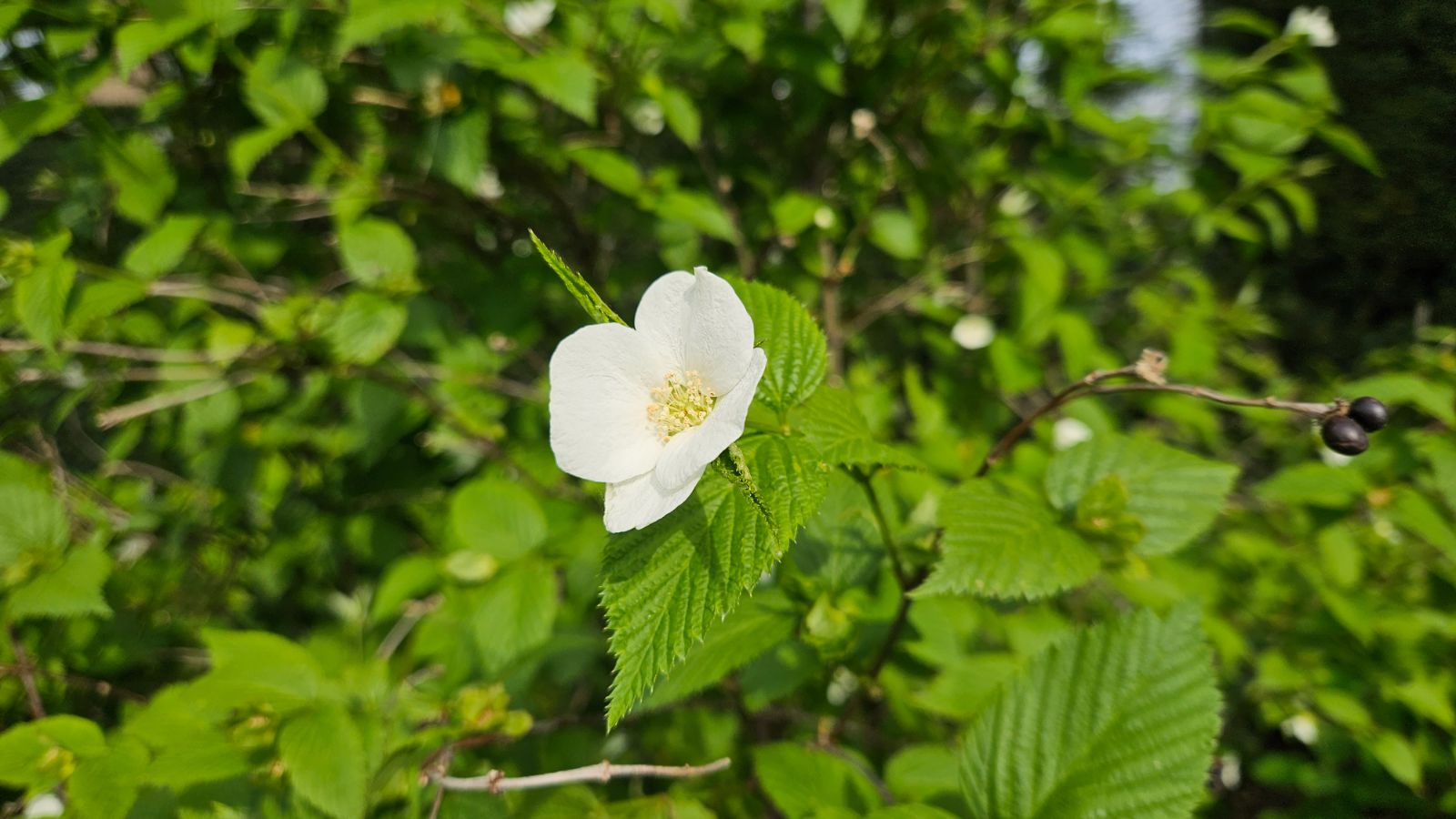
Despite close kinship with the also monospecific genus Kerria, Rhodotypos is somewhat of an outlier in the Rosaceae family. It is distinguished by the arrangement of its leaves (opposite rather than alternate, which is the norm in the family) and its four-petalled flowers, in contrast to the five petals found in most Rosaceae flowers. Its black fruit, defined as a drupelet or something between a berry and a drupe, which persists through winter in clusters of four and earned the plant its common name in English, Jetbead, also sets it apart. Together with Neviusia and Coleogyne, Rhodotypos and Kerria form the tribe Kerrieae in the subfamily Amygdaloideae of the Rosaceae.
The generic name alludes to its similarity to Rosa, derived from the ancient Greek ῥόδον (rhódon, ‘rose’) + τῠ́πος (tŭ́pos, ‘mark, type’) (wiktionary.org 2025). Rhodotypos has been prone to, erm…, typos (or a misconception that the ending of the epithet is derived from Latin) and has often been misspelt as Rhodotypus, for example in Curtis’s Botanical Magazine (Hooker 1869). The error probably originated in Bentham and Hooker’s Genera Plantarum, where they also misspelt the related genus Neviusia as Neviusa (Bentham & Hooker 1865).