Quercus ellipsoidalis

Sponsor
Kindly sponsored by
The Trees and Shrubs Online Oak Consortium
Credits
Article from New Trees by John Grimshaw & Ross Bayton
Recommended citation
'Quercus ellipsoidalis' from the website Trees and Shrubs Online (treesandshrubsonline.
Genus
- Quercus
- Subgen. Quercus, Sect. Lobatae
Common Names
- Northern Pin Oak
- Jack Oak
Other taxa in genus
- Quercus acerifolia
- Quercus acherdophylla
- Quercus acrodonta
- Quercus acuta
- Quercus acutifolia
- Quercus acutissima
- Quercus afares
- Quercus affinis
- Quercus agrifolia
- Quercus alba
- Quercus aliena
- Quercus alnifolia
- Quercus aquifolioides
- Quercus arizonica
- Quercus arkansana
- Quercus aucheri
- Quercus augustini
- Quercus austrina
- Quercus × auzendei
- Quercus baloot
- Quercus bambusifolia
- Quercus baronii
- Quercus bicolor
- Quercus brantii
- Quercus buckleyi
- Quercus canariensis
- Quercus canbyi
- Quercus candicans
- Quercus castanea
- Quercus castaneifolia
- Quercus cerris
- Quercus chenii
- Quercus chrysolepis
- Quercus coccifera
- Quercus cocciferoides
- Quercus coccinea
- Quercus conspersa
- Quercus crassifolia
- Quercus crassipes
- Quercus delavayi
- Quercus dentata
- Quercus deserticola
- Quercus dolicholepis
- Quercus douglasii
- Quercus dumosa
- Quercus durifolia
- Quercus eduardii
- Quercus emoryi
- Quercus engelmannii
- Quercus engleriana
- Quercus euboica
- Quercus eugeniifolia
- Quercus fabri
- Quercus faginea
- Quercus falcata
- Quercus floribunda
- Quercus frainetto
- Quercus franchetii
- Quercus fruticosa
- Quercus fusiformis
- Quercus gambelii
- Quercus garryana
- Quercus geminata
- Quercus georgiana
- Quercus germana
- Quercus gilliana
- Quercus gilva
- Quercus glabrescens
- Quercus glauca
- Quercus graciliformis
- Quercus gravesii
- Quercus griffithii
- Quercus grisea
- Quercus guyavifolia
- Quercus hartwissiana
- Quercus hemisphaerica
- Quercus × hispanica
- Quercus hondae
- Quercus hypargyrea
- Quercus hypoleucoides
- Quercus ilex
- Quercus ilicifolia
- Quercus imbricaria
- Quercus incana
- Quercus infectoria
- Quercus insignis
- Quercus ithaburensis
- Quercus kelloggii
- Quercus × kewensis
- Quercus kiukiangensis
- Quercus laceyi
- Quercus laevis
- Quercus lamellosa
- Quercus lanata
- Quercus lancifolia
- Quercus laurifolia
- Quercus laurina
- Quercus × leana
- Quercus leucotrichophora
- Quercus × libanerris
- Quercus libani
- Quercus lobata
- Quercus lobbii
- Quercus lodicosa
- Quercus longinux
- Quercus longispica
- Quercus look
- Quercus × ludoviciana
- Quercus macranthera
- Quercus macrocalyx
- Quercus macrocarpa
- Quercus macrolepis
- Quercus marilandica
- Quercus mexicana
- Quercus michauxii
- Quercus mongolica
- Quercus monimotricha
- Quercus montana
- Quercus morii
- Quercus muehlenbergii
- Quercus myrsinifolia
- Quercus myrtifolia
- Quercus nigra
- Quercus × numidica
- Quercus oblongifolia
- Quercus obtusata
- Quercus oglethorpensis
- Quercus oxyodon
- Quercus pagoda
- Quercus palmeri
- Quercus palustris
- Quercus pannosa
- Quercus parvula
- Quercus petraea
- Quercus phellos
- Quercus phillyreoides
- Quercus planipocula
- Quercus poilanei
- Quercus polymorpha
- Quercus pontica
- Quercus prinoides
- Quercus pubescens
- Quercus pyrenaica
- Quercus rehderiana
- Quercus reticulata
- Quercus robur
- Quercus rotundifolia
- Quercus rubra
- Quercus rugosa
- Quercus rysophylla
- Quercus sadleriana
- Quercus salicina
- Quercus sartorii
- Quercus × schneideri
- Quercus schottkyana
- Quercus semecarpifolia
- Quercus senescens
- Quercus serrata
- Quercus sessilifolia
- Quercus setulosa
- Quercus shumardii
- Quercus sinuata
- Quercus spinosa
- Quercus stellata
- Quercus stenophylloides
- Quercus suber
- Quercus subspathulata
- Quercus tarokoensis
- Quercus tatakaensis
- Quercus texana
- Quercus tomentella
- Quercus trojana
- Quercus tungmaiensis
- Quercus turbinella
- Quercus × turneri
- Quercus undulata
- Quercus utahensis
- Quercus utilis
- Quercus uxoris
- Quercus variabilis
- Quercus velutina
- Quercus virginiana
- Quercus vulcanica
- Quercus warburgii
- Quercus wislizenii
- Quercus xalapensis
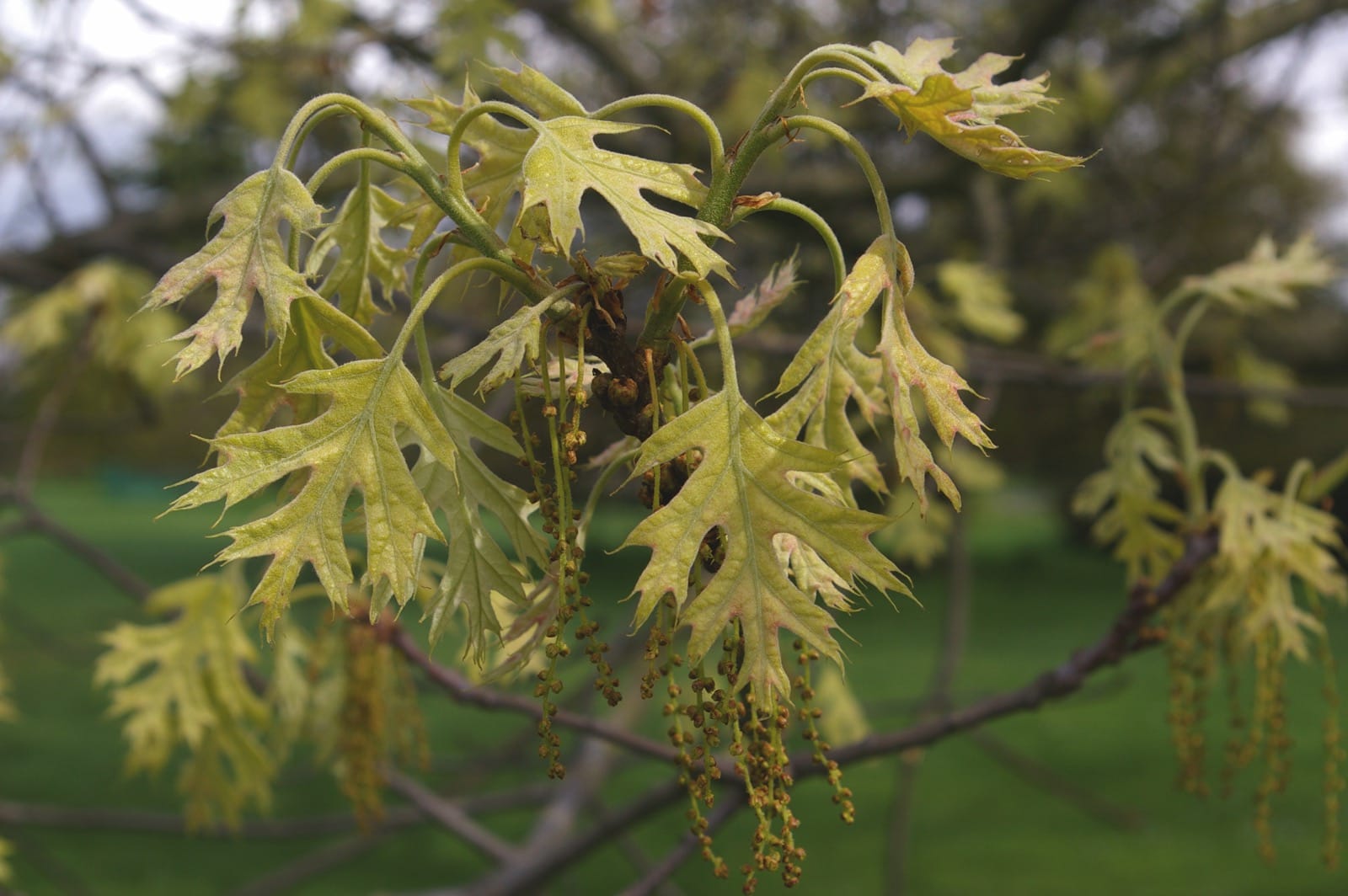
Tree to 20 m, 1.5 m dbh. Bark thin, greyish brown, divided into thin plates by shallow fissures. Crown narrow, oblong, with many forked branches; stumps of dead branches often prominent at the base of the trunk. Branchlets dark reddish brown and glabrous. Leaves deciduous, 7–13 × 5–10 cm, elliptic to obovate, glabrous, though lower surface often has tufts of hair in the vein axils, three to four secondary veins on each side of the midrib, margins with five to seven deep lobes, lobes largely oblong, expanding distally and terminating in spiny bristles (15–55 in total), median lobes longer than other lobes, lobe sinuses over half the distance to the midrib, apex acute; petiole 2–5 cm long, glabrous. Cupule turbinate or deeply cup-shaped, 1–1.9 × 0.6–1.1 cm, outer surface reddish brown and slightly pubescent, inner surface light brown and glab rous; scales obtuse or acute, apices tightly appressed. Acorn broadly ovoid to ellipsoid, with one-third to half of its length enclosed in the cupule, 1–2 cm long, stylopodium may be surrounded by several faint rings. Flowering May, fruiting August of the following year (USA). Nixon 1997. Distribution CANADA: Ontario; USA: Illinois, Indiana, Iowa, Michigan, Minnesota, Ohio, Wisconsin. Habitat Limestone ridges and slopes, dry sandy sites and along small streams between 150 and 500 m asl. USDA Hardiness Zone 4. Conservation status Least Concern. Illustration Nixon 1997; NT9, NT719. Cross-references B499, S414, K86. Taxonomic note This species may be of hybrid origin (Jensen et al. 1984).
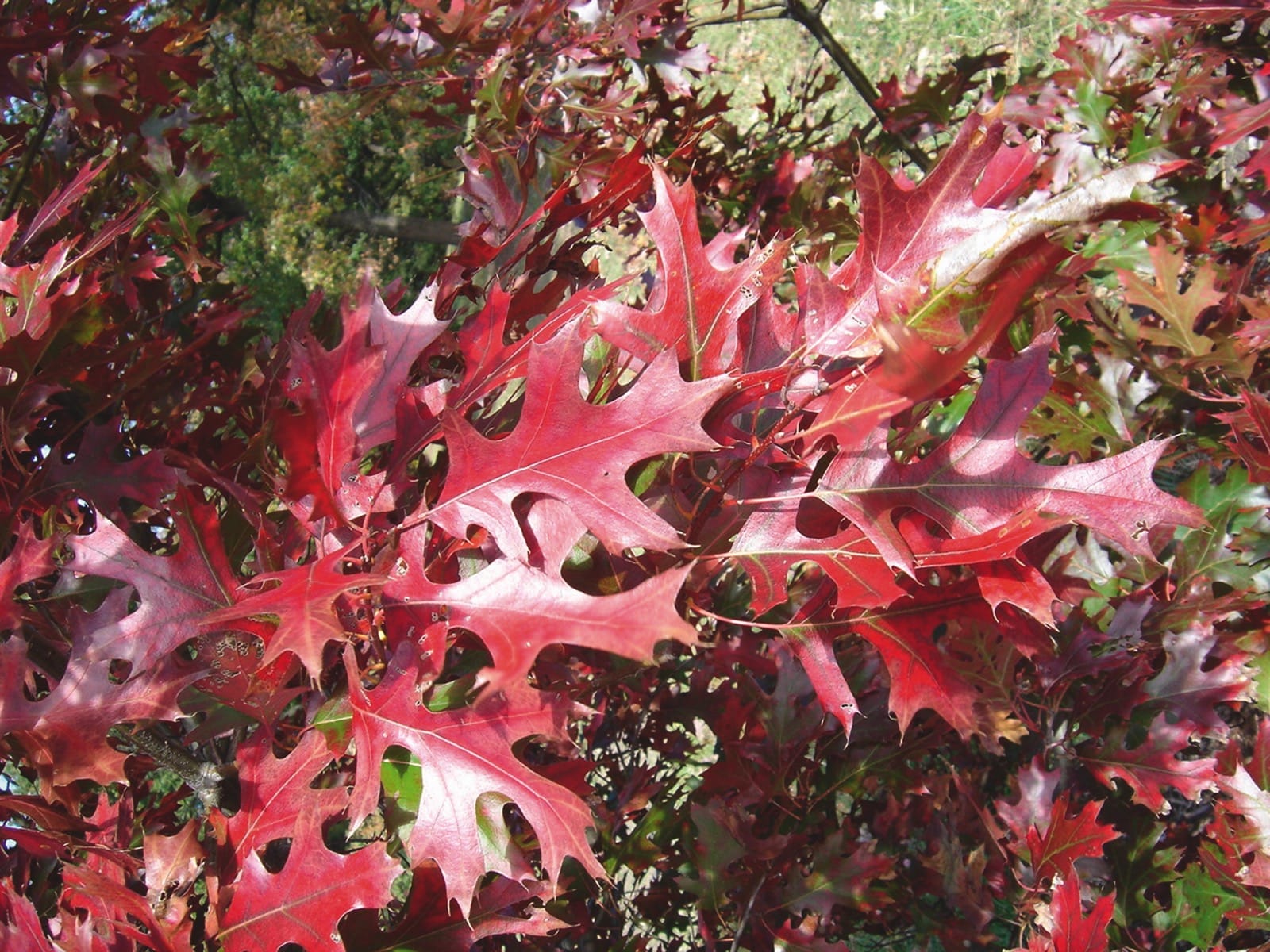
Briefly described by Bean (1976b), who mentions a moderately sized tree at the Royal Botanic Garden Edinburgh, Quercus ellipsoidalis is a species that has since become only slightly better known in Europe. It is apparently not greatly valued in North America either (Sternberg 2004), although one tree collected by C.S. Sargent is still growing at the Arnold Arboretum and it is in most collections, including good specimens at the Morton Arboretum. The old Edinburgh tree still survives, and has been joined by two more recent plantings. One of these, accessioned in 1985 and now 8 m in height, has been badly damaged by Grey Squirrels and its trunk is covered in scars from their depredations. Specimens in southern England seem to have avoided this fate, and the largest ones observed for the present work, at the Hillier Gardens, are fine upright trees. One of these, sited near Brentry House, is apparently an unrecognised champion, measured in 2001 at 18.4 m (Sir Harold Hillier Gardens database) – the official champion being a tree at Borde Hill planted in 1935, 17 m in 1995 (Johnson 2003). When these trees are given plenty of space they have a tend ency to develop wide-spreading branches to form a rounded crown. An individual at Kew, donated in 1974 by J.R.P. van Hoey Smith, is currently c.10 m tall and as much wide, with a dbh of 32 cm. This and another specimen at Kew coloured to a rich tan-brown in 2005 (a poor year for autumn colour in England), with the leaves hanging dry on the tree to great effect, but a brighter red can usually be expected; Sternberg (2004) notes the exceptional red autumnal colouring of this species, while Hillier & Coombes (2002) regard it as equal to the best forms of Q. coccinea. The cultivar ‘Hemelrijk’ has been propagated from a tree at the de Belder property noted for its reliable brilliant red colours in autumn, and the habit of retaining its tan leaves all winter. In spring the young leaves emerge pink, and then become an attractive deep green. ‘Hemelrijk’ was selected by Robert and Jelena de Belder in about 1980, and introduced to the nursery trade by M.M. Bömer, Zundert, the Netherlands (J. Bömer, pers. comm. 2006). Quercus ellipsoidalis is regarded as a calcifuge (Hillier & Coombes 2002), and at Kruchten succumbs to chlorosis at pH 6.8.