Please consider supporting TSO in our May Appeal 2026 Donate

Cornus flowers
 

May Appeal 2026

Please help keep TSO growing!

IDS Trees and Shrubs Online has become a fundamental source of reliable information about cultivated woody plants, freely available to everyone, everywhere. We hope you find it useful.

For the first time we are asking our users if you could support us.

If everyone who uses TSO during May 2026 gives just £10, we would cover our costs for a whole year, enabling us to accelerate our work.

Donate

Prinsepia sinensis (Oliv.) Hallier

TSO logo

Sponsor this page

For information about how you could sponsor this page, see How You Can Help

Credits

Roderick Cameron (2025)

Recommended citation
Cameron, R. (2025), 'Prinsepia sinensis' from the website Trees and Shrubs Online (treesandshrubsonline.org/articles/prinsepia/prinsepia-sinensis/). Accessed 2026-05-16.

Family

  • Rosaceae

Genus

Common Names

  • Cherry Prinsepia
  • Mandschurische Dornkirsche
  • 东北扁核木 dong bei bian he mu

Synonyms

  • Plagiospermum sinense Oliv.
  • Sinoplagiospermum sinense (Oliv.) Rauschert

Glossary

anther
Pollen-producing structure of flower at the tip of the filament; part of a stamen.
axillary
Situated in an axil.
bud
Immature shoot protected by scales that develops into leaves and/or flowers.
crustaceous
Somewhat hard elastic; resembling a hard crust or shell.
endocarp
Innermost layer of the fruit wall. Can be membranous and indistinguishable from the other layers of the fruit wall or may be hard woody and distinctive (see drupe).
included
(botanical) Contained within another part or organ.
phenology
The seasonal timing of events in the life cycle of a plant or animal and the study thereof.
simple
(of a leaf) Unlobed or undivided.
style
Generally an elongated structure arising from the ovary bearing the stigma at its tip.

References

Credits

Roderick Cameron (2025)

Recommended citation
Cameron, R. (2025), 'Prinsepia sinensis' from the website Trees and Shrubs Online (treesandshrubsonline.org/articles/prinsepia/prinsepia-sinensis/). Accessed 2026-05-16.

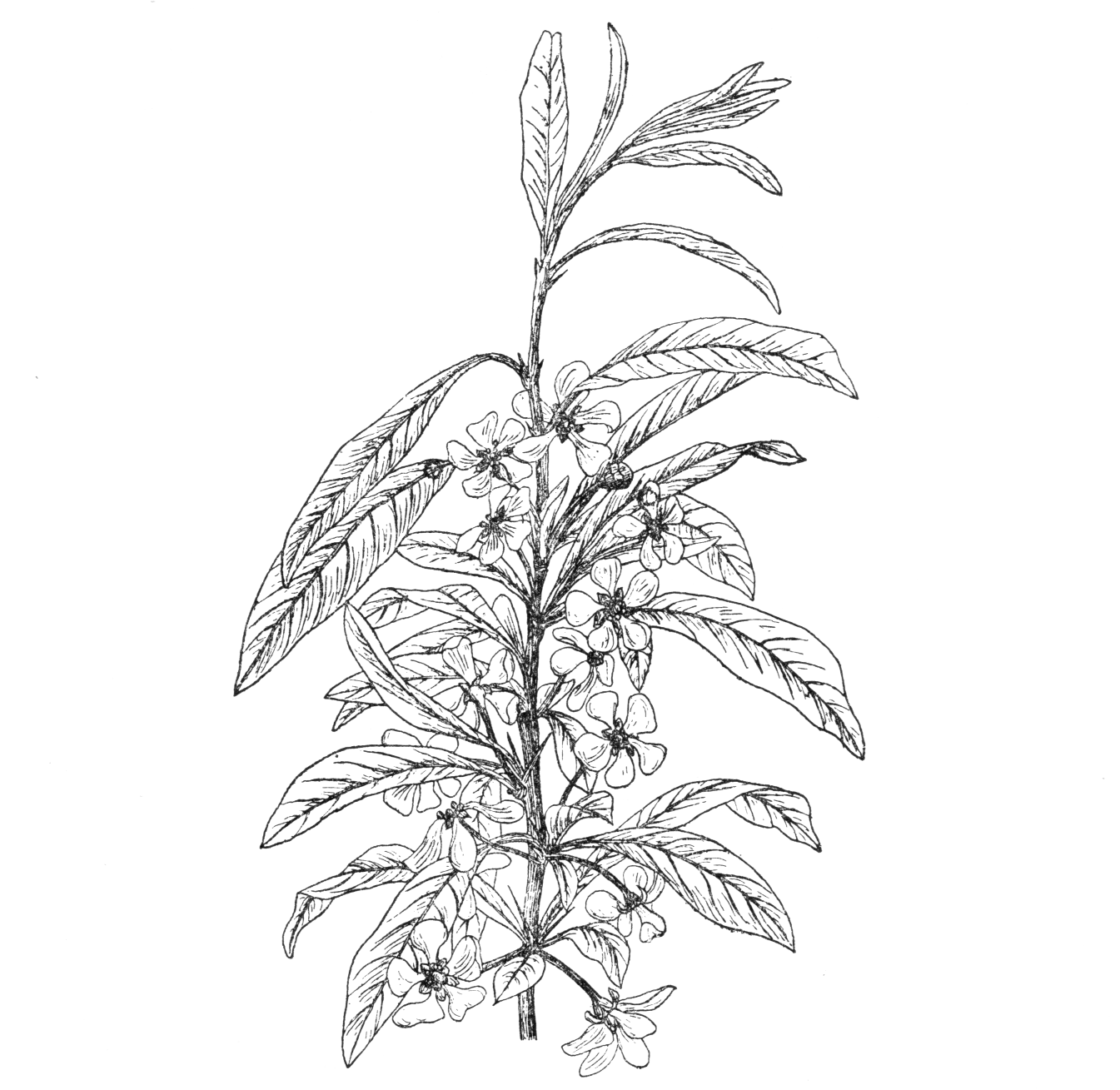
Shrubs to 2 m tall with a rather lax, spreading habit. Branches greyish-green to purplish-brown, robust, glabrous; branchlets reddish-brown, longitudinally angled, glabrous; spines erect to recurved, 6–10 mm, usually leafless. Winter buds purplish-red, ovoid, pubescent. Leaves alternate, on the shoots of the year, oblong-lanceolate, lanceolate, or very rarely straplike, 3–6.5 × 0.6–2 cm, below pale green, above dark green, base subrounded to broadly cuneate, margin serrate with teeth widely spaced, apex acute, acuminate, or caudate; secondary veins prominent below, impressed above; petiole 5–10 mm, glabrous. Inflorescences in leaf axils, 1-flowered or to a 4-flowered cluster; bracts small, membranous, lanceolate, above pubescent, glabrescent. Flowers bright yellow, about 1.5 cm in diameter, pedicel 1–1.8 cm, to 2 cm in fruit, glabrous. Hypanthium bell-shaped, outside glabrous. Sepals triangular-ovate, short, outside glabrous, margin ciliate. Petals 5, roundish, tapered to a short claw, apex obtuse. Stamens about 10, in 2 whorls. Ovary glabrous. Style short. Fruits juicy, drupe purplish red to purplish brown, subglobose to oblong, 1–1.5 cm in diameter, glabrous. (Gu & Bartholomew 2003; Bean 1976).

Distribution  China Northeast: Heilongjiang, Jilin, Liaoning, Inner Mongolia North KoreaSouth KoreaRussia Southern Far East: Primorsky Krai

Habitat Mixed forests, forests on shady slopes, open places on slopes, stream sides: 500–900 m asl.

USDA Hardiness Zone 4-8

RHS Hardiness Rating H7

Conservation status Not evaluated (NE)

Prinsepia sinensis is not as widely cultivated as Ernest Wilson might have expected it to be, given the terms he used to describe it blooming in the Arnold Arboretum in 1927: ‘A large, dome-shaped bush of this fine shrub is in full blossom … The arching, spreading branches are densely clothed with clusters of yellow plum-like blossoms which emit a strong odor of almonds … This plant has been growing in the Arboretum since 1903 and never known winter injury.’ (Wilson 1927). Aside from its ornamental charm, it displays a hardy resilience inherited from ancestors accustomed to demanding conditions.

Like its congeners, Prinsepia sinensis is a drought-tolerant shrub, with axillary spines that indicate the ancestral species of Prinsepia may have grown in semi-arid areas. P. sinensis is restricted to a relatively small area centred on the eastern part of northeast China and also including Korea and Primorsky Krai in Russia. Ma et al. (2019) posited that, during the Last Glacial Maximum (about 21,000 years ago), it was found across a larger area that extended further south, but a northward post-glacial colonisation led to its current distribution.

The species is easily transplanted and undemanding, requiring little more besides fertile, well-drained soil and an open, sunny location (Dirr 2009). This matches the natural conditions in habitat reported by Kesselring at the time of its first introduction (see below), who mentioned it grew on sandy, light soil interspersed with gravel in an open, free location (Purpus 1903).

Donald Wyman included it in a list of ‘Some of the best plants for Espaliers’, remarking that it was extremely hardy and one of the first shrubs to show leaves in the spring, and praising its bright red fruits in late summer. He recommended it be grown in simple fan-shaped or arching designs (Wyman 1969). No specific pests or diseases have been reported for this plant.

Prinsepia sinensis can be propagated from seed. Fruit should be macerated to remove the pulp and two months cold stratification is recommended. Optimum germination temperature is around 15°C; tests at 25°C resulted in no germination (Dirr & Heuser 1987). It can also be multiplied vegetatively, from lignified and semi-lignified cuttings and by division, but propagation from seed is easier and more cost-effective (Onica et al. 2022).

The Hillier Manual (Edwards & Marshall 2019) gives 1908 as the date of introduction of Prinsepia utilis to Western gardens, but that reveals a rather narrow-(i.e. Anglo-)minded interpretation of what constitutes Western cultivation. At a meeting of the German Dendrology Society in 1901, Carl Albert Purpus displayed a shrub he had in cultivation, received as Prunus japonica from St. Petersburg Botanical Garden, raised from seed collected by Komarov in Manchuria (Purpus 1902). At a meeting the following year, Purpus reported that he had been informed by Jakob Kesselring of St. Petersburg that the plant was in fact Plagiospermum sinensis (now Prinsepia sinensis), and that it did not seem to be entirely hardy in St. Petersburg, where it froze back to the ground each winter. Purpus stated that he had grown the shrub for five years and that it proved completely hardy in winter, and he shared observations regarding phenology and propagation (Purpus 1903). Komarov was in Manchuria from 1895 to 1897, from where he returned to St. Petersburg in late 1897 (Geltman 2020). So based on Purpus’ account, it is reasonable to suppose that it was introduced to cultivation around 1897 and that credit for the introduction should go to Komarov. Vladimir Leontievich Komarov (1869–1945) was a botanist and geographer. His influential three-volume Flora of Manchuria (1901–7) was based on his travels there. He was President of the USSR Academy of Sciences (1936–1945) and Honorary President of the USSR Geographical Society (1940–1945) (GBUMAC (State Budgetary Institution of Culture of Moscow) 2025).

From St. Petersburg material was also sent to Phillipe de Vilmorin, who in 1908 presented a plant to Kew, the point at which Bean reported that it had been ‘introduced from France.’ It flowered there in 1916, in the same year as a plant in Glasnevin, received from Thomas Smith’s nursery in Newry, who obtained it from Regel and Kesselring’s nursery in St. Petersburg, perhaps before Kew did (Bean 1909). Seed from Komarov’s collection may have been sent to the Arnold Arboretum, where it was planted in 1903. According to Rehder (Rehder 1915), it flowered profusely every year, but fruited rarely and sparingly.

The species was first described by Daniel Oliver in 1886 from flowering branches with still undeveloped leaves, collected by missionaries in North China (Oliver & Hooker 1886). Oliver named it Plagiospermum sinensis, thereby founding a new genus. The genus name presumably refers to the lateral, almost basal position of the style: Plagiospermum derives from ancient Greek πλάγιος (plágios, ‘oblique’) + σπέρμα (spérma,’ seed’) (wiktionary.org 2025). In 1903, Hans Hallier determined, based on Oliver’s description and drawings, that it was better placed in Prinsepia, as he found it to be in general similar to Royle’s P. utilis. This view, however, was not universally accepted. According to Otto Stapf (1917), Plagiospermum and Prinsepia were very distinct: in Prinsepia the buds are enclosed in protective scales, the leaves have no stipules, the indefinite stamens have discrete anther cells, and the stone in the fruit has a thin and crustaceous endocarp; in Plagiospermum, in contrast, the bud scales are replaced by persistent stipules, the stamens are arranged in two series and have contiguous anther cells, and the endocarp is thick and stony. Though P. sinensis is now widely accepted as the correct name, as late as 1952 Sealy upheld Stapf’s ‘excellent reasons’ for separating P. sinensis, together with P. uniflora, as the distinct genus Plagiospermum. It later transpired that Plagiospermum was an invalid name, as it had already been used by Cleve in 1868 to name an alga; Rauschert replaced it with Sinoplagiospermum in 1982.

Bean in 1909 published a note reporting that Plagiospermum sinensis, which had been described in the absence of fruit and had been placed in Celastraceae, was now moved to Prinsepia in Rosaceae. He did not cite Hallier or any other publication, and he suggested that Oliver had made the change himself in an unpublished manuscript. This name published by Bean (i.e. Prinsepia sinensis (Oliv.) Oliv. ex Bean) has been used extensively in the literature, but it is in fact an isonym of the correct name published by Hallier in 1903.