Kindly sponsored by
Sir Henry Angest
Tom Christian (2025)
Recommended citation
Christian, T. (2025), 'Picea orientalis' from the website Trees and Shrubs Online (treesandshrubsonline.
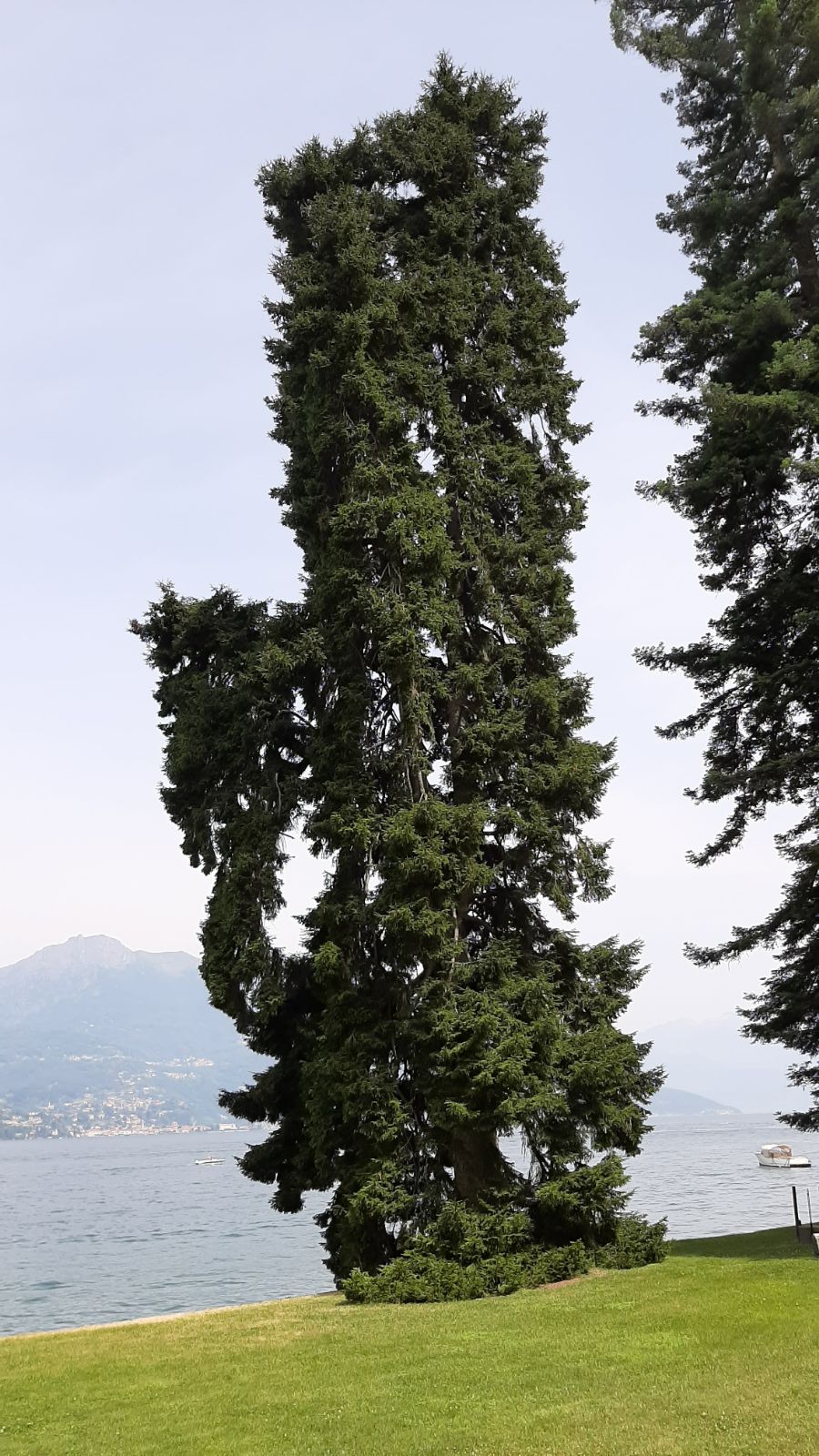
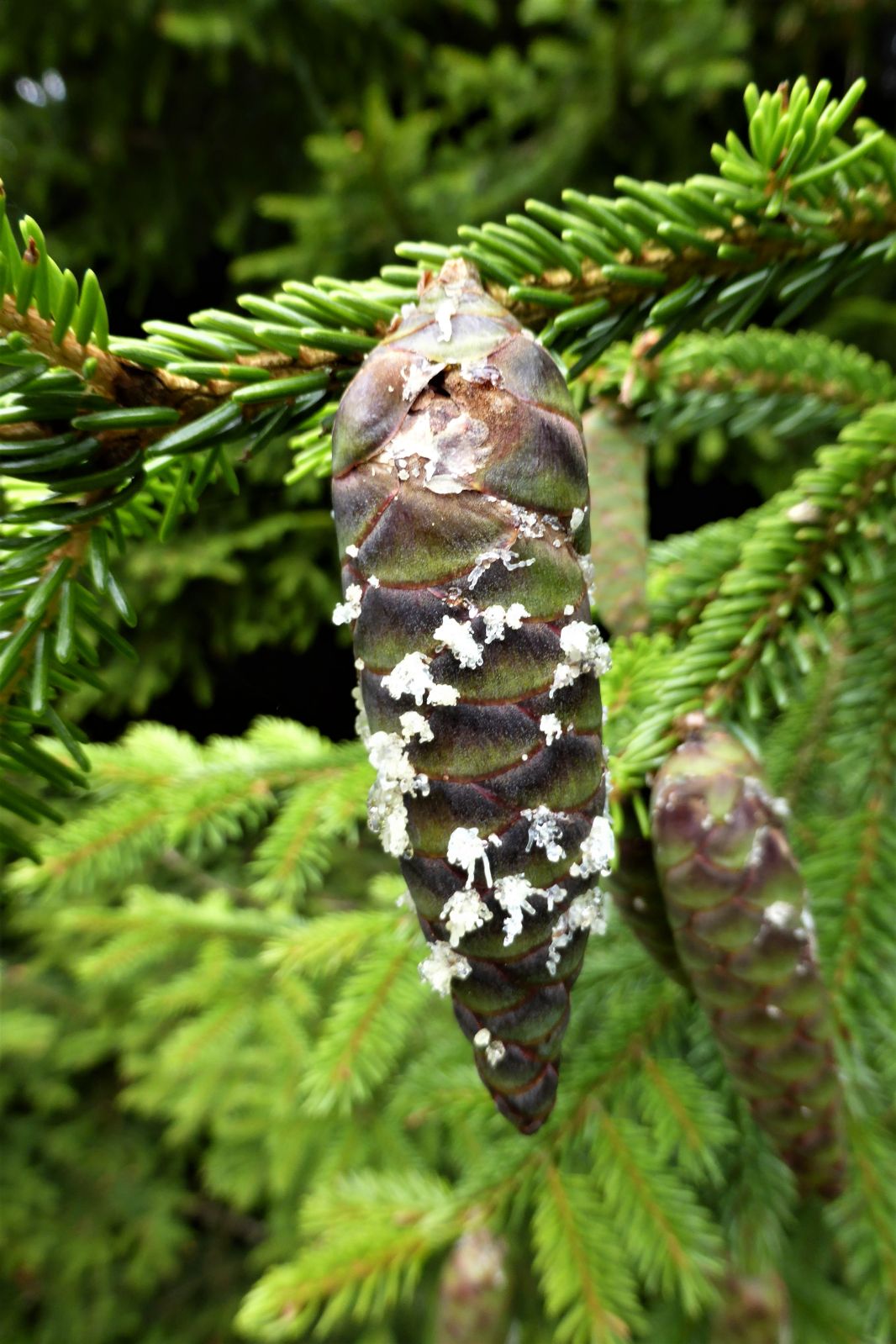
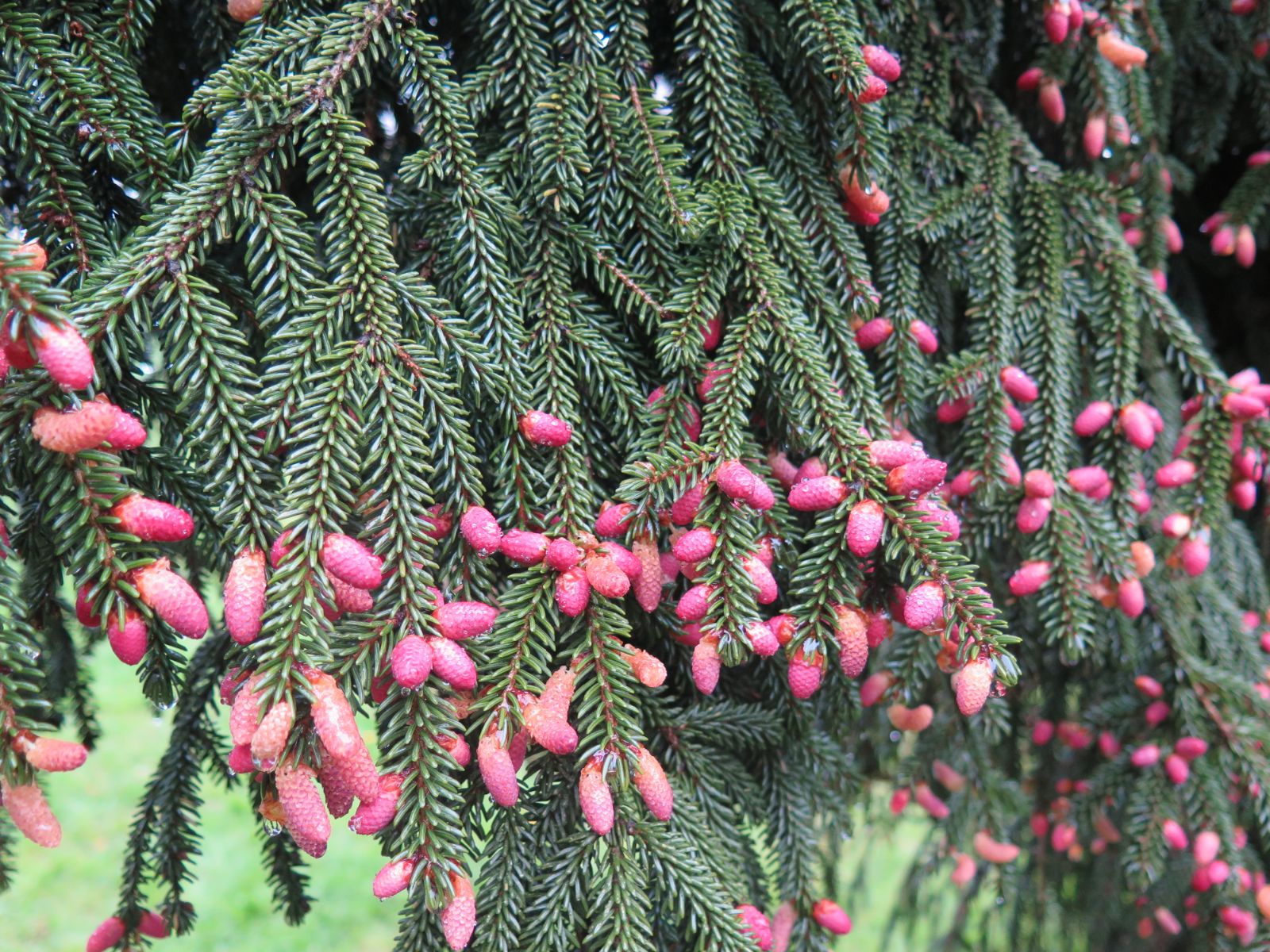
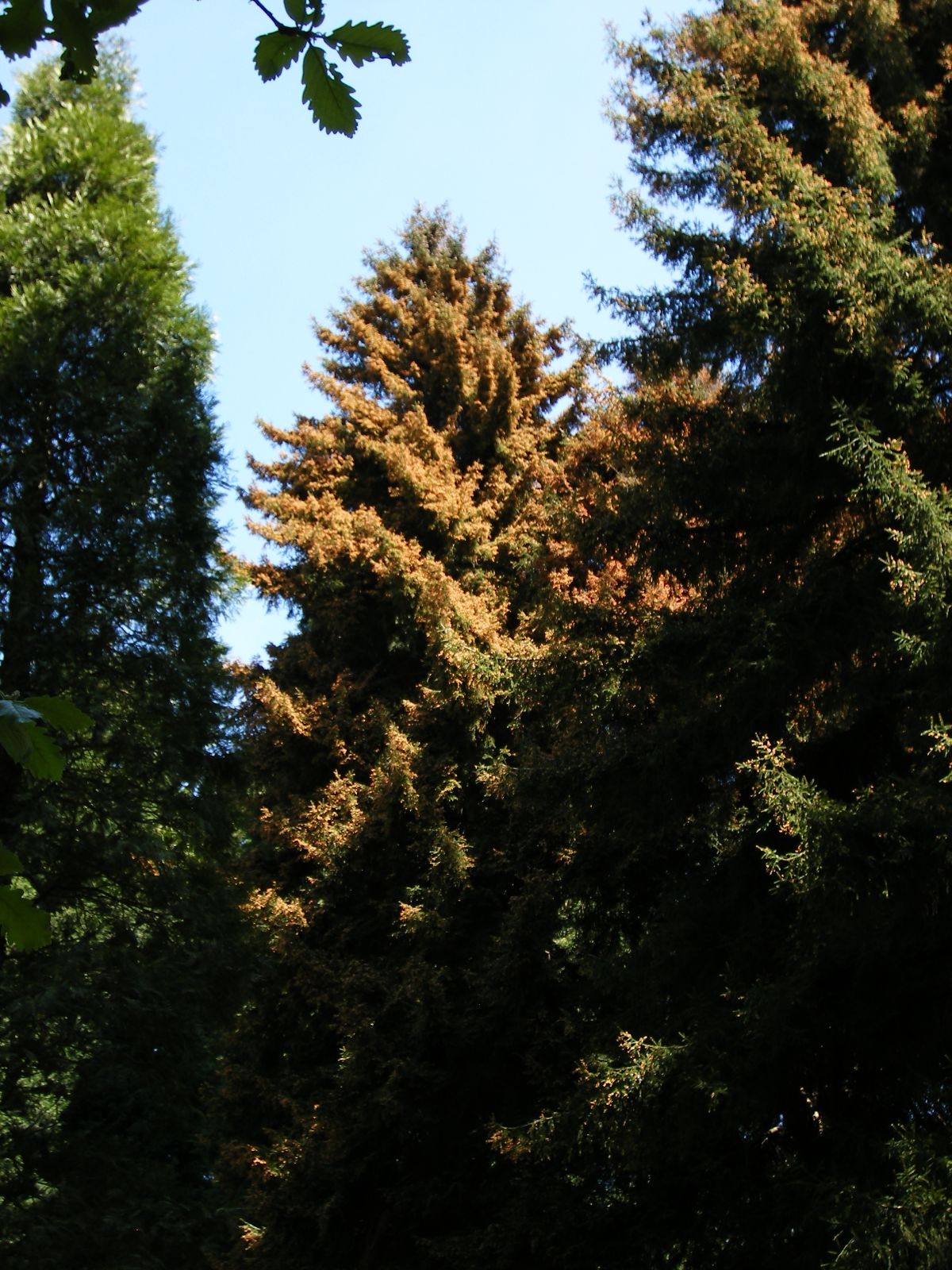
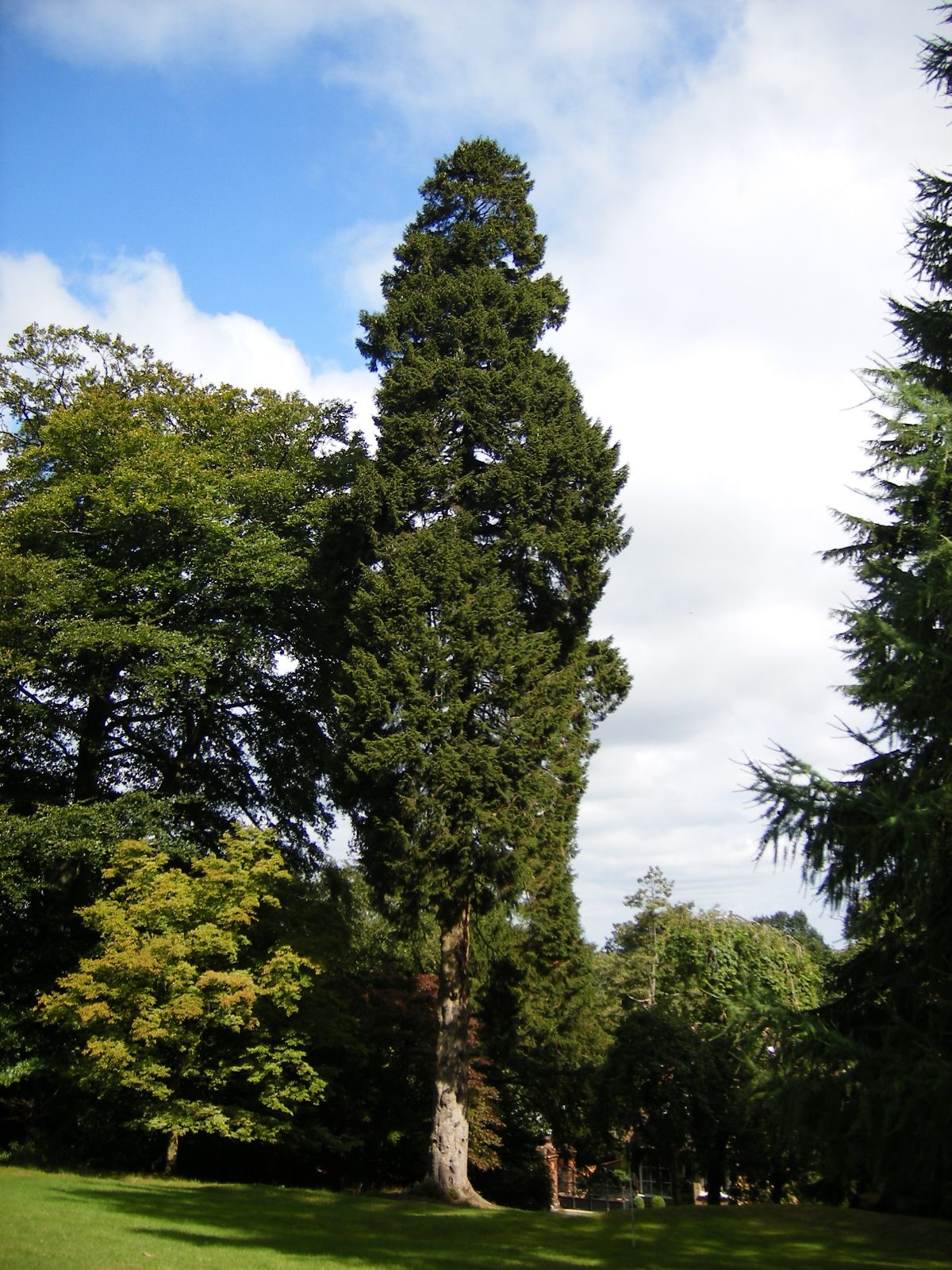
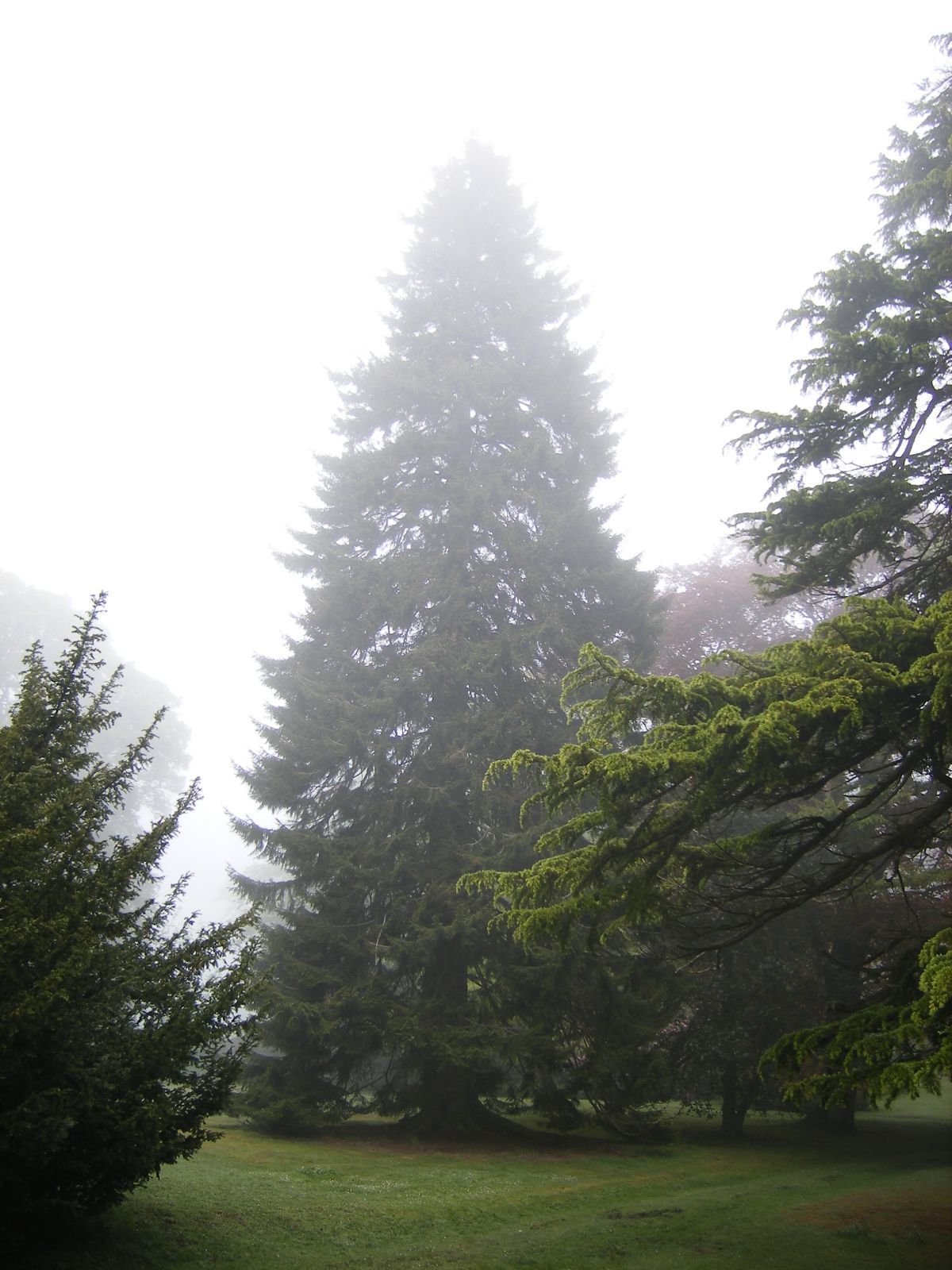
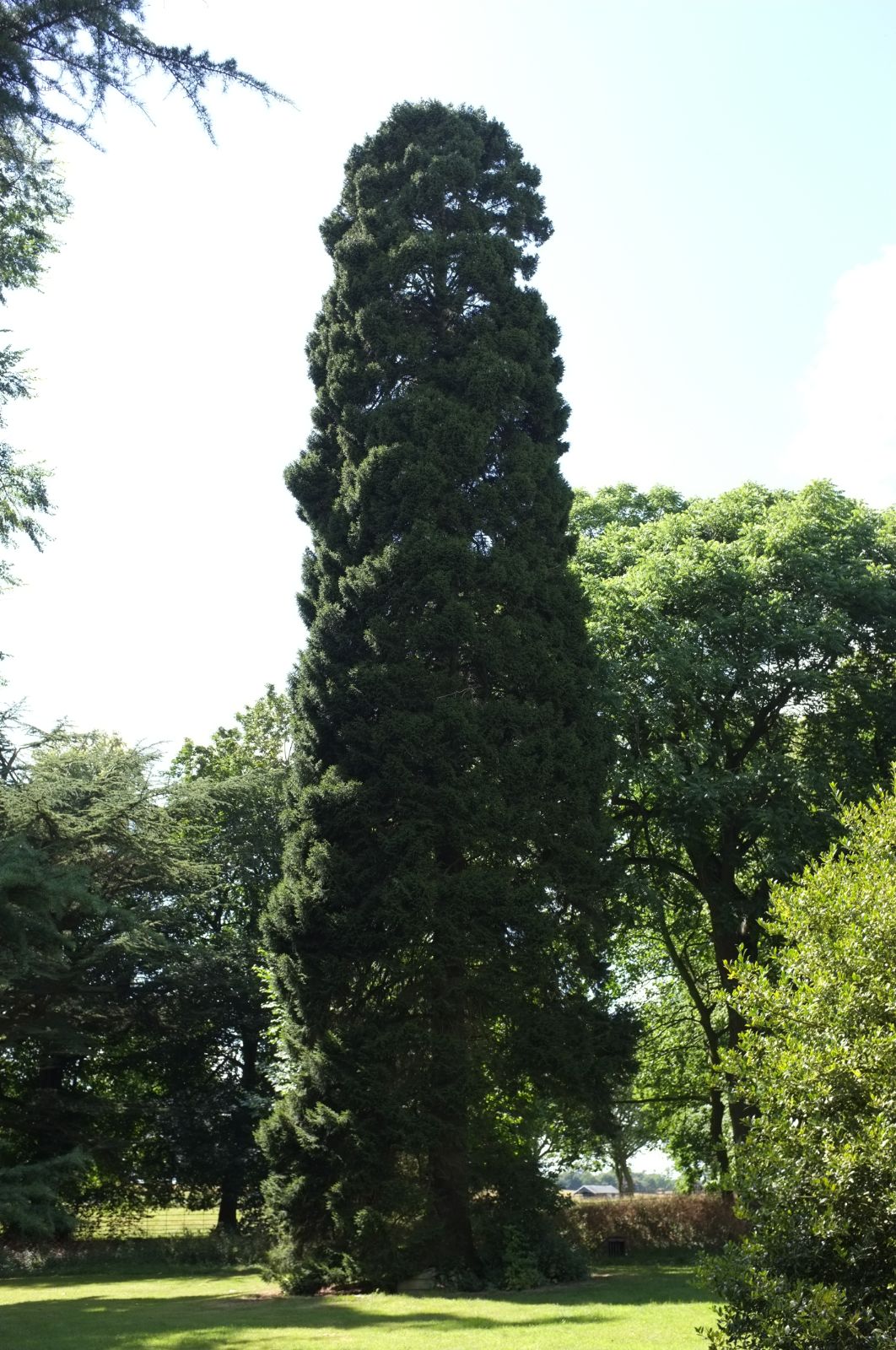
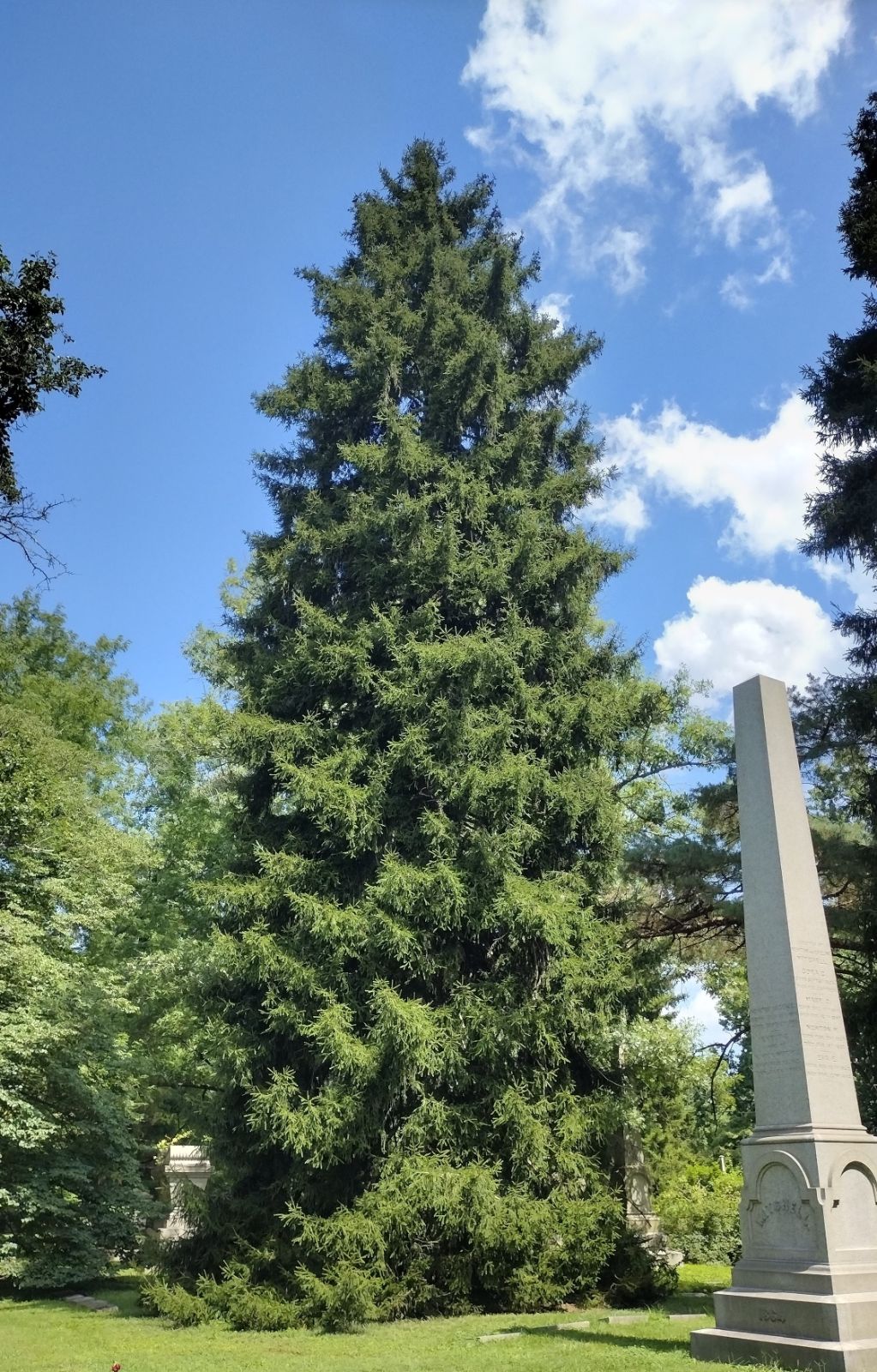
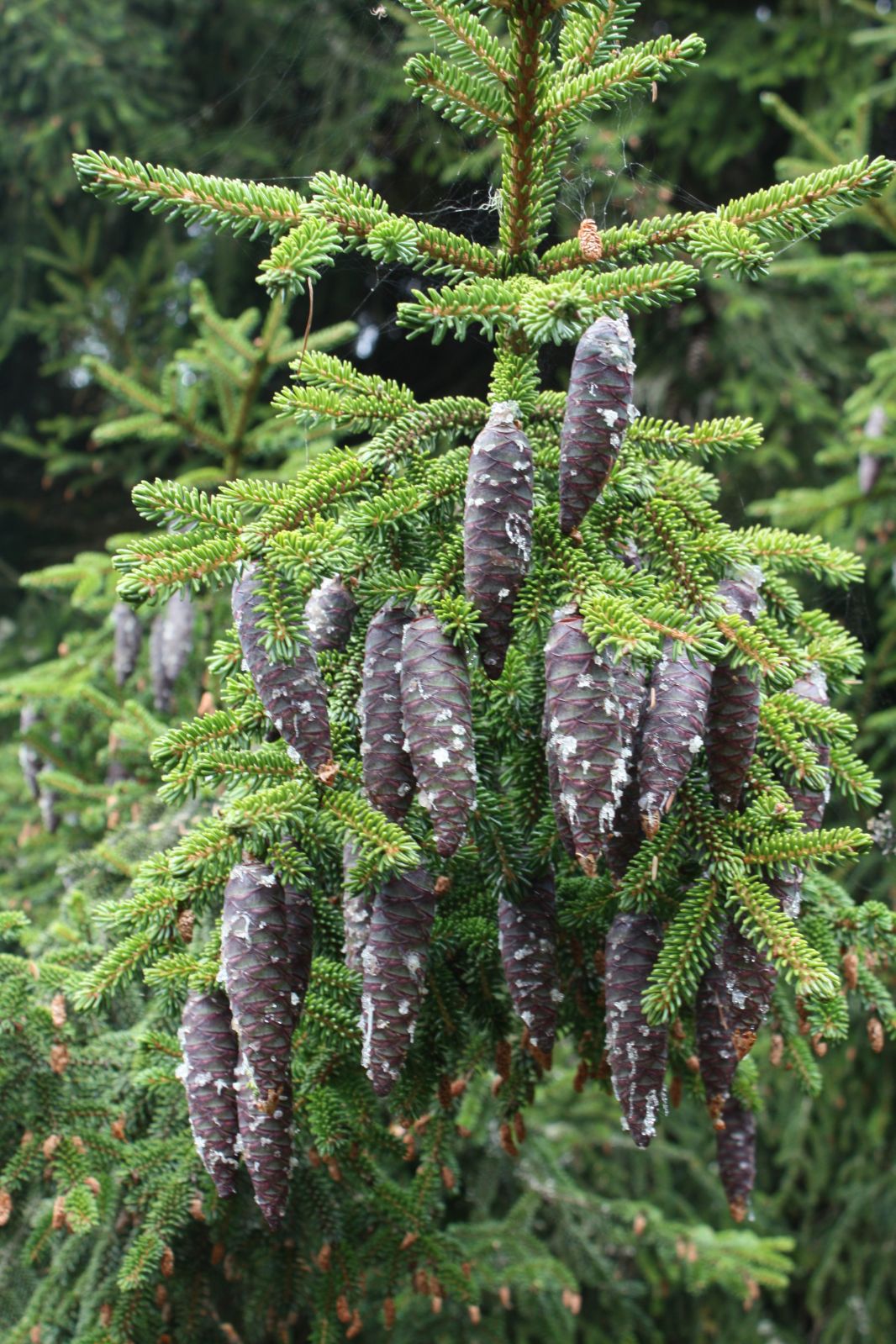
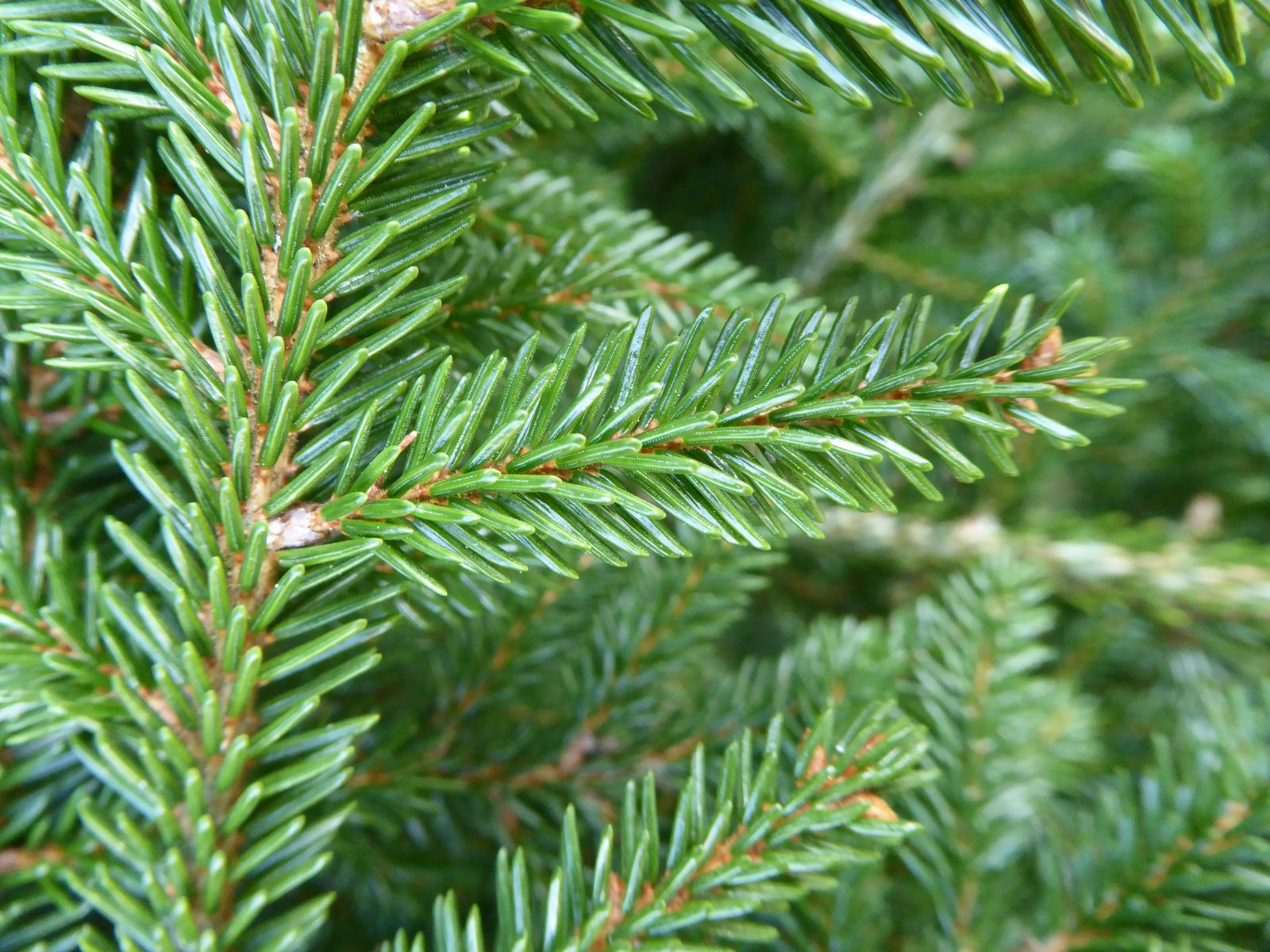
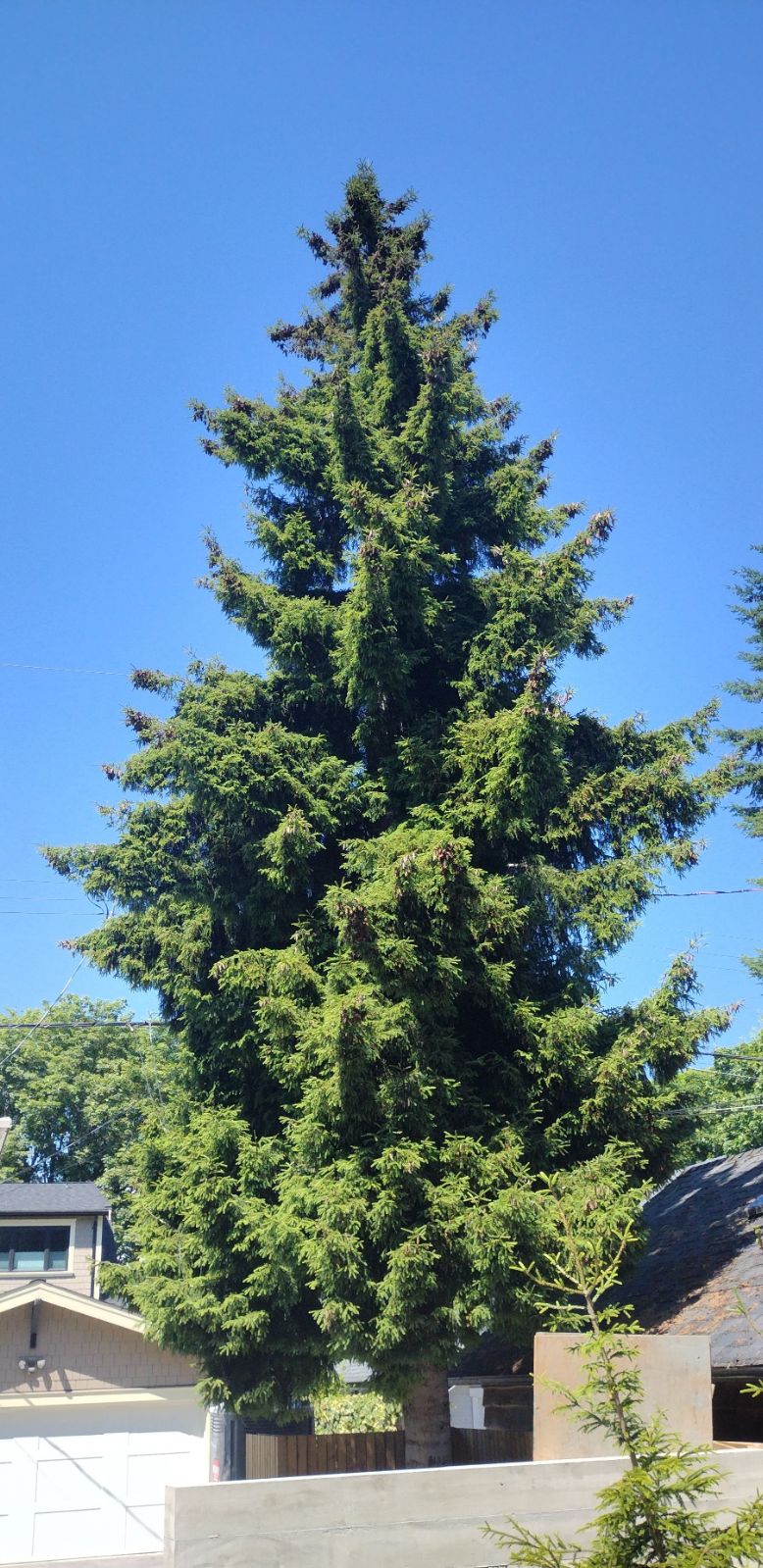
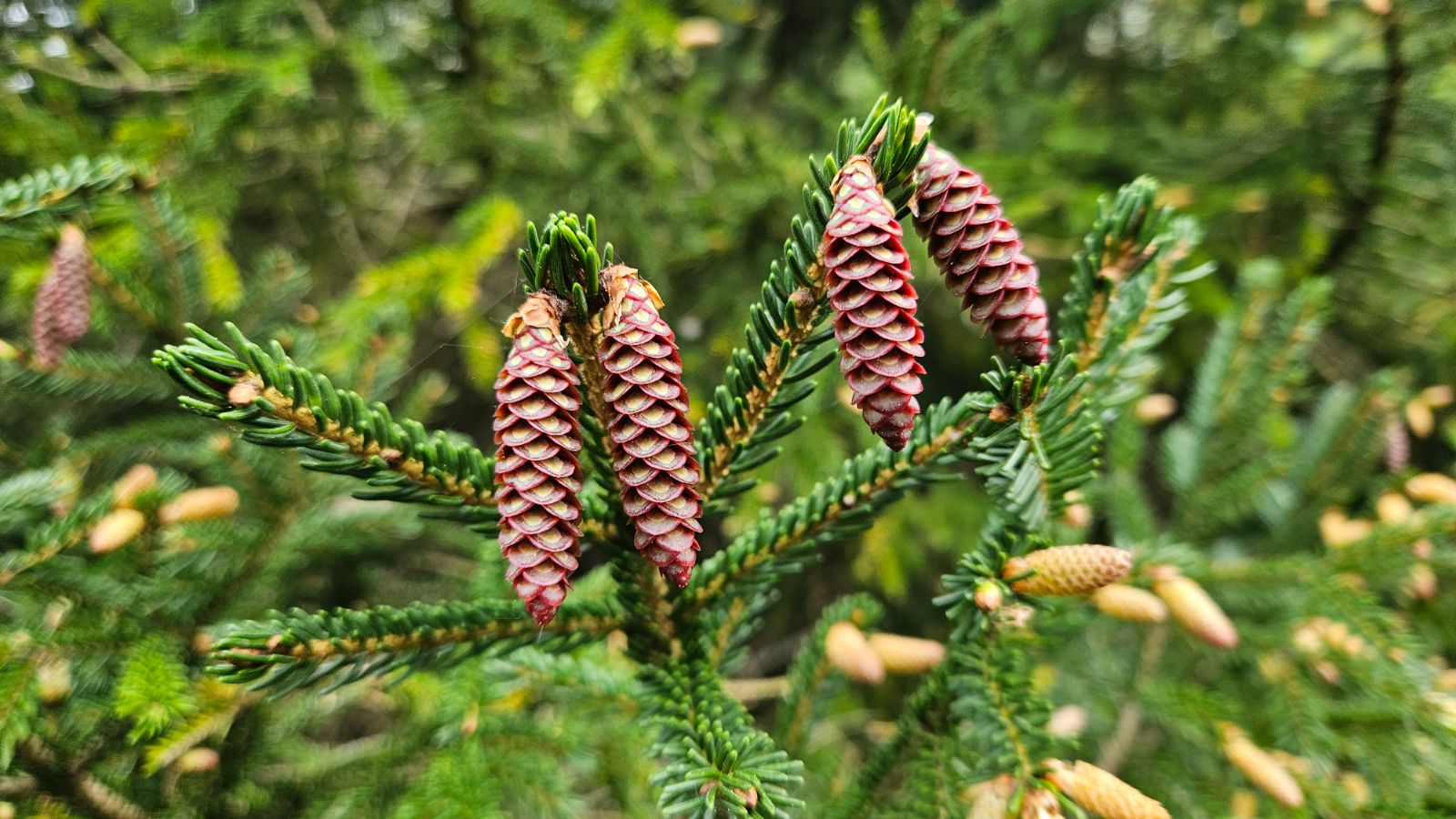
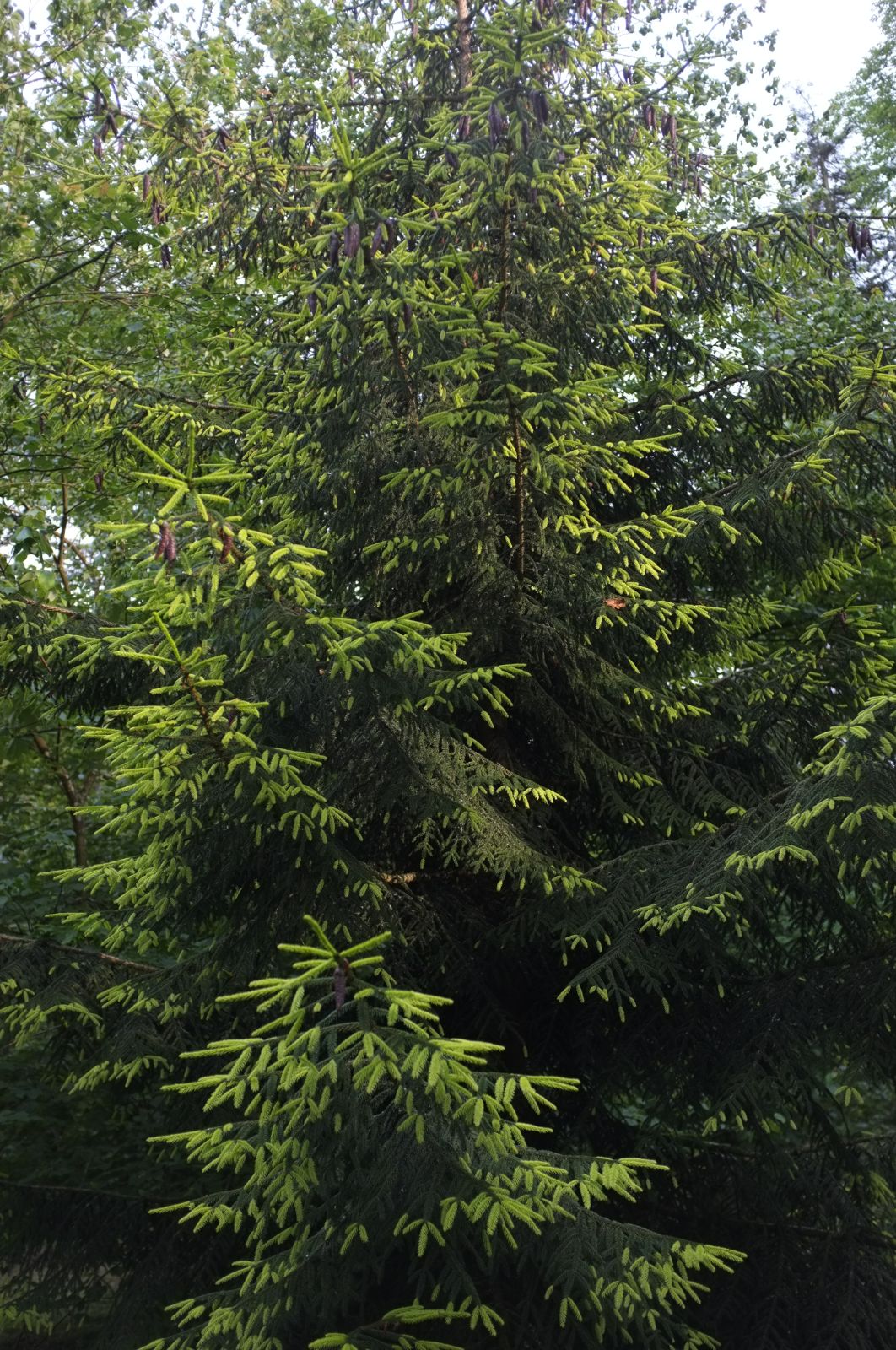
Tree 40–60 m tall, 1.5–2.5 m dbh. Bark rough, soon breaking into irregular plates flakes, reddish-brown, later grey, detaching in thin irregular plates. Crown narrowly pyramidal to conical, usually dense, branches retained low on the trunk especially in cultivation. First order branches variable, spreading or downswept, long or short, slender, assurgent at tips; second order branches slender, spreading or pendent. Branchlets short, slender, flexible, buff to pale brown, grey-brown by third year, with narrow ridges and shallow grooves, short-pubescent; pulvini small, paler than shoot. Vegetative buds ovoid-conical, acute, 3–5 mm long, not resinous; bud scales triangular, obtuse, appressed with free tips, reddish-brown, persisting several years. Leaves radially spreading, swept forward above shoot, pectinate below, 6–10 × 0.7–1 mm, linear, straight, apex abruptly obtuse or sub-acute, rhombic in cross section, with 1–2 lines of stomata above and 2–5 below; leaf colour glossy dark green. Pollen cones 1–2 cm long. Seed cones terminal, often numerous, narrowly cylindrical, sessile, 4.5–10 × 2–3.3 cm with open scales, green at first, ripening through purplish hues to red-brown or dark purplish-brown. Seed scales broad obovate to suborbicular, 1.2–1.7 × 1–1.4 cm at midcone, thin, rigid, finely striated, glossy; upper margin entire or lacerate; base cuneate. Bract scales ligulate, 5–6 mm long, entirely included. Seeds ovoid, 3–4 × 2.5 mm, apex sub-acute, brown, with a papery ovate wing 6–8 × 4–5 mm, pale yellowish-brown. (Farjon 2017; Bean 1976).
Distribution Azerbaijan Caucasus Georgia Caucasus Russia Caucasus Turkey Caucasus
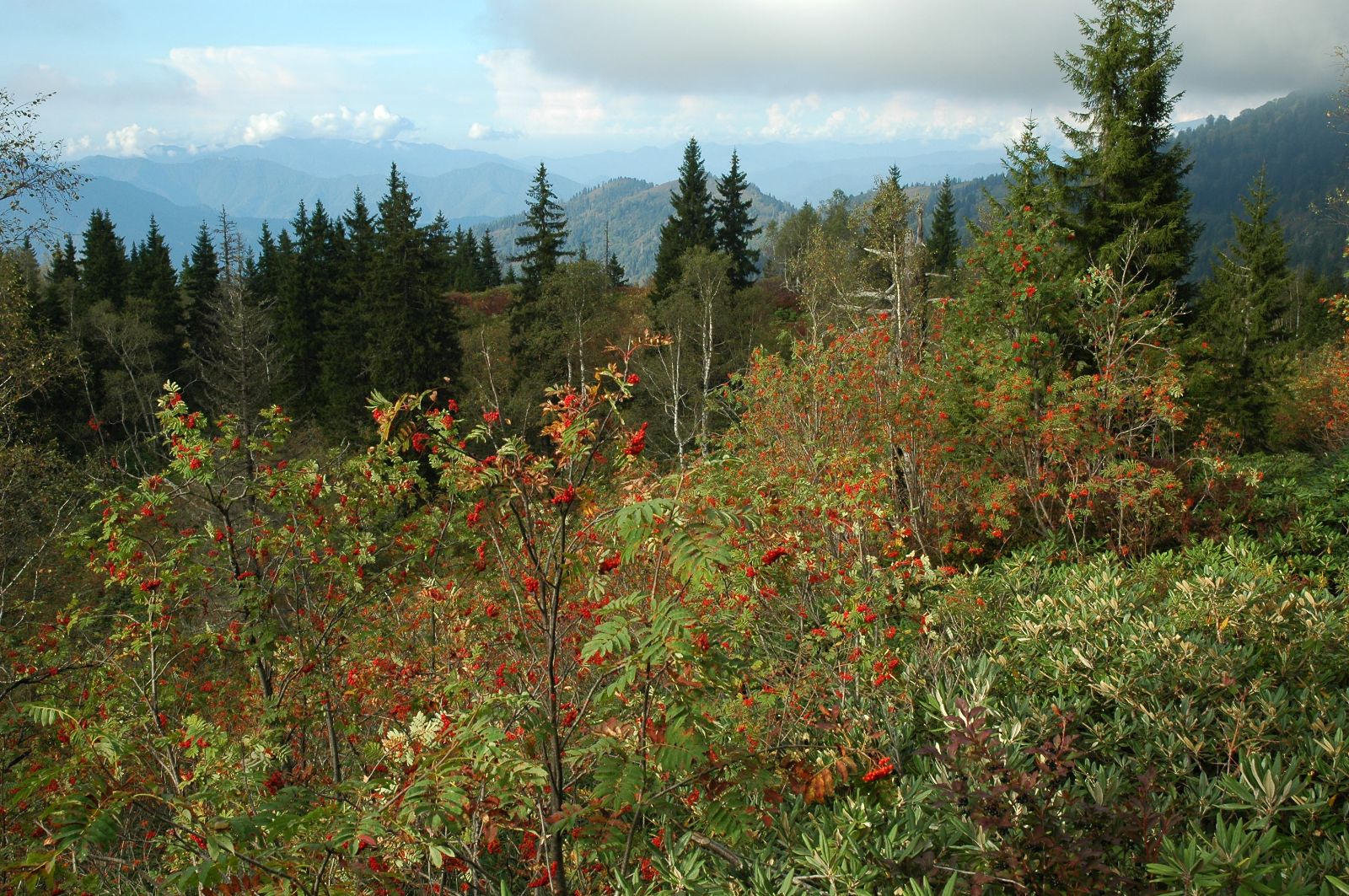
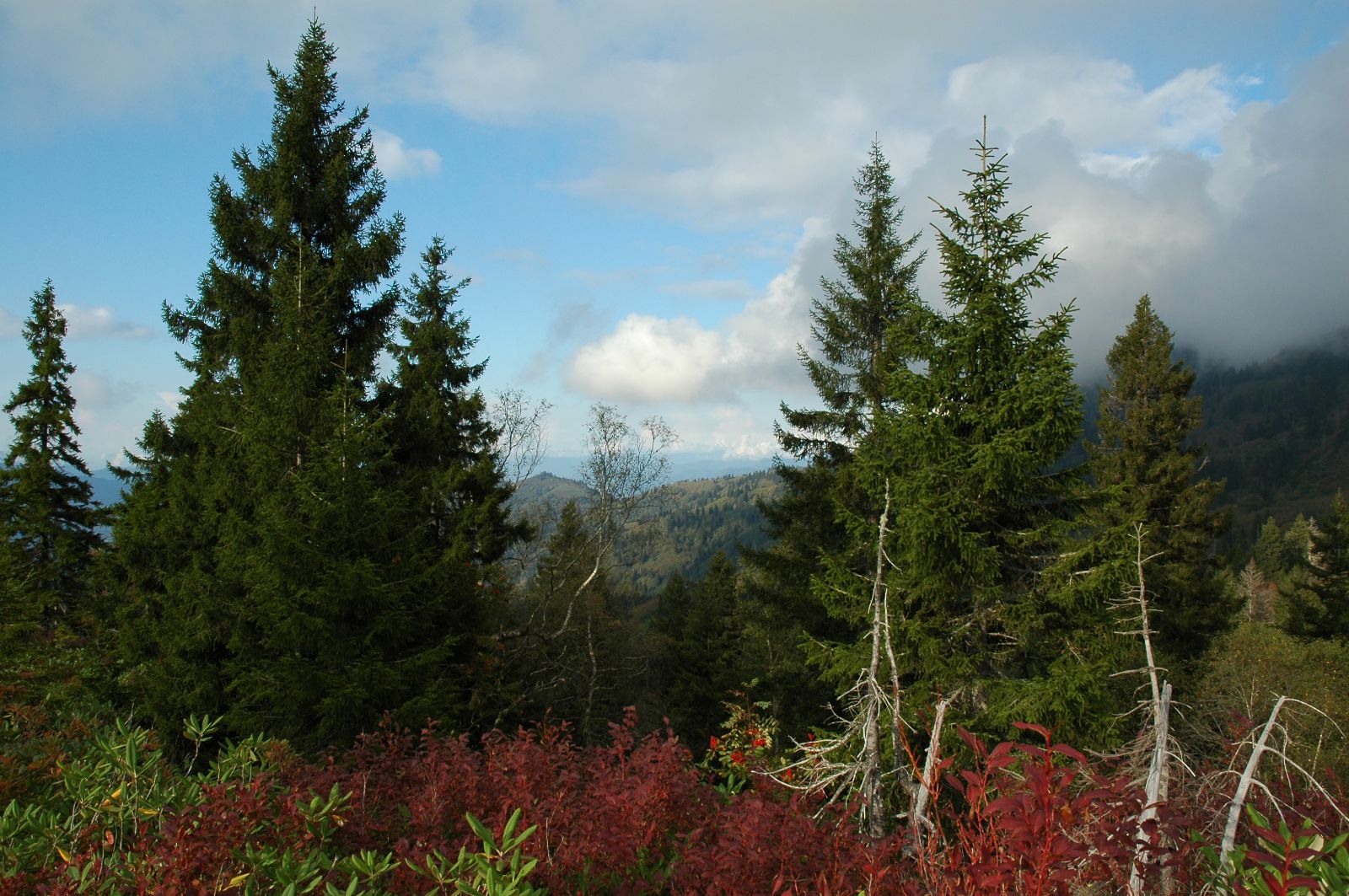
Habitat Temperate forest in hills and mountains (400–)700–2100 m asl, in a region characterised by cool to cold winters and relatively warm, dry summers. Precipitation varies from 1000–2000 mm per year. Forming pure stands at higher elevations or co-dominant with Abies nordmanniana subsp. nordmanniana; at lower elevations it occurs in mixed forest with Fagus orientalis, Acer spp., Ilex colchica and Taxus baccata.
USDA Hardiness Zone 4-7
RHS Hardiness Rating H7
Conservation status Least concern (LC)
Picea orientalis is one of the most distinct and ornamental of spruces. It is also incredibly versatile, tolerating both very wet and rather dry, very cold and rather warm climates, as well as different soil types including acid peats, limestone and even shallow chalk. The forests it inhabits in the Caucasus are very beautiful, but perhaps no more so than toward its lower altitudinal limit in autumn, where its elegant silhouette of dark-but-warm-green peppers a deciduous matrix of golds, yellows and reds as the beech, maple, rowan and cherry all turn.
The vernacular name Oriental Spruce might seem counter intuitive for a tree distributed in the Caucasus Mounains, but it has the same root as many other famous ‘orients’ including the Orient Express, L’Orient (Napoleon’s flagship in the eastern Mediterranean, so-named to indicate his ambitions in the region but sunk by the British at the Battle of the Nile in 1798) and, in case there are any dendrologists reading this, Alnus orientalis, Carpinus orientalis, Fagus orientalis, Platanus orientalis, and so on. The Orient in question is derived from the ancient term given to much of the eastern Roman Empire which approximated to the area from the eastern Balkan peninsula to Syria, but as later Europeans travelled further into Asia the term moved eastward with them, and in some quarters stretches as far as Asia’s Pacific Coast, but, at least as employed by botanists, is typically considered to cover the area from the Bosphorus to the Caspian. The late British dendrologist Alan Mitchell sought to circumvent any possible confusion by advocating the name Caucasian Spruce (Mitchell 1996), but romance triumphed over practicality and Oriental Spruce remains the more popular name.
Picea orientalis was introduced to cultivation in Europe in the late 1820s or 1830s, then to North America soon afterward. Alan Mitchell gave 1838 as the date of introduction to Britain but noted that it would not be widely available here until the 1850s, when large and frequent introductions ensured it became part of the standard set of conifers sent out by major nurseries to Victorian landowners seeking to establish fashionable new pineta (Mitchell 1996). Within just a few years of its introduction Picea orientalis was cultivating legions of fans on both sides of the Atlantic. By the time of the Royal Horticultural Society’s Conifer Conference of 1892 it had been cultivated for over fifty years and was admired in collections in every part of the UK and Ireland as well as in France, Germany, Denmark and Sweden (Hansen 1892). For Henry Elwes it was the most generally successul spruce cultivated in the UK and Ireland, and among the most beautiful of all conifers that could be grown in Massachusetts (Elwes & Henry 1906–1913). It’s popularity has never waned and more recently Dirr (2009) has advocated it for smaller spaces in North America due to its gracefulness and slower rates of growth there than in Europe, but despite all of this it has never gone mainstream, and it remains confined to large gardens and specialist collections, although it is frequent within such sites.
In the recent past Picea orientalis has been considered a possible ‘alternative species’ for commercial forestry in Britain, particularly in the east of the country where conditions might become too warm and dry for P. abies and P. sitchensis, the latter of which currently dominates UK commercial forestry (Wilson 2011). Unfortunately, P. orientalis has proven particularly attractive to Great Spruce Bark Beetle (Dendroctonus micans) and trees of all ages, except the very youngest, are now under attack throughout England and into southern Scotland. Whilst P. orientalis seems to live with the beetle for many years, infestations will eventually kill the tree, and it is a particularly sad reality that the UK and many adjacent European nations stand to lose many fine examples of this handsome spruce.
Indeed, up until very recently, there have been so many fine trees across our area that there is little to be gained by citing any other than the very best (in years to come, such league tables will inevitably focus on Dendroctonus survivors). In the UK and Ireland, as with so many conifers, these are concentrated in Scotland where there are trees 35 m or more at Blair Castle, Perthshire, and in adjacent Angus at Brechin Castle and Cortachy Castle. The tallest of all is at Benmore Botanic Garden, Argyll, 41 m × 98 cm dbh in 2017, where another is 38.5 × 1.15 m dbh. In a private garden in Perthshire a tree growing in the shelter of a steep, east-facing slope was 40 m × 82 cm in 2013 and surely taller now (Tree Register 2024). The only trees elsewhere in Britain that can match these heights are in areas with deep, sheltered valleys, such as Graythwaite Hall, Cumbria, 35 m in 2013; there are historic records of trees to 34 m at Stanage, Powys, Wales in 1978 and 37 m at Bowood, Wiltshire in 1984, where the fine pinetum has grown many record breaking trees.
In mainland Europe there are trees exceeding 30 m recorded from Slovakia (30.1 m in the park at Dolna Krupa, Trnava); Belgium (32 m at Arboretum Tervuren); Germany (several locations, the tallest 32.4 m in Pillnitz, Saxony); and the Netherlands (several locations, the tallest 34.8 m in the park at Rozendaal) (Monumental Trees 2024). The largest at the Botanic Garden in Gothenburg, Sweden, from a 1921 planting were 21 m × 67 cm in 2005; in the adjacent landscape arboretum there is a grove of 200 trees raised from seed gathered in Artvin, Turkey, in 1957 and planted in 1961, in 2005 the tallest of these was 16.5 m and the largest 29 cm dbh (Aldén 2006).
Although it is widely cultivated in North America records with dimensions are scarce – Dirr (2009) considers it one of the most valuable species for planting through zones 4–7, far superior in the northern and midwestern US to the ubiquitous P. abies and P. glauca, and notes 24 m specimens at Biltmore, North Carolina and 21 m at Spring Grove, Cincinnati, Ohio. In his 1982 survey of spruces in the Arnold Arboretum Warren was able to report five extant trees from 1873, and another collected in the wild by Sargent in 1903, all ‘magnificent trees reaching 21 m in height’ (Warren 1982).
As a distinctive spruce distributed well away from any other, Picea orientalis has never been plagued by taxonomic uncertainty. It was described by Linnaeus in the second (1763) edition of Species Plantarum as Pinus orientalis. It was transferred to Picea in the middle of the following century as Pinaceae genera became better understood (Farjon 2017). The biogeography of P. orientalis makes this an intriguing species for researchers, ostensibly linking European and Asian populations, but recent molecular phylogenetic studies have failed to resolve its position. It is usually placed in a clade dominated by Asian spruces but with a few European outliers including P. abies and P. obovata. In perhaps the most complete phylogeny Lockwood et al. (2013) found P. orientalis sister to a sub-clade containing P. maximowiczii of Japan (which has much in common with Oriental Spruce), P. omorika of the Balkans, and, somewhat less certainly, P. alcoquiana, also of Japan. Feng et al. (2018), whilst sampling fewer species, also demonstrated a close relationship with P. omorika.
The name applied to a tree raised at the H. den Ouden nursery at Boskoop, the Netherlands, in 1911 with especially dark green leaves, but otherwise resembling the species (Auders & Spicer 2012). Such forms are not uncommon in batches of seedlings (pers. obs.), but another point of distinction is that ‘Atrovirens’ appears not to grow so fast nor so large as the type. The UK and Ireland champion trees are both in the south of England: for height, 17.5 m tall × 29 cm dbh in the Valley Gardens, Windsor Great Park; and for girth, 13.5 m × 45 cm dbh in the Sir Harold Hillier Gardens, Hampshire (Tree Register 2025).
Awards
FCC
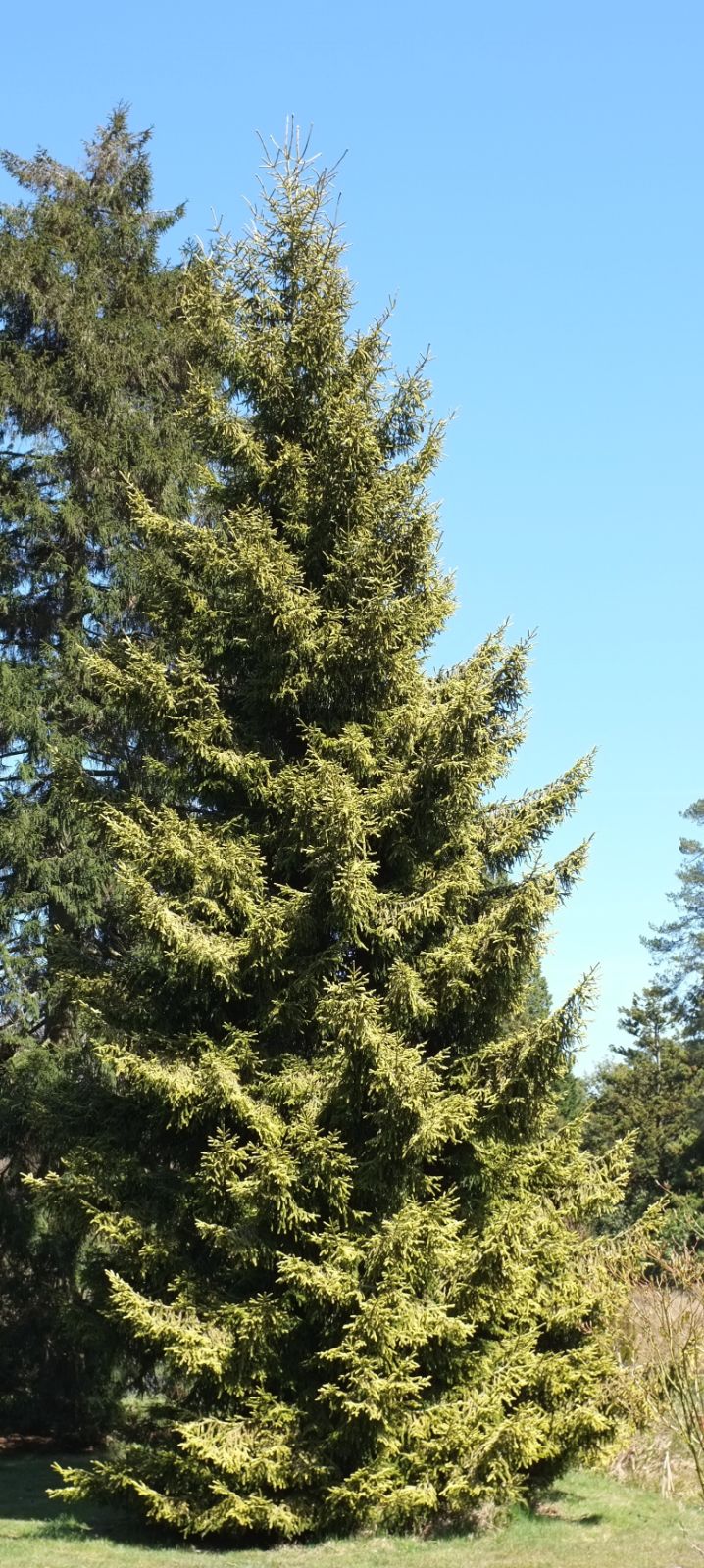
The only Picea orientalis cultivar discussed by W.J. Bean (Bean 1976), this is perhaps still the most familiar. It seems to be a relatively common aberrance in this genus for occasional seedlings to produce yellow extension growth in the spring; cultivars have been selected for this trait in P. abies, P. mariana, P. omorika and P. pungens, to give just four examples, but it is perhaps P. orientalis ‘Aurea’ that stands as the poster child for all such spruces.
There are several reasons for this: like its parent, P. orientalis ‘Aurea’ is both handsome and vigorous, though ultimately not such a large-growing tree and still suitable for most gardens; it is adaptable, being un-fussy with regard to soil type and successfully cultivated across a rather broad range of temperate climates; the fresh golden-yellow growth in spring contrasts arrestingly with the older foliage, but this has the decency to quickly mature green and is typically dark green by the following winter, giving several seasons of interest; finally, it is easy to propagate and quick to grow on, making it popular with nurseries.
‘Aurea’ was raised in Germany before 1873, probably entering commerce soon afterward, and was awarded a First Class Certificate by the RHS in 1893 (Edwards & Marshall 2019). Some of the largest in the UK include the champion for girth at Vernon Holme, Kent (perhaps the same tree referred to by Bean, perhaps not) planted 1906 and 21 m tall × 63 cm dbh in 2017. This tree is also a joint champion for height, sharing that crown with a tree at Thorp Perrow, North Yorkshire, 21 m × 54 cm dbh in 2021 (Tree Register 2025).
Over the years several authors have stated or implied ‘Aurea’ and ‘Aureospicata’ are one and the same (e.g. Bean 1976; Dirr 2009) while others treat them as distinct. Auders & Spicer (2012) state that ‘Aureospicata’ is distinct but fail to list any distinguishing details; it was first recoreded – also in Germany – by Beissner (1909). The Tree Register of Britain and Ireland lists both cultivars, but only on the basis of two plants labelled ‘Aureospicata’ growing in Windsor Great Park. The American Conifer Society database states that ”Aureospicata’ has foliage that fully darkens to deep green while ‘Aurea’ will retain a yellowish glow through the summer’ (American Conifer Society 2025) but the intensity of yellow, and the speed with which this matures to dark green, are likely to be affected by local conditions including light intensity. Despite their distinct origins, the very subtle physical difference means that these two cultivars are now thoroughly mixed up in collections and nurseries, nevertheless we will retain separate entires for the time being.
Largely indistinguishable from ‘Aurea’, the two cultivars nevertheless have distinct origins (albeit both in Germany – Beissner 1909; Auders & Spicer 2012). The difference is apparently the rate at which the vivid yellow spring growth fades to the dark green colour typical of the species: ‘Aureospicata’ fades quickly, while ‘Aurea’ fades slowly, passing through a longer-lasting greenish-yellow phase in the summer (American Conifer Society 2025). Both clones are now hopelessly muddled in gardens and the nursery trade, with the shorter more user-friendly ‘Aurea’ being the more commonly encountered name, but not necessarily the more commonly encountered tree. See ‘Aurea’, above, for further commentary.
A tree fairly typical of the species, but of somewhat reduced vigour (to 2.5 m tall in ten years) and with distinctly pendulous second order branches and branchlets. Listed by the Hillier Nurseries, UK in 1972 (Auders & Spicer 2012). A tree in the Sir Harold Hillier Gardens (Hampshire, UK) probably planted at about this time was 15.8 m tall × 56 cm dbh in 2022; another, planted at Bedgebury National Pinetum (Kent, UK) in 2008 was 8 m × 13 cm dbh in 2024 (Tree Register 2025).
Here we list a curated selection of cultivars that remain less than 1 m tall and broad ten years from planting. For further introductory remarks on cultivars see the notes at the end of the genus article. In the case of Picea orientalis, dwarf cultivars derived from witches’ brooms usually have small dark green leaves typical of the species and a nest-like habit when young, forming dense, compact plants growing wider than tall; after some years most selections develop a leader and grow into small, squat cones, a few ultimately revert. Some of the oldest selections of this type became so alike with age, and so muddled in nurseries and collections, that their names long since ceased to carry any meaning and we do not discuss the now-indistinguishable ‘Compacta’, ‘Gracilis’ and ‘Nana’ (Auders & Spicer 2012). Among the dwarf cultivars treated here the most distinctive are those that depart from this formula, such as those five with seasonal or year-round yellow foliage (e.g. ‘Daureas’) or those that differ in habit (e.g. the mat-forming ‘Ferny Creek Prostrate’) although this might actually be a P. abies cultivar. It is surprising how often these two amply distinct species are confused, and unfortunately this confusion has been compounded by the distribution of erronously attributed cultivars.
A dwarf of typical bird nest habit, to 0.7 m tall and slightly wider in ten years, eventually developing a leader and becoming a small, squat, upright plant. The new growth is brighter than is typical, approaching yellowish-green (but not yellow). Raised c. 1970 by Layne Ziegenfuss and Greg Williams in the United States (Auders & Spicer 2012).
Very like ‘Barnes’ but leaves, including young spring growth, a much darker green. Raised by F.W. Bergman of Pennsylvania in 1980 (Auders & Spicer 2012).
A plant fitting the standard formula for Picea orientalis dwarfs, presumably found along the eponymous highway in the northeast United States by Cliff Stone who sent a plant to the Poly Hill Arboretum in 1969 (Auders & Spicer 2012). It remains in commerce.
Essentially a miniature version of ‘Aurea’, of very slow growth with yellow extension growth in the spring that fades to typical dark green. To 70 cm tall in ten years. Origin unknown, but offered by the Stanley & Sons nursery of Oregon as recently as 2009 (Auders & Spicer 2012).
An extremely small, slow-growing, tight and compact miniature globe suitable for troughs and other containers. Put into commerce before 1965 by the Dutch firm H. den Ouden & Son (Auders & Spicer 2012).
A mat-forming plant selected in Australia before 1999 and reportedly reaching 20 cm tall and 70 cm across in ten years, and inclined to mound in later years (Auders & Spicer 2012). However, images in the RHS Encyclopaedia of Conifers (Auders & Spicer 2012, p. 709) and online (e.g. American Conifer Society, accessed 04/07/25) suggest this cultivar belongs to Picea abies and not P. orientalis, but no living plants have been seen in research for this account on Trees and Shrubs Online. The misidentification of parent species is common among devotees of conifer cultivars.
A name reported by Auders & Spicer (2012) for a mat-forming plant listed by the Oregon firm Bucholz & Bucholz in 2009, but curiously untraceable by internet searches in 2025 (pers. obs.).
A plant forming a broad, squat mound rather than a mat as its name might suggest. Slow-growing, it can reach 30 cm tall and 60 cm across in ten years. The new spring growth is a soft golden-yellow, fading to dark green by the onset of the following winter. Presumably raised in the United States and offered by Bucholz & Bucholz of Oregon in 2009 (Auders & Spicer 2012).
A small, almost globose plant when young, gradually becoming an elegantly proportioned cone to 1 m tall and 60 cm across at the base in ten years (just fitting the definition of dwarf used here). The overall habit appears rather loose, and even the leaves are (relatively) sparsely set on the young shoots. Of uncertain origin, but in North American commerce since at least 2009 (Auders & Spicer 2012).
Adhering to the general formula for Picea orientalis dwarfs, ‘Mount Vernon’ slowly (2–5 cm per year) forms a squat plant wider than tall, and after many years becomes a small, squat, conical tree (Auders & Spicer 2012). It is recommended for troughs and other containers, rock gardens and so forth (Iseli Nursery 2025). Introduced to commerce by Wells Nursery of Washington State in 1972 and now widely available. The meaning behind the name ‘Mount Vernon’ is not recorded, but it is logical to imagine the parent tree once grew there.
Synonyms / alternative names
Picea orientalis 'Reynolds No. 1'
Picea orientalis 'M3 Witches' Broom No. 1'
A witches’ broom forming a globose plant, the young growth very pale, almost yellowish-green, quickly fading to dark green through the growing season. Found by the side of the UK’s M3 motorway by Bernard Reynolds in the 1970s. He originally named it ‘Murphy’ for Mike Murphy, but that cultivar name had also been used under P. abies and cultivar names may not be duplicated in a genus. Another witches’ broom, selected from the same place at the same time by the same person, has been named ‘Reynolds’, and it seems that the two are now much confused, with some assuming that P. orientalis ‘Murphy’ was renamed ‘Reynolds’ but they are two distinct clones. ‘Reynolds’ appears not to have such pale yellowish-green spring growth (Auders & Spicer 2012).
Synonyms / alternative names
Picea orientalis 'M3 Witches' Broom No. 2'
Picea orientalis 'Reynolds No. 2'
See P. orientalis ‘Murphy’.
A selection ascribing to the standard formula for Picea orientalis dwarfs, slow-growing, initially wider than tall, later forming a small, squat, conical tree. Foliage typical. To 50 cm tall and 70 cm across in ten years. Selected by Don Shadow in the United States in 1984 (Auders & Spicer 2012).
Synonyms / alternative names
Picea orientalis 'Sulphur Flush'
An unusual selection with silvery new growth in spring, fading to green over the summer months but retaining some silver leaves and others speckled silver over the summer months, turning mostly green over the following winter. Susceptible to scorch in very strong sun. Probably selected in Europe, offered in the Netherlands from before 1990 (Auders & Spicer 2012). This cultivar fits our definition of dwarf by remaining less than 1 m tall and broad after ten years, but ultimately its growth will accelerate and it will attain the proportions of a small tree.
A slow-growing compact dwarf with paler green leaves than typical, but otherwise resembling so many others. Origin unconfirmed but suspected to be the eponymous arboretum in Ohio (Auders & Spicer 2012).
Synonyms / alternative names
Picea orientalis 'Tom Thumb'
A tiny globose plant of extremely slow growth (to just 10 cm tall and 25 cm across in ten years) the young growth in spring golden-yellow, later darkening through the growing season. Found before 1990 as a mutation on a plant of ‘Skylands’ growing in New York State (Auders & Spicer 2012).
Synonyms / alternative names
Picea orientalis 'Pygmaea'
Foliage with a yellow sheen, but otherwise resembling so many other dwarf selections. Received from R.S. Corley by the Wansdyke Nursery, UK, before 1979 (Auders & Spicer 2012). An old plant in Bedgebury National Pinetum (Kent, UK) had reached 12.8 m tall × 30 cm dbh by 2024, demonstrating either that this clone does not remain dwarf for very long, or else is prone to reversion (Tree Register 2025; O. Johnson pers. comm. 2025).
A dwarf plant with weeping side branches received at the Sir Harold Hillier Gardens from an unknown Dutch nursery in 1965 (Auders & Spicer 2012).
A handsome, slow-growing conical plant with golden-yellow extension growth in spring, the upper leaf surfaces retaining some yellow colouration into the following year. Up to 70 cm tall in ten years, but ultimately larger; an old tree in the Heather Garden (part of the Valley Gardens in Windsor Great Park, UK) was 8 m tall in 2021 (Auders & Spicer 2012; Tree Register 2025). Raised before 1979 at the K. Wittboldt-Müller nursery in Germany (Auders & Spicer 2012). In many respects it has been superseded by ‘Firefly’ (q.v.) but that selection is faster growing.
A mutation on ‘Aurea’ selected for coming into growth two weeks earlier than that cultivar (hence the name) and for retaining the yellow foliage colour for longer. It was selected and distributed by Konijn in the Netherlands before 1972, when it began to appear in catalogues (Auders & Spicer 2012). A tree planted at the UK’s Yorkshire Arboretum in 1981 had reached 8 m × 20 cm dbh by 2023, suggesting quite a modest growth rate, although it might be faster on better soil.
Synonyms / alternative names
Picea orientalis 'Skylands Seedling' (?)
A seedling of the much faster ‘Skylands’ raised and selected at the Iseli Nursery, Oregon, entering commerce in the 2000s. This is possibly the same plant listed in the RHS Encyclopaedia of Conifers (Auders & Spicer 2012) under the name ‘Skylands Seedling’, but those authors report that plant grows to just 75 cm tall in ten years, whereas the Iseli Nursery states 1.8 m or more for ‘Firefly’. Like ‘Skyland’ the habit is conical, but in ‘Firefly’ the growth is denser and the young foliage a brighter yellow, but like its parent ‘Firefly’ retains a golden colouration through the winter months (Iseli Nursery 2025).
Initially a tree of moderate vigour, reaching 2.5 m in ten years, but then slowing right down. An example at the Sir Harold Hillier Gardens (Hampshire, UK) planted in 1989 was 10.7 m tall × 27 cm dbh in 2017 (Tree Register 2025). Believed to have been raised in the United States before 1961 (Auders & Spicer 2012). An example at the Arnold Arboretum, Boston, is beside a plant of ‘Atrovirens’ which appears almost identical (pers. obs.).
An upright, weeping plant with widely and irregularly spaced branches, varying in length and the degree to which they themselves are branched. To 2.5 m tall in ten years but may require staking to establish. Raised before 1905 in what is now Timişoara, Romania (Auders & Spicer 2012). The largest known from the UK is a tree planted in 1981 and by 2022 approaching 14 m tall at the Sir Harold Hillier Gardens, Hampshire (Tree Register 2025).
A troublesome name that has been applied to several variably pendulous clones over the years. Pendulous clones worth growing now tend to be individually named (e.g. ‘Doverside Pendula’) and the name ‘Pendula’ should probably be consigned to history.
A plant presumably distributed from the Raraflora Nursery in Pennsylvania, forming a much broader, squatter looking tree than the species. It might be re-naming of ‘Raraflora Monstrosa’ which would have been an illegitimate name on the grounds of containing the Latin word monstrosa (Auders & Spicer 2012).
Like several other Picea selections given the name ‘Virgata’, this is a curious plant with snake-like growth, though perhaps not so striking as e.g. P. abies ‘Virgata’. Recorded from a park in Aachen, Germany, in 1910 (Auders & Spicer 2012).
Synonyms / alternative names
Picea orientalis 'Aurea Compacta'
A vigorous plant with bright yellow spring growth like in ‘Aurea’, but retaining a good yellow foliage colour through the growing season and following winter, the leaves only turning darker green in their second or third year. It was selected as a seedling in Skylands, part of Ringwood State Park in New Jersey, about 1950 (Auders & Spicer 2012). It is potentially more vigorous than ‘Aurea’; Auders & Spicer suggest 3 m after ten years (cf. 2.5 m after ten years for ‘Aurea’) and the largest specimens in the UK also attest to increased vigour. The largest of all is one of several trees planted at Bedgebury National Pinetum, Kent in 1986; by 2024 it stood 16.8 m tall with a dbh of 45 cm (Tree Register 2025). To those who like golden conifers this is an improvement on ‘Aurea’, but others would still favour ‘Aurea’ for providing greater year-round interest by way of its annual transition from yellow to mid green to dark green. Dirr (2009) notes that, like several other yellow cultivars, ‘Skylands’ may scorch in particularly intense sun and that the leaves may fade in warmer parts of our North American area; he suggests it is at its best in cooler climates.
A relatively slow-growing tree (2 m tall in ten years) with the young growth creamy-white rather than the more common yellow of so many other cultivars. This growth fades to mid green by the end of the growing season. Listed by the Oregon firm Stanley & Sons in 2009 (Auders & Spicer 2012).
A particularly narrow tree forming a dense column to 3.5 m tall and 1.2 m across after ten years, selected at the Ernie Van Speybrock nursery in Oregon (Auders & Spicer 2012). Similarly proportioned trees will occur among batches of seed-raised plants (pers. obs.).