Picea obovata Ledeb.

TSO logo

Sponsor

Kindly sponsored by
Sir Henry Angest

Credits

Tom Christian (2025)

Recommended citation
Christian, T. (2025), 'Picea obovata' from the website Trees and Shrubs Online (treesandshrubsonline.org/articles/picea/picea-obovata/). Accessed 2026-02-12.

Family

  • Pinaceae

Genus

Common Names

  • Siberian Spruce
  • Jel Sibirskaya
  • Sibirj Gatsuur
  • 西伯利亚云杉 (xian bei yun shan)

Synonyms

  • Picea abies var. obovata (Ledeb.) Lindq.
  • Picea abies subsp. obovata (Ledeb.) Hultén
  • Picea excelsa var. obovata (Ledeb.) A.Blytt
  • Picea excelsa var. obovata (Ledeb.) Ahlfv.
  • Picea obovata var. argentea Luchnik
  • Picea obovata var. brevifolia Luchnik
  • Picea obovata var. coerulea Malyschev
  • Picea obovata var. densifolia Luchnik
  • Picea obovata var. krylovii Luchnik
  • Picea obovata subsp. krylovii (Luchnik) Silba
  • Picea obovata var. lucifera Luchnik
  • Picea obovata var. lutescens Luchnik
  • Picea obovata var. pendula Luchnik
  • Picea obovata subsp. petschorica Govor.
  • Picea obovata var. seminskiensis Luchnik
  • Picea obovata var. tschiketamanica Luchnik
  • Picea obovata subsp. tschiketamanica (Luchnik) Silba
  • Picea vulgaris var. altaica Tepl.
  • Picea wolossowiczii Sukaczev

Glossary

bifid
Divided up to halfway into two parts.
dbh
Diameter (of trunk) at breast height. Breast height is defined as 4.5 feet (1.37 m) above the ground.
glabrous
Lacking hairs smooth. glabrescent Becoming hairless.
glandular
Bearing glands.
included
(botanical) Contained within another part or organ.
introgression
Incorporation of genes from one species into the genotype of another through repeated hybridisation or repetitive backcrossing between a hybrid and one of its parents.
subspecies
(subsp.) Taxonomic rank for a group of organisms showing the principal characters of a species but with significant definable morphological differentiation. A subspecies occurs in populations that can occupy a distinct geographical range or habitat.

Credits

Tom Christian (2025)

Recommended citation
Christian, T. (2025), 'Picea obovata' from the website Trees and Shrubs Online (treesandshrubsonline.org/articles/picea/picea-obovata/). Accessed 2026-02-12.

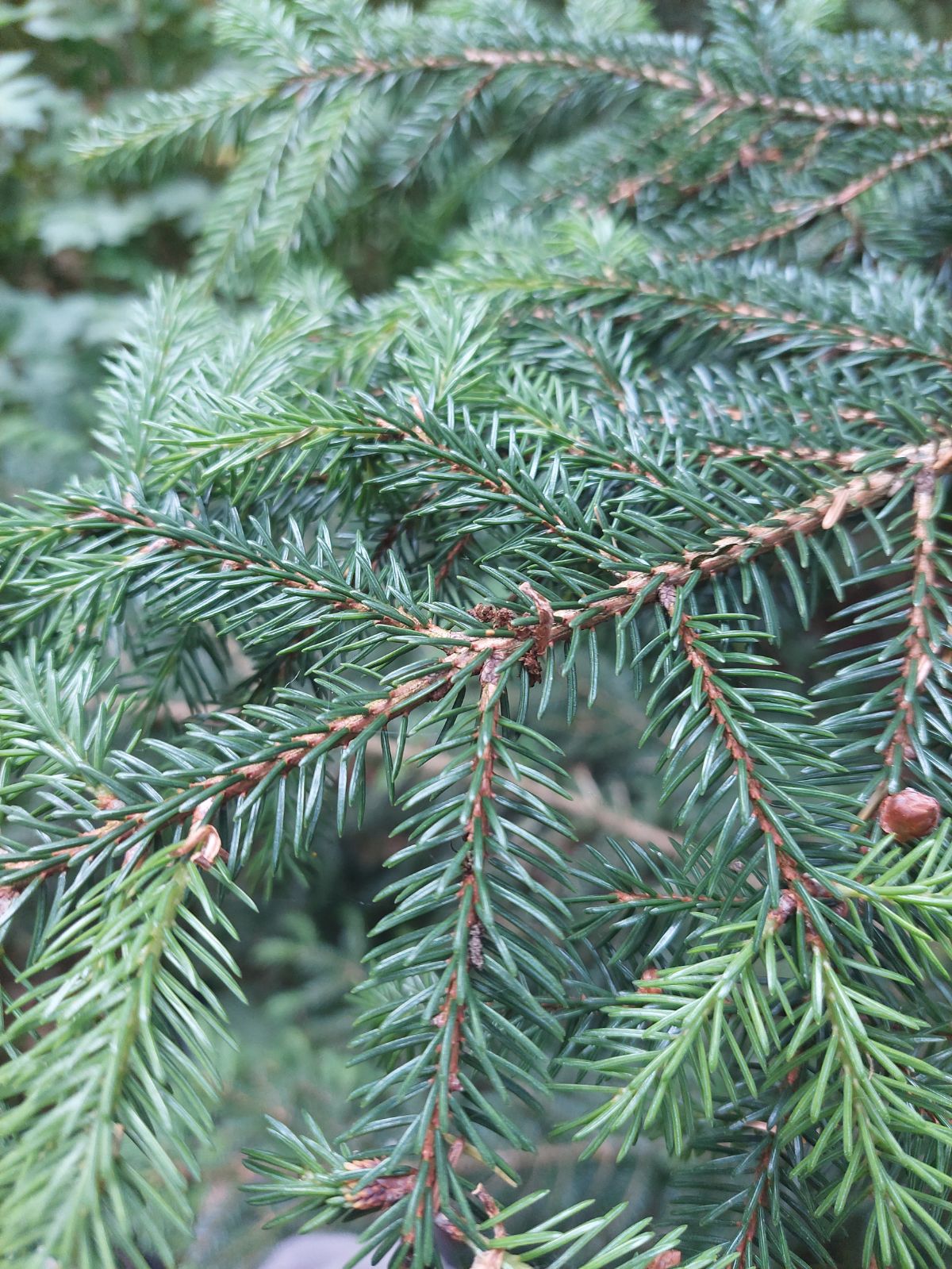
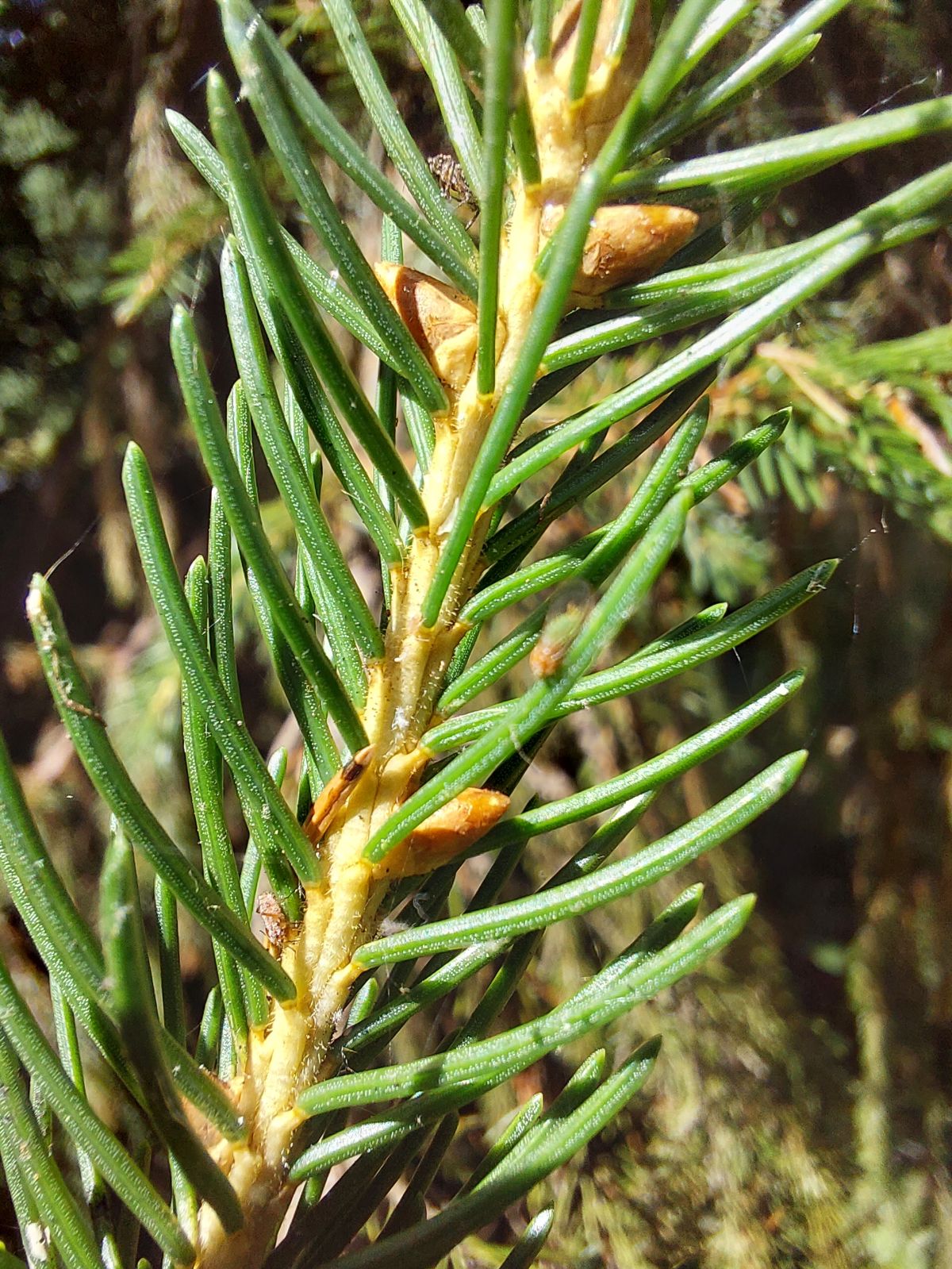
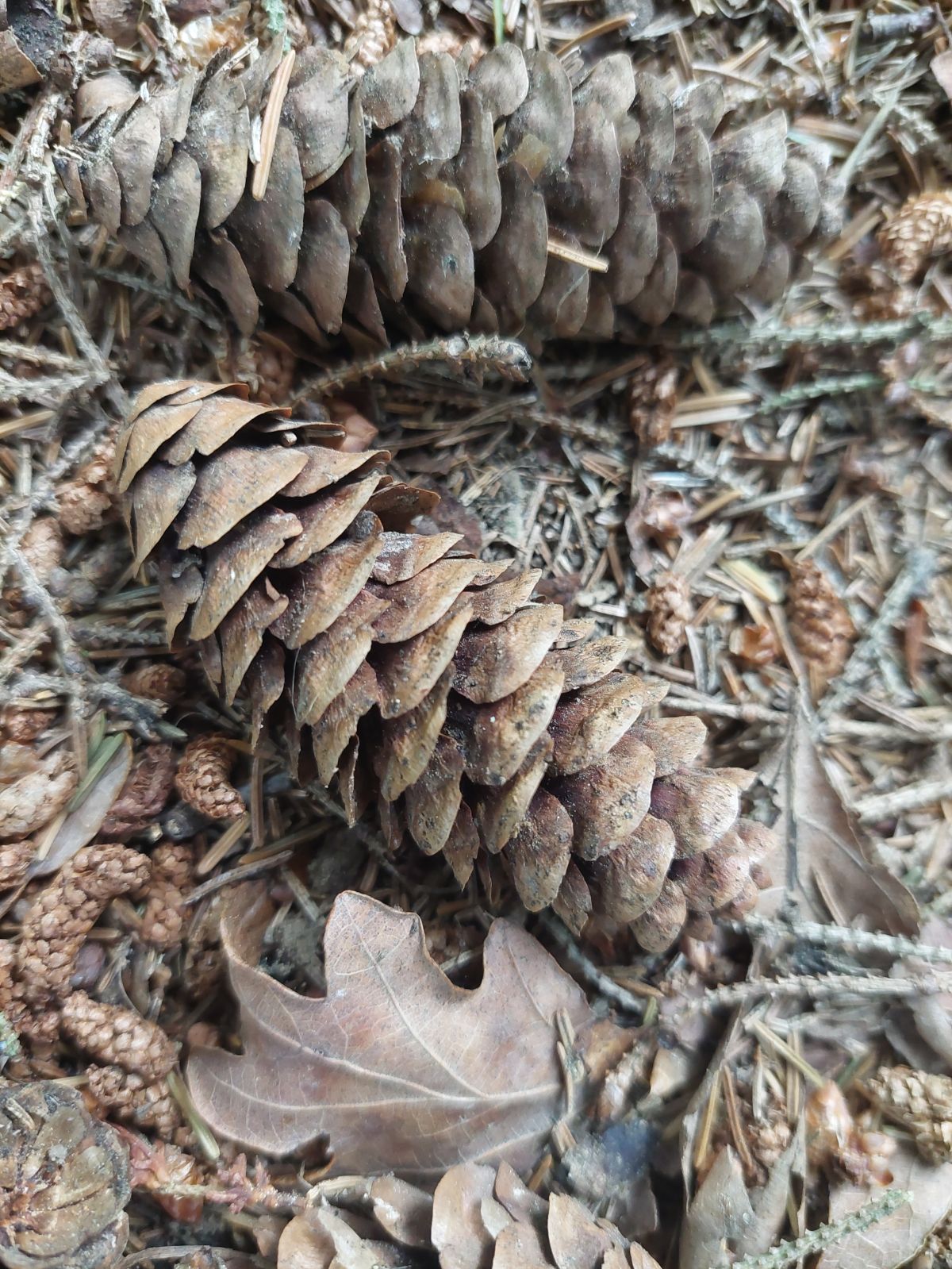
Tree 35–40 m tall, to <1 dbh. Bark of young trees yellowish- to reddish-brown, soon turning grey-brown then grey, breaking into irregular thin plates, detaching in old trees to reveal yellowish or reddish brown bark beneath, which soon greys. Crown conical, often narrowly so. First order branches slender, spreading horizontally or bowed downward, assurgent at tips; second order branches variable, assurgent to pendent. First year branchlets pale yellowish-white to off-white, with an initial dense covering of glandular hairs, turning yellowish-brown and more weakly pubescent in their second year, finally grey. Vegetative buds ovoid-conical, 4–5 × 3–4 mm, not or slightly resinous; bud scales triangular, obtuse, pale reddish- or orange-brown, persisting for several years. Leaves directed forward particularly above shoot, parted below, 8–25 × 1–1.8 mm, base truncate, linear, straight or curved, apex acute, quadrangular in cross section with 2–4 dotted lines of stomata on all surfaces, sometimes barely perceptible except with a lens; leaf colour lustrous dark green above, lower surfaces slightly paler. Pollen cones 1–1.5 cm long. Seed cones narrow cylindrical, rarely ovoid-oblong, sessile, (4–)5–8(–11) cm long at maturity, green or purplish at first, ripening to brown to dark brown. Seed scales obovate-oblong to flabellate, 1.5–2.5 × 1–2 cm at midcone, smooth, glabrous; upper margin rounded, entire; base cuneate. Bract scales ligulate, 2–3 mm long, entirely included. Seeds ovoid-oblong, 2–4 mm long, dark brown, occasionally blackish, with a papery ovate-oblong or cuneate wings (6–)10–15 mm long, pale brown. (Farjon 2017; Debreczy & Rácz 2011; Tutin et al. 1964).

Distribution  China Altai Finland ? far north Kazakhstan Altai Mongolia Altai Russia from European Russia east to the Sea of Okhotsk in far eastern Russia

Habitat Forming forests across a vast swathe of northern Eurasia, including taiga vegetation, in mountains, hills and river basins. Across most of its range it occurs from near sea level to <1800 m asl; at its southern limit in the Altai mountains of central Asia it extends to 2400 m asl. Common associates include other classic taiga species, including Abies sibirica, Alnus hirsuta, Betula nana, Larix sibirca, Pinus sibirica, Pinus sylvestris, Populus tremula and Salix caprea.

USDA Hardiness Zone 2-5

RHS Hardiness Rating H7

Conservation status Least concern (LC)

Picea obovata is an irksome species to describe and discuss in a work focused on cultivated plants. As a wild plant it has the largest range of any spruce, ranging from the Siberian tree line in the north, south to an isolated outpost in the Altai where the borders of Russia, Mongolia, China and Kazakhstan meet. East to west it stretches from the Sea of Okhotsk in far eastern Russia (though remaining west and south of the Verkhoyansk mountains in eastern Siberia) to its western limit somewhere in northwest European Russia (Arkhangelsk, Karelia and Murmansk regions).

In the west of its range Picea obovata is still frequently treated as a subspecies of P. abies, or else its populations in northern Finland and northwestern-most Russia are considered to represent hybrids between P. obovata and P. abies (viz. P. × fennica (Regel) Kom.). Farjon considers it ‘more than likely’ that multiple hybridisation events have occurred due to ‘the repeated retreat of P. abies into refuges that were situated in European Russia during the ice ages. The two taxa mixed in their subsequent recolonisation[s]’ (Farjon 2017). This supposition has since been substantiated by molecular investigations that suggest P. obovata, recolonising European Russia from refuges in the Urals, used refuges of P. abies as stepping stones, leading to hybridisation (Tsuda et al. 2016). It stands to reason that introductions of ostensible P. obovata to European herbaria and cultivation will have included samples gathered in this region of overlap, which might explain why descriptions of P. obovata in European literature are so woefully inconsistent, and why some descriptions (even Farjon’s in A Handbook of the World’s Conifers (Farjon 2017)) seem to mix and match features of the two.

When sampled from the majority of its range – where it does not overlap with Picea abies P. obovata is ‘very distinctive in its thinner, near-white to yellowish-white branchlets (or on the upper side yellowish-grey) initially densely set with glandular hairs (vs. branchlets reddish-brown and glabrous or with nonglandular hairs); needles light green (vs. dark green), typically shorter […] and thinner […]; and much smaller cones (5–11 cm vs. 10–15<18.5 cm) with rounded scale-tips (vs. tapering to rounded, bifid to blunt)’ (Debreczy & Rácz 2011). At least in the UK, trees adhering to this description are few and far between, and an open mind is as useful an aid to identification as a textbook. The most useful ‘tell’ is a combination of the oft-cited character of very pale, nearly white shoots, and the leaves swept forward and downward below the plane of the shoot, an arrangement only otherwise encountered in P. morrisonicola from Taiwan.

Only very few individuals of Picea obovata have ever been recorded from the UK and Ireland, where the prevailing oceanic climate is a world away from the strongly continental one of northern Eurasia. The Tree Register’s public-facing database lists only twenty, with notes against several of them hinting at varying degrees of confidence in the identifications (Tree Register 2024). It is perhaps no coincidence that some of the trees that have been longest-known, and which today are among the finest examples, grow in some of the coldest parts of the country, particularly inland Aberdeenshire in northeast Scotland and at Dawyck Botanic Garden in the Scottish Borders, both regions where the climate perhaps gets as close to continental as anywhere in these islands, and where trees from 20–25 m have been recorded.

It is perhaps a better prospect in a continental climate, such as the Arnold Arboretum where several accessions are recorded: 354–79 from the Russian Altai is surely genuine and two good trees are recorded, the largest to 21 cm dbh; five other accessions include one of unknown origin and four from northern Finland, from where the potential for introgression with Picea abies must be kept in mind (Arnold Arboretum 2024). Nevertheless, even in areas where it can be grown successfully it cannot be said that P. obovata is particularly ornamental, and on the rare occasions it is cultivated its chief interest seems to be botanical curiosity. A handful of cultivars are known, mostly selected for the intensity of glaucousness in the leaves, of which the best is probably ‘Krylovii’.


'Aurea'

A small tree of modest growth, to 2 m tall in ten years. During the growing season the foliage is somewhat glaucous, turning golden-yellow only in the cold winter months. Probably selected in Russia but details are lacking (Auders & Spicer 2012).


'Koliba'

A diminutive bun derived from a witches’ broom, but its ultimate origin is unclear (Auders & Spicer 2012).


'Krylovii'

A reasonably vigorous selection from Russia before 1990, forming an elegant tree that can achieve 3 m height in ten years. It is a relatively sparsely branched and thus open tree with ‘intense blue foliage’ (Auders & Spicer 2012).


'Pendula'

A weeping form selected in Russia with relatively long leaves, those on the first year shoots rather markedly glaucous but turning grey-green on older wood. It may require staking to form a leader but can attain 3 m in ten years (Auders & Spicer 2012).


'Seminsjaka'

A plant with intensely blue leaves but otherwise typical of the species, reaching 3 m tall in ten years. Selected in Russia prior to 1990 (Auders & Spicer 2012).


'Snake Auders'

Selected from a seed bed in Latvia by the late Aris Auders, this cultivar is notable for the vividly glaucous foliage which emerges violet, turning blue after about six weeks. Reasonably vigorous, to 3 m in ten years (Auders & Spicer 2012).