Picea brachytyla (Franch.) Pritz.

TSO logo

Sponsor

Kindly sponsored by
Sir Henry Angest

Credits

Tom Christian (2025)

Recommended citation
Christian, T. (2025), 'Picea brachytyla' from the website Trees and Shrubs Online (treesandshrubsonline.org/articles/picea/picea-brachytyla/). Accessed 2026-04-21.

Family

  • Pinaceae

Genus

Common Names

  • Sargent Spruce
  • 麦吊云杉 (mai diao shan)
  • 原变种 (yuan bian zhong)
  • 油麦吊云杉 (you mai diao shan)

Synonyms

  • Picea ajanensis Mast.
  • Picea ascendens Patschke
  • Picea alcoquiana Mast. (non Carrière)
  • Picea brachytyla var. complanata (Mast.) W.C.Cheng ex Rehder
  • Picea brachytyla var. latisquamea Stapf
  • Picea brachytyla f. rhombisquamea Stapf
  • Picea complanata Mast.
  • Picea pachyclada Patschke
  • Picea sargentiana Rehder & E.H.Wilson

Glossary

Tibet
Traditional English name for the formerly independent state known to its people as Bod now the Tibet (Xizang) Autonomous Region of the People’s Republic of China. The name Xizang is used in lists of Chinese provinces.
dbh
Diameter (of trunk) at breast height. Breast height is defined as 4.5 feet (1.37 m) above the ground.
glandular
Bearing glands.
glaucous
Grey-blue often from superficial layer of wax (bloom).
monophyletic
(of a group of taxa) With a single ancestor; part of a natural lineage believed to reflect evolutionary relationships accurately (n. monophyly). (Cf. paraphyly polyphyly.)
sensu stricto
(s.s.) In the narrow sense.
synonym
(syn.) (botanical) An alternative or former name for a taxon usually considered to be invalid (often given in brackets). Synonyms arise when a taxon has been described more than once (the prior name usually being the one accepted as correct) or if an article of the International Code of Botanical Nomenclature has been contravened requiring the publishing of a new name. Developments in taxonomic thought may be reflected in an increasing list of synonyms as generic or specific concepts change over time.
taxon
(pl. taxa) Group of organisms sharing the same taxonomic rank (family genus species infraspecific variety).
variety
(var.) Taxonomic rank (varietas) grouping variants of a species with relatively minor differentiation in a few characters but occurring as recognisable populations. Often loosely used for rare minor variants more usefully ranked as forms.

References

Credits

Tom Christian (2025)

Recommended citation
Christian, T. (2025), 'Picea brachytyla' from the website Trees and Shrubs Online (treesandshrubsonline.org/articles/picea/picea-brachytyla/). Accessed 2026-04-21.

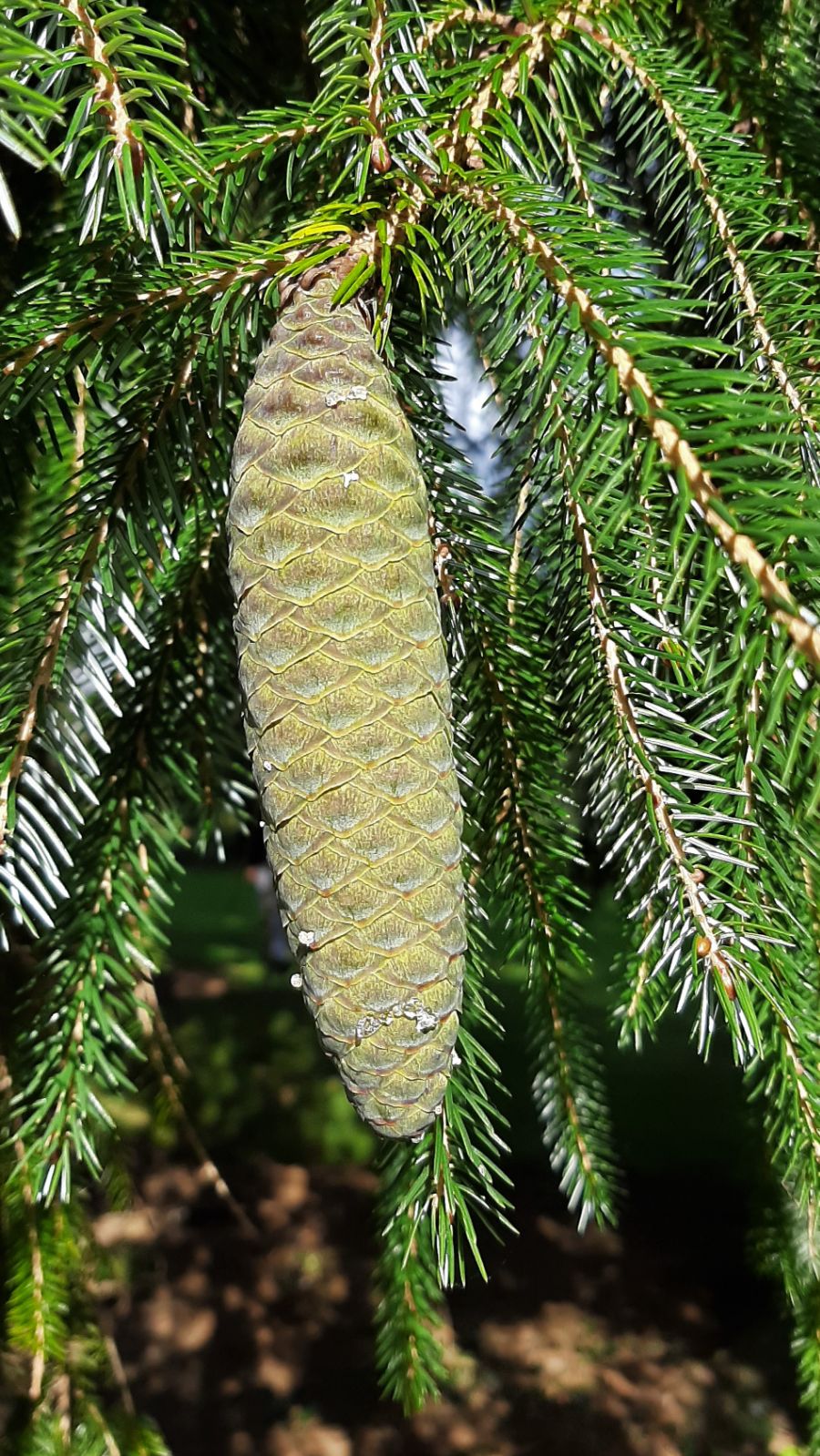
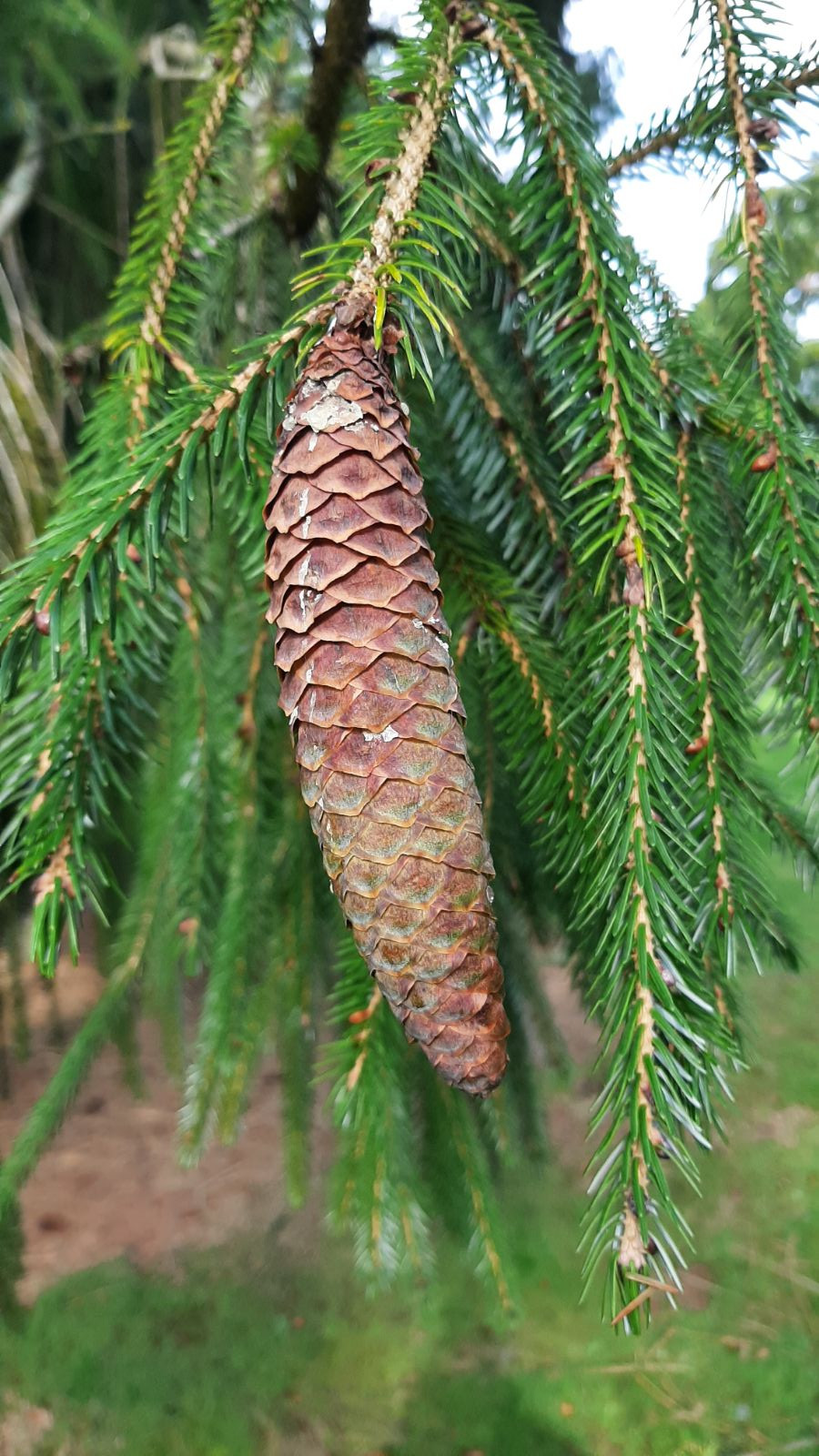
Tree to 40 m tall, to 1.2 m dbh. Bark soon becoming rough, reddish-brown at first, later dark grey and flaking in irregular plates revealing dark reddish-brown bark beneath. Crown broadly conical to pyramidal, narrower in older trees. First order branches long, slender, spreading horizontally or downcurved; second order branches slender, downswept to pendulous. Branchlets slender, flexible (leading shoots stout), creamy-white in the first year, soon light brown to orange-brown, occasionally pruinose, ridged and shallowly grooved, glabrous to minutely pubescent; pulvini small, whitish-yellow, directed forwards. Vegetative buds ovoid conical, on leading shoots 5–8 × 4 6 mm, smaller on lateral shoots, often obscured by leaves, slightly resinous; bud scales closely appressed, tips never free, triangular, chestnut-brown, persisting for several years. Leaves curved forward and downward, leaves at side of shoot depressed below plane of shoot, lower leaves parted, nearly pectinate, somewhat radially spreading on coning shoots, (8–)10–20(–25) × 1–1.5(–2) mm, base truncate, linear, curved, somewhat flattened and keeled on both sides, apex acute or mucronate, stomata on lower side only in two broad bands of many rows, obscuring the midrib, lustrous dark green above, shining white below. Pollen cones 1–2 cm long. Seed cones cylindrical-oblong, tapering to a short peduncle at base, apex obtuse, (5–)6–10(–15) × 3–4(–5) cm, green or purplish-green at first, ripening to dark brown, often slightly purplish until fully ripe. Seed scales angular obovate to nearly rhombic, thin, rigid, 1.6–2(–2.5) × 1–1.4(–1.8) cm at midcone, upper surface striated or wrinkled, glabrous, upper margin variable, usually recurved, apex emarginate or erose, base cuneate. Bract scales ligulate, 2–3 mm, entirely included. Seeds ovoid-oblong, 3 × 2 mm, light brown; seed wings ovate-oblong, 10–14× 5–7 mm, orange-brown. (Farjon 2017; Fu, Li & Mill 1999; Sargent 1916).

Distribution  China S Gansu, NW Hubei, S Shaanxi, N&E Sichuan

Habitat Montane conifer forests c. 1300–2800 m asl, typically on podzol soils. Common associates include Abies chensiensis and A. fargesii. Around Gongga Shan, Sichuan, Picea brachytyla forms forests with Tsuga chinensis (replaced by Abies fabri at higher elevations); common broadleaf associates here include Acer caudatum, Betula utilis, Sorbus spp..

USDA Hardiness Zone 7

RHS Hardiness Rating H6

Conservation status Vulnerable (VU)

Taxonomic note Since the mid-20th century most major works (e.g. Dallimore & Jackson 1966; Bean 1976; Krüssmann 1985; Farjon 1990, 2001, 2017; Fu, Li & Mill 1999; Debreczy & Rácz 2011) have recognised a variety, Picea brachytyla var. complanata (Mast.) W.C.Cheng ex Rehder. Following several phylogenetic studies there is now sufficient evidence to say that this taxon does not merit distinction and it is lumped with the type. Spruce populations with a discreet distribution in NW Yunnan, and possibly adjacent parts of SE Tibet and SW Sichuan, previously referred to var. complanata, do not belong to this species. Further work is needed to resolve their position. Most major texts conflate the NW Yunnan populations with P. brachytyla sensu stricto in their discussion of ecology/habitat notes, etc (e.g. Farjon 2017; Debreczy & Rácz 2011; Fu, Li & Mill 1999). See below for further discussion.

Picea brachytyla was described in 1899 from Farges 806, gathered in Kangding in west-central Sichuan, China. It has traditionally been understood to have a discontinuous but wide range in western China, from northwest Hubei through southern Shaanxi, southern Gansu, Sichuan, to northwest Yunnan and extreme southeast Tibet. Variation across this large area has resulted in a number of named forms, but most recent treaments have tended to recognise only a single variety, var. complanata (Mast.) W.C.Cheng ex Rehder, restricted to the western part of the range (e.g. Dallimore & Jackson 1966; Bean 1976; Krüssmann 1985; Farjon 1990; Fu, Li & Mill 1999; Debreczy & Rácz 2011; Farjon 2017).

Phylogenetic studies appear to tell a different story. Recent phylogenies of Picea all agree that the genus includes three major clades, and that Picea brachytyla belongs to a clade containing mostly so-called ‘flat-leaved’ species from Asia (but not including those from Japan); that is to say its nearest relatives include members of the P. likiangensis species group, P. farreri, P. spinulosa, etc. (Ran, Wei & Wang 2006; Lockwood et al. 2013; Shao et al. 2019). What these and other studies have failed to agree on, however, are the details of the relationships between these species. On the other hand, together with more focussed studies such as Ru et al. (2016), Shen, Ran & Wang (2019) and Lyu et al. (2020) they provide evidence that spruce populations in northwest Yunnan and southeast Tibet, hitherto referred to P. brachtyla var. complanata, do not form a monophyletic clade with P. brachtyla.

This is a more intricate problem than it might first appear. The ‘var. complanata’ sampled in these studies are those populations in northwest Yunnan and adjacent regions, but var. complanata was not described from this region; it is simply the name that has been applied to material distributed here. Var. complanata was described – originally at species rank – from Wilson’s collections around Daxiangling, Ya’an Prefecture, central Sichuan (W 3030, 3031) (Sargent 1916). Picea brachtyla was itself first described from this same area of mountains west of the Chengdu Plain, and recent investigations have demonstrated that these populations represent only a single entity (Ru et al. 2016; Lyu et al. 2020). Var. complanata must, therefore, become a synonym of P. brachytyla, rather than a separate species to accommodate western populations. In his essay The Taxads and Conifers of Yunnan, Wilson (1926) seems to suggest that the name P. complanata should be applied to material distributed in western Yunnan, but unfortunately Masters chose Sichuan material for the type when he described P. complanata in 1906, and this concept must stand. Such are the rules of botanical nomenclature.

None of the other names that have been described, and which have since fallen into the synonymy of Picea brachytyla s.l., can be applied to the northwest Yunnan populations either, as they were all founded on collections made in west-central Sichuan: Picea ascendens Patschke (W 3024 from Wenchuan County), P. pachyclada Patschke (W 1896 from west of Xinjin) and P. sargentiana Rehder & E.H.Wilson (W 4048 from Wenchuan County or west of the same) (Sargent 1916). P. sikiangensis, a name of uncertain status and application, was used by Jean Hoch in reference to material from northwest Yunnan with glandular hairs (K. Rushforth pers. comm. 2020); it is treated here as a synonym of P. likiangensis subsp. balfouriana but its status requires further investigation. Neither of the late John Silba’s varieties of P. spinulosa (viz. var. pseudobrachytyla, var. yatungensis) are referable here (Silba 1990). It is regrettable that neither Ru et al. (2016) nor Lyu et al. (2020) sampled populations of P. brachytyla from further north in Gansu, Shaanxi or Hubei, the former study due to prohibitive costs, the latter because they could not locate any populations, which is interesting in itself.

This leaves the identity of the spruce populations in northwest Yunnan, that resemble Picea brachytyla in some respects but which have unequivocally been shown not to belong here, an open question. Lyu et al. (2020), Ru et al. (2016) and Lockwood et al. (2013) each found that these populations nest within the P. likiangensis species group, but could not resolve their exact placement. Lyu et al. (2020) point out that some studies (Shao et al. 2019; Shen, Ran & Wang 2019) have inferred a close relationship with P. farreri and postulate that northwest Yunnan populations ‘might be transferred to P. farreri if they form a monophyletic group’ (Lyu et al. 2020) but further research is needed. During research for this account no living trees were seen that were traceable to this area and that also resembled P. brachytyla. Dickson 13, introduced to the Royal Botanic Garden Edinburgh in 2013 as ‘Picea brachytyla var. complanata’ and widely distributed among sites participating in the International Conifer Conservation Programme under Edinburgh’s accession 20132162, is P. likiangensis (pers. obs.).

Going forward, contemporary workers should apply the name Picea brachytyla only to populations distributed in central and northern Sichuan eastward through southern Gansu, southern Shaanxi and into southern Hubei. Material from this area, or at least from Sichuan, is well represented in cultivation. Wilson collected extensively here, and many of the names listed in synonymy were founded on his collections. His seed collections, gathered on various expeditions, came under W 1282, 1530, 2076, 2078, 2079, 2081, 4048, and 4050 (Sargent 1916).

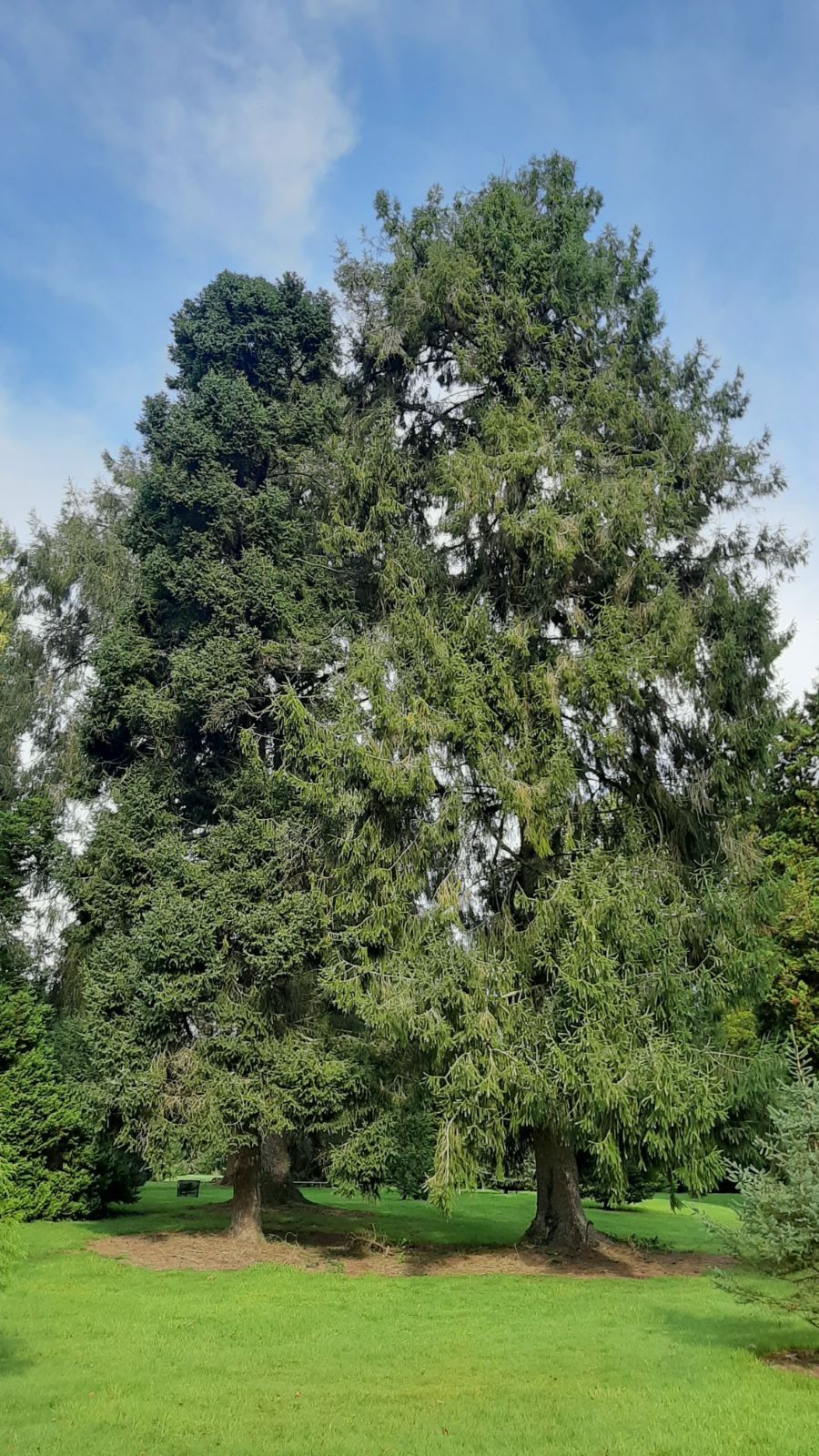
In the UK and Ireland Picea brachytyla would prove well suited to the climate across these islands, but particularly to milder, wetter, western regions where fine trees are now well distributed: 33.5 m tall × 93 cm dbh at Westonbirt, Gloucestershire in 2024, 32 m × 90 cm at Stourhead, Wiltshire in 2021, 29.5 m × 82 cm at Strathallan, Perthshire in 2017, 28 m × 90 cm at Stanage, Powys in 2023, and 27.5 m × 1.06 m at Tregrehan, Cornwall in 2024 (Tree Register 2024). P. brachytyla is curiously rare in North America; no Wilson material survives at the Arnold (Arnold Arboretum 2024) but it is represented there by material raised from Chinese Academy of Forestry seed sent in 1980, the best of which is now 26.8 cm dbh (Arnold Arboretum 2025). The Oregon nursery Bucholz & Bucholz began offering P. brachytyla from 1980 (Jacobson 1996) perhaps from the same sending, which was widely distributed, including via commercial channels. SICH 956 and 1126 were both gathered in Liangshan Yi, Sichuan, and introduced (as var. complanata) to multiple collections.

For W.J. Bean this was among the handsomest of spruces ‘with leaves of an unusually cheerful shade of green, contrasting with the vividly glaucous under­surface’ (Bean 1976). When branches are being buffeted by wind this creates a beautiful two-tone effect, which is also obvious on a still day looking up into the canopy of mature trees from the base. It seems to be a strong grower everywhere, and being late into growth is rarely troubled by late frosts (Bean 1976).