Pherosphaera W.Archer bis

TSO logo

Sponsor this page

For information about how you could sponsor this page, see How You Can Help

Credits

Simon Grant & Tom Christian (2025)

Recommended citation
Grant, S. & Christian, T. (2025), 'Pherosphaera' from the website Trees and Shrubs Online (treesandshrubsonline.org/articles/pherosphaera/). Accessed 2026-04-12.

Family

  • Podocarpaceae

Synonyms

  • Microstrobos J.Garden & L.A.S.Johnson

Glossary

family
A group of genera more closely related to each other than to genera in other families. Names of families are identified by the suffix ‘-aceae’ (e.g. Myrtaceae) with a few traditional exceptions (e.g. Leguminosae).
included
(botanical) Contained within another part or organ.

Credits

Simon Grant & Tom Christian (2025)

Recommended citation
Grant, S. & Christian, T. (2025), 'Pherosphaera' from the website Trees and Shrubs Online (treesandshrubsonline.org/articles/pherosphaera/). Accessed 2026-04-12.

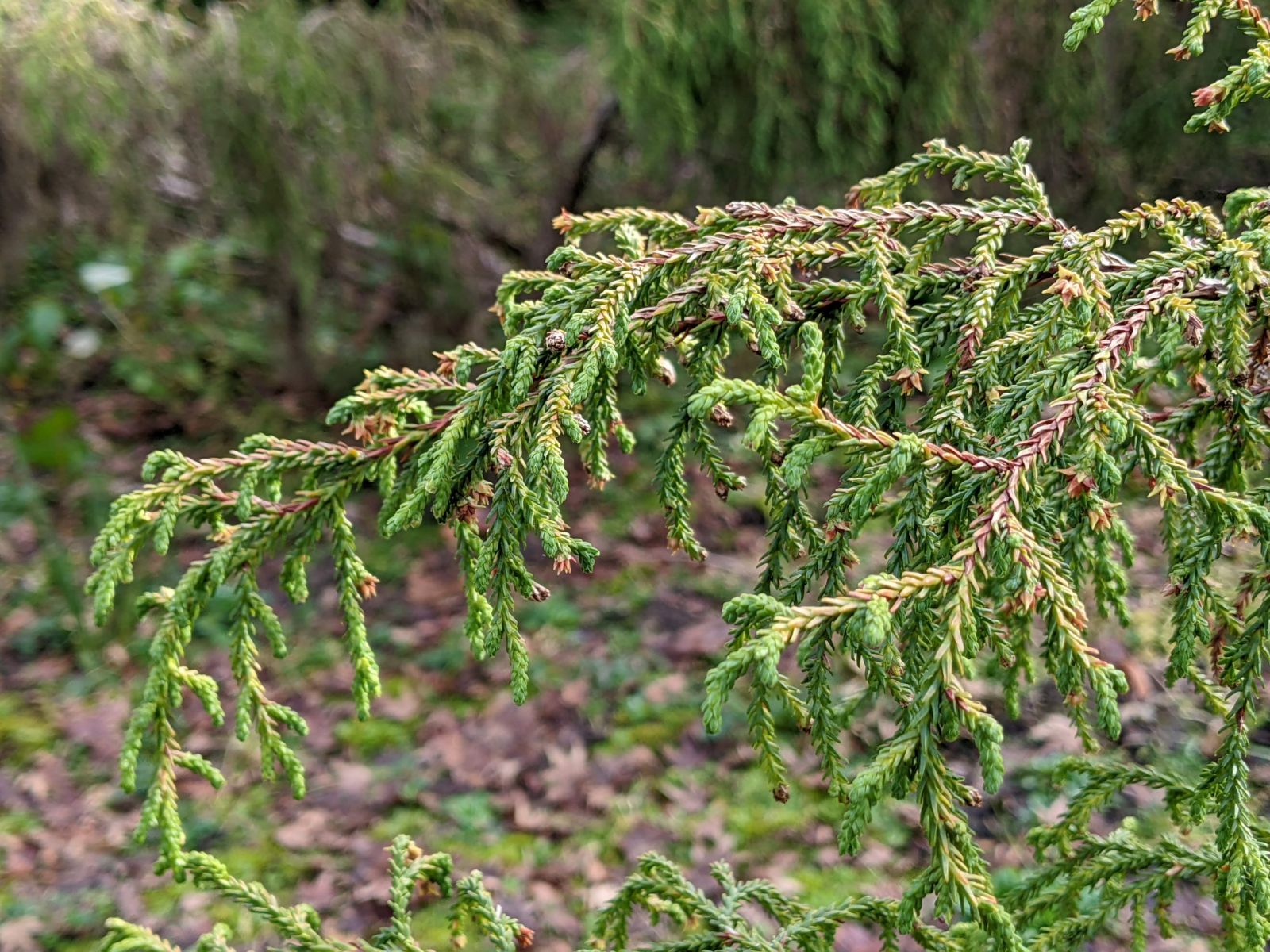
Dioecious, evergreen, coniferous shrubs. Typically to 1.5 m (P. fitzgeraldii) or 2.5 m (P. hookeriana) tall. Branches more or less procumbent to arching or assurgent, nodding to pendulous at their ends. Leaves spirally arranged and mostly scale like, juvenile and adult leaves similar. Seed cones terminal, globular, <6 mm long, with 3–8 scales. Unusually for members of Podocarpaceae, the seed cones and fertile scales are not fleshy at maturity (cf. the closely related Microcachrys has bright red fleshy seed cones at maturity.) The branches of P. fitzgeraldii are drooping to pendulous, the leaves 2–4 × 1 mm in size with the plant rarely over 1 m in height but twice that in width. In contrast P. hookeriana is more erect with assurgent or spreading branches, the plant at times reaching 2.5 m in height. Its leaves are smaller only reaching 2.5 mm × 1 mm in size and scale like but largely free in young plants and even smaller at 1 × 1 mm and closely appressed on thicker wood. (Farjon 2017).

The name Pherosphaera was first used by Tasmanian-born botanist William Archer in 1849 (Archer 1849), referring to the Tasmanian highland species Pherosphaera hookeriana. Archer’s name is derived from the Greek phero (to bear) and sphaira (spheres), a description of the shape of the seed cones. The first specimens were collected from near Lake St Clair in 1847 by R.C. Gunn, an amateur botanist who sent many Tasmanian specimens to William Hooker and who also assisted Joseph Hooker in collecting specimens in 1840–41. P. hookeriana is named after Joseph Hooker (Archer 1849). The discovery of what is now regarded as the second member of the genus, P. fitzgeraldii from New South Wales, would set in motion a series of taxonomic machinations the like of which are infamous in the Podocarpaceae.

Following its discovery in dense, wet forests high in the Blue Mountains, Pherosphaera fitzgeraldii was initially placed in the genus Dacrydium as D. fitzgeraldii, described by von Mueller in his 1878–1881 work Fragmenta Phytographiae Australiae. von Mueller stated at the time that P. hookeriana was similar and could also be included in Dacrydium, which it was a few years later in 1887 (Brummitt, Mill & Farjon 2004). At that time, and until well into the latter half of the 20th century, most Podocarpaceae were being included in either Dacrydium or Podocarpus (see the Podocarpus genus page for an overview of the taxonomic history of this family). Both species remained in Dacrydium until 1951 when J. Garden and L.A.S. Johnson moved them both out as Microstrobos, the Tasmanian species as M. niphophilus (snow-loving) and the Blue Mountain species as M. fitzgeraldii (Garden & Johnson 1951). Their justification for ignoring the earlier name Pherosphaera was their belief that Archer had mistakenly applied it to a female plant of what is now Microcachrys tetragona. Finally, in 2004, Brummitt, Mill & Farjon disagreed with the conclusion that samples had been mixed up between three similar looking species growing together in the Tasmanian highlands (Microcachrys tetragona, Pherosphaera hookeriana and Diselma archeri) and reinstated the genus Pherosphaera and this time included both P. hookeriana and P. fitzgeraldii in it (Brummitt, Mill & Farjon 2004).

Phylogenetic analysis has shown Pherosphaera to be most closely related to Microcachrys; the most striking difference is that in Microcachrys the seed cones are bright red and fleshy at maturity, whereas in Pherosphaera they are more or less spherical and not fleshy. The latter is a particularly unusual occurence in Podocarpaceae.

For all their rarity the limited horticultural experience would seem to suggest that both species of Pherosphaera are reasonably easy to propagate, although P. fitzgeraldii, despite its extraordinarily niche natural habitat, appears to be the more amenable in general cultivation. Certainly in UK gardens, semi-ripe heel cuttings of P. fitzgeraldii treated with rooting hormone and put over bottom heat in a closed-case or under polythene have rooted successfully, albeit slowly, taking about six months to reach a size at which they could be potted on at Cambridge Botanic Garden. A high mortality rate was observed amongst rooted cuttings once they had been individually potted; the reasons for this are unclear but both medium and water pH are suspected (A. Summers pers. comms. 2025). Although seed has been introduced and successfully raised in the past, records of their treatment have not been kept.

Identification key

1aBranchlets drooping to pendulous; leaves free for most of their length, mostly 2–4 mm longP. fitzgeraldii
1bBranchlets spreading, somewhat contorted; leaves appressed (imbricate), mostly to 1 × 1 mmP. hookeriana