
Osmanthus × fortunei
Credits
Article from Bean's Trees and Shrubs Hardy in the British Isles
Recommended citation
'Osmanthus × fortunei' from the website Trees and Shrubs Online (treesandshrubsonline.
Genus
Synonyms
- Olea japonica Sieb., nom. nud.
- Osmanthus aquifolium var. ilicifolius latifolius Hort.
- O. ilicifolius var. latifolius Hort.
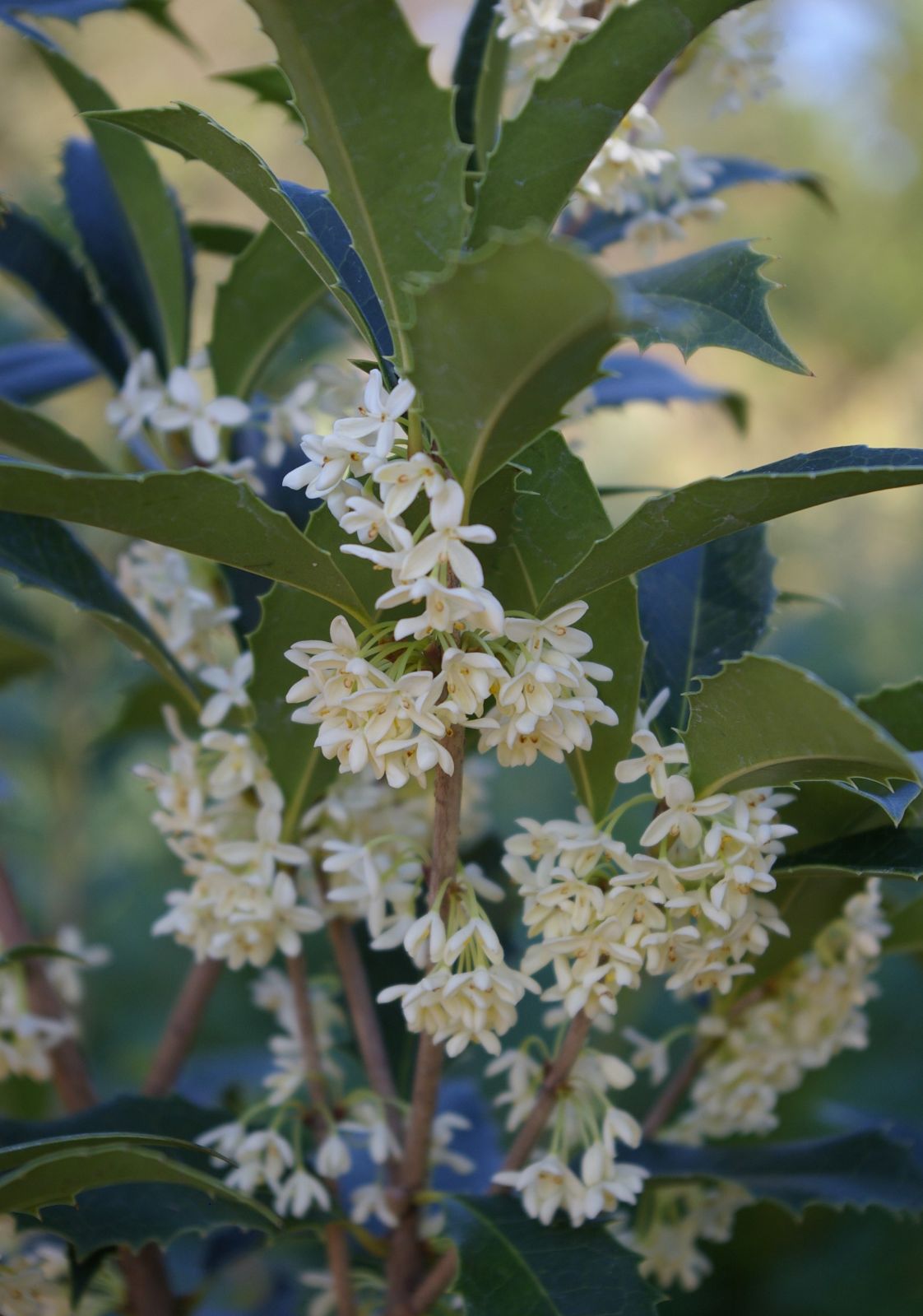
An evergreen shrub of rounded, bushy habit, rarely more than 6 ft high in inland counties, but 15 to 20 ft high in Cornwall, the whole plant devoid of down. Leaves leathery, 21⁄2 to 4 in. long, 11⁄2 to 3 in. wide, oval or slightly ovate, broadly wedge-shaped at the base, taper-pointed and spine-tipped, the margins armed like one of the large broad leaved forms of common holly with up to ten or twelve triangular, spine-tipped teeth on each side, 1⁄6 in. long. Some of the leaves, however, especially those at the base of the twig, are not toothed at all. Flowers about 1⁄3 in. across, white and delightfully fragrant, produced in clusters in the leaf-axils during autumn.
A hybrid of Japanese origin between O. heterophyllus and O. fragrans; introduced by Fortune in 1862. It is apparently known in this country only in the male state. It is quite hardy at Kew, and has only once been seriously injured in my recollection, which was in the great frosts of February 1895, when the temperature fell to nearly zero on three successive nights. It does not flower profusely except in such places as Cornwall. It is easily distinguished from O. heterophyllus by its larger, broader leaves, with more numerous teeth on either margin. For the history of this shrub and the elucidation of its confused naming, see Kew Bulletin, 1911, p. 177.
This hybrid has been re-made in California and the offspring is known under the name ‘San José’. ×
O fragrans Lour.
Synonyms
Olea fragrans Thunb