Myrtus
Credits
Article from Bean's Trees and Shrubs Hardy in the British Isles
Recommended citation
'Myrtus' from the website Trees and Shrubs Online (treesandshrubsonline.
Family
- Myrtaceae
Common Names
- Myrtle
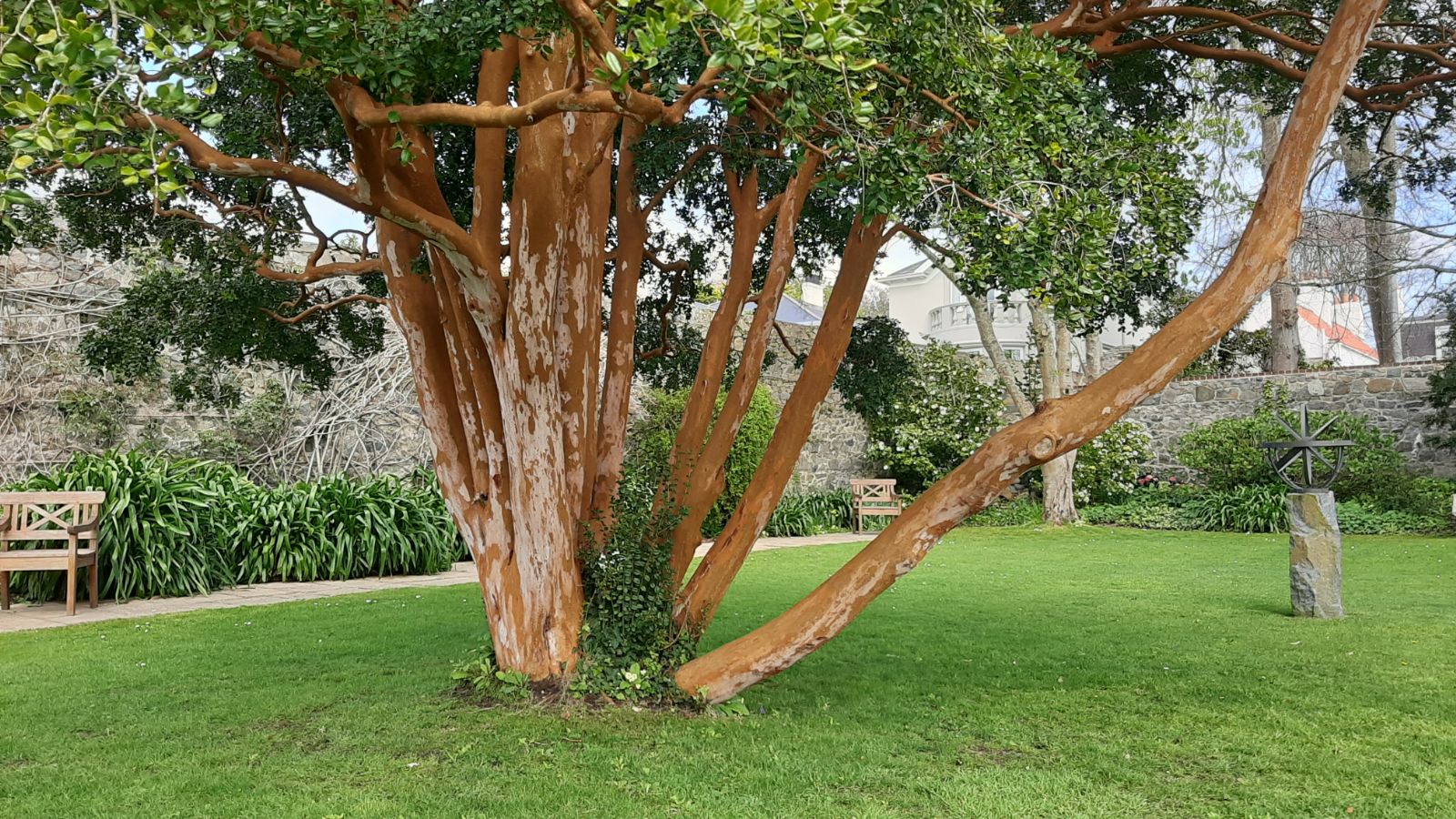
Of the species treated in this work under Myrtus only one, M. communis (the common myrtle), would remain in the genus if all the segregate genera were to be recognised. The genus in the wide sense has been broken up chiefly on seed and embryo characters coupled with geographical distribution. The difficulty is that the so-called generic characters are not very convincing, and, moreover, those derived from seeds and embryos are not known for many species. A further difficulty is the lack of a comprehensive study of the family and the fact that genera have been segregated by botanists working only on a section of the family, or the representatives of it in one geographical area. The last worldwide study of the family was made by George Bentham, whose conclusions are set out in Bentham & Hooker fil., Genera Plantarum, Vol. 1 (1865), pp. 690–725, and in Journ. Linn. Soc., Vol. 10 (1869),’pp. 101–166. He retained under Myrtus the species dealt with here, and until another comprehensive account is available it seems best to follow that meticulous and erudite botanist. Comments on the segregate genera will be found under the species concerned.
The leading characters of the species described here are: evergreen shrubs or trees with opposite, entire, glandular-punctate leaves. Flowers white (sometimes slightly tinged with pink), axillary, solitary or in few-flowered clusters. Sepals and petals four or five. Stamens numerous (except in M. nummularia). Ovary enclosed in the calyx-tube, with a single style. Fruits berry-like, crowned by the persistent calyx.