
Lomatia hirsuta
Credits
Article from Bean's Trees and Shrubs Hardy in the British Isles
Recommended citation
'Lomatia hirsuta' from the website Trees and Shrubs Online (treesandshrubsonline.
Genus
Synonyms
- Embothrium hirsutum Lam.
- L. obliqua (Ruiz & Pavon) R. Br.
- Embothrium obliquum Ruiz & Pavon
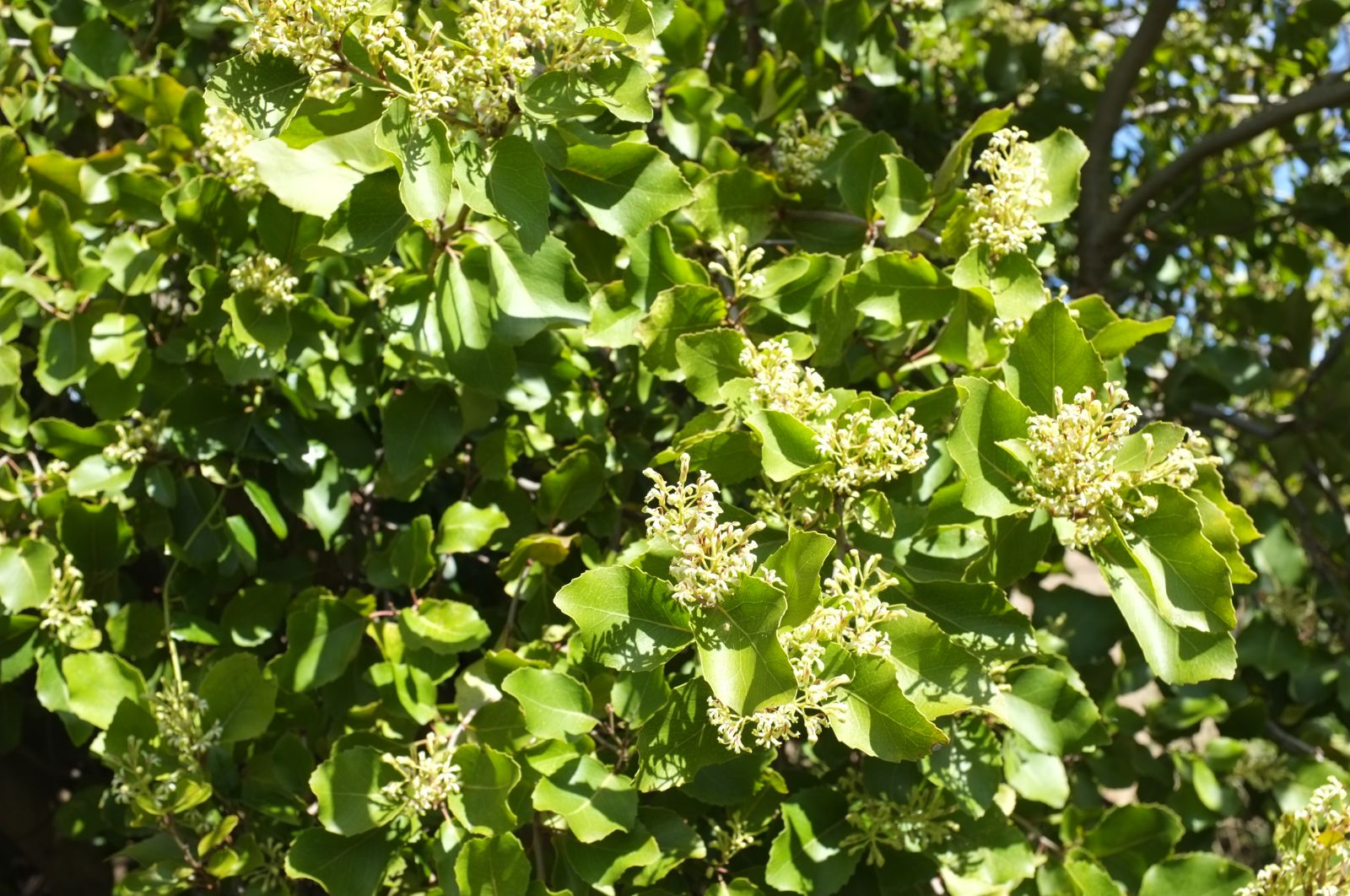
An evergreen shrub or small tree 20 to 60 ft high; young stems slightly downy. Leaves alternate, leathery, ovate, 11⁄2 to 4 in. long, 3⁄4 to 21⁄2 in. wide, wedge-shaped or rounded at the base, blunt at the apex, coarsely round-toothed; as they unfold they are covered with tawny down, but afterwards become perfectly glabrous, and of a deep glossy green; stalk brownish, about one-fourth the length of the blade. Flowers borne in axillary racemes 2 to 3 in. long, pale greenish yellow, not showy. Bot. Mag., n.s., t. 335.
Native of Chile, Argentina, Peru, and Ecuador; introduced by H. J. Elwes in 1902. It proved hardy at Kew, planted on an outside border near one of the plant-houses where it was 9 ft high until the winter of 1946–7, when it was killed by the severe weather. This species would no doubt be better suited growing under the same conditions as Embothrium. Probably the best specimen in the country grows in woodland at Nymans in Sussex. Raised from seeds collected by H. F. Comber on his Andean expedition (1925–7), it is now about 50 ft high.
L. dentata R. Br. – Seeds of this, the third Chilean lomatia, were sent home by H. F. Comber under his number 987 but there is no record of any garden plant from this source. It was reintroduced in 1963 by means of cuttings taken from a bush about 8 ft high growing near Lake Pangipulli in Osorno province. A plant from this sending, raised at Kew, is now growing at Wakehurst Place, Sussex, but has yet to experience a hard winter. L. dentata is very distinct from L. hirsuta in its toothed leaves and pure white flowers. It is unlikely to be as hardy.
From the Supplement (Vol. V)
The plant mentioned on page 593 as growing in the Wild Garden at Nymans, Sussex, measures 36 × 31⁄4 + 31⁄4 ft (1985). The species also grows well at Branklyn in Perthshire.
L. dentata – The plant at Wakehurst Place, Sussex, was 11 ft high and 6 ft wide in 1984. Its flowers are greenish white, not pure white as on the wild plant from which the cutting was taken.