Roderick Cameron (2025)
Recommended citation
Cameron R. (2025), 'Kerria japonica' from the website Trees and Shrubs Online (treesandshrubsonline.
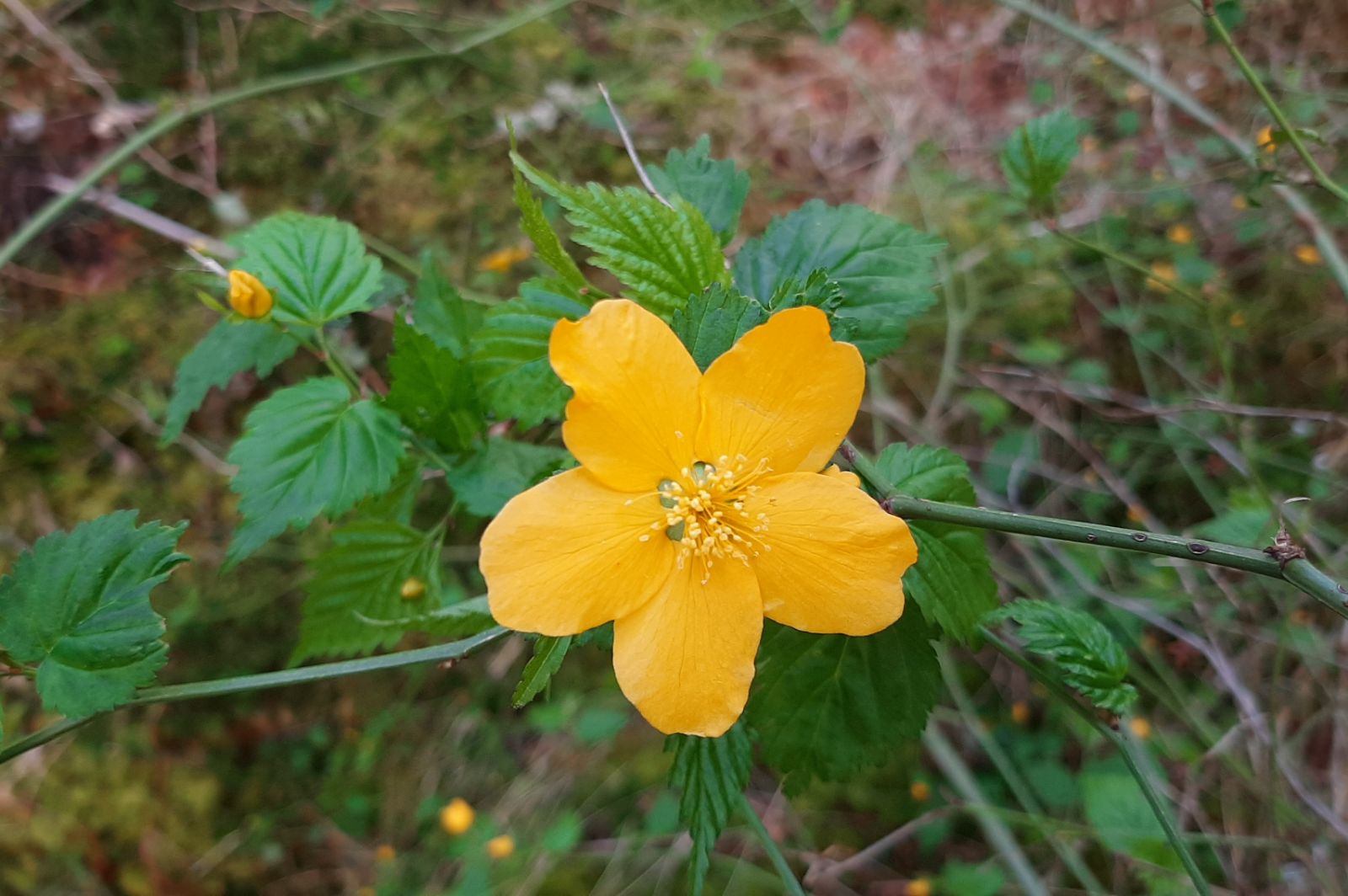
Shrubs (1–) 2–3 m tall. Branchlets green (becoming brown after a few years), usually curved, supple, cylindrical, slightly tapering, quite glabrous and glossy, forming a dense interlacing mass becoming loose with age. Leaves alternate, 3–10 × 2–4 cm, ovate-lanceolate, base rounded, apex long and tapering, bright green and glabrous above, beneath paler and hairy on veins or in vein axils, margin doubly toothed. Leaves larger on barren shoots of the year than on the flowering twigs; petiole 5–15 mm, glabrous. Flowers yellow, 2.5–6 cm in diameter, solitary at the end of short leafy twigs springing from previous year’s shoots. Petals usually five, sometimes 4 or 6, (to 34 in multi-petalled cultivars), strong yellow to slightly orangish or yellow-cream, broadly elliptic, 1.5–2 × 11.8 cm, 1 to 4 times as long as sepals. Calyx green, 1–1.5 cm in diameter. Stamens yellow, numerous. Fruits aggregated nutlets, (1–)5 in 1 whorl, tan, obliquely obovoid-globose,4–5 × 3.5–4 mm, enveloped in the persistent calyx. Flowers in spring. (Li, Ikeda & Ohba 2003; Bean 1981; Dirr 2009).
Distribution China Central and South; Anhui, Fujian, Gansu, Guizhou, Henan, Hubei, Hunan, Jiangsu, Jiangxi, Shaanxi, Shandong, Sichuan, Yunnan, Zhejiang Japan South Korea
Habitat Thickets on mountain slopes; 200–3000 m asl.
USDA Hardiness Zone 4-9
RHS Hardiness Rating H5
Conservation status Not evaluated (NE)
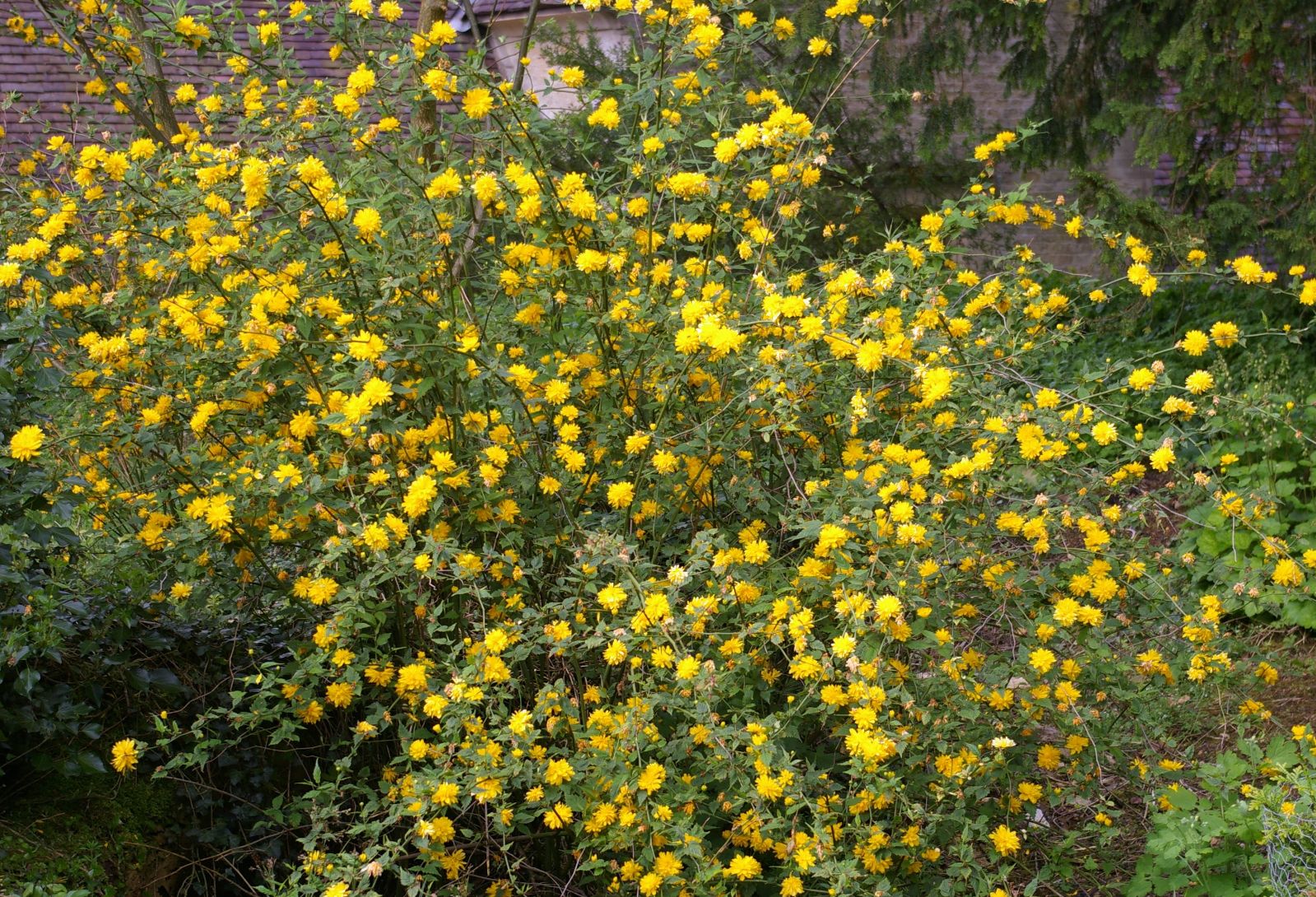
A deciduous shrub native to China, Korea, and Japan, notable for its graceful, arching stems. Its cheerful spring display and ease of cultivation have made it a stalwart of cottage gardens and shaded borders across temperate regions. The slender, yellowish green to bright green shoots are particularly conspicuous and attractive in winter, and the foliage can take on soft lemon-yellow colouration in autumn. The plant’s main attraction, however, lies in its vivid golden-yellow flowers, which appear in spring for two to three weeks. The flowers tend to bleach out in full sun, so the plant is best sited in partial shade or at least out of the afternoon sun (Dirr 2009).
It tolerates a range of soils, but prefers loamy, well-drained soil of medium fertility. Dense soils may cause root rot. If fertility levels are too high, it can become weed-like and grow excessively, resulting in fewer flowers. It has a tendency to sucker and will form dense thickets if unmanaged. Suckers should be removed, and heavy pruning after flowering is sometimes necessary. Stems can be cut to the ground for plant renovation, and dead stems require removal in winter; occasional thinning of old stems is also recommended (NC State University 2025), though it will persist for many years with no care at all.
Propagation is easy from softwood cuttings. Terminal stem cuttings should be taken in spring to mid-summer (between May and July in the northern hemisphere). The application of a rooting hormone helps develop a better root system. Alternatively, sucker growth can be dug from around the perimeter of the shrub and replanted (Clemson Cooperative Extension 2025). These qualities were noticed very soon after it was introduced: an 1810 article in Curtis’s Botanical Magazine remarked that ‘it increases very fast by suckers which the roots throw up in numbers, and strikes most readily from cuttings’ (Sims 1810). Dirr (2009) suggested it would be good to propagate this plant from seed, but he had yet to witness fruit set. Stewart (2010) recommends soaking seeds in water prior to sowing as the only necessary pretreatment, but it appears that K. japonica only rarely produces viable seed, especially outside its natural habitat. In Japan, the plant is known in popular culture for its tendency to bear no fruit (see below).
Plants can sometimes become infected with Kerria Twig and Leaf Blight, a fungal disease caused by Blumeriella kerriae, a plant pathogen specific to the genus. It causes leaf spots, stem lesions, and even severe defoliation. Small spots that appear on leaves later coalesce so that the leaves turn yellow to brown and eventually drop. Stem lesions are elliptical, purple-brown cankers, which can girdle the stems and cause dieback. It was known only in North America till 2014, when it was first reported in the UK, thus damaging the plant’s reputation of being disease-free as well as highly ornamental (RHS 2025; Clemson Cooperative Extension 2025).
The plant has long been cultivated in Japan, where it was known by 1700 (Bean 1981). Its taxonomy was initially troubled, as it was moved around different genera and even families. It was first understood to be a Rosaceae and named Rubus japonica by Linnaeus (1771), but it was later moved to Corchorus, a Malvaceae closely related to Tilia, by Houttuyn, following Thunberg’s determination, which was based on a specimen that lacked fruits (Houttuyn 1778). In 1818, De Candolle saw that, based on certain floral characteristics, it was not a Corchorus and that the initial placing in Rosaceae was correct. He determined it was sufficiently distinct to merit its own genus. He renamed it Kerria japonica, dedicating the genus to William Kerr, who in 1805 had introduced a specimen of the double-flowered form (see ‘Pleniflora’ below) collected in China (Sims 1810). De Candolle published his findings in a letter to The Linnean Society, in which he claimed that his first somewhat sycophantic intention was to dedicate the genus to James Edward Smith, President of the Society. He was unable to do so, he lamented, as the genus Smithia had already been named in his honour in 1789 (De Candolle 1818). In 1822, Desvaux would also determine that the plant was misplaced in Corchorus and belonged in the Rosaceae; he suggested it should be placed in Spiraea, though he did not go as far as proposing a name. The single-flowered form, typical of the species, was not introduced till 1834 by John Reeves (Bean 1981).
Kerria japonica plays an important part in Japanese culture. The word for the colour ‘golden yellow’ is taken from the name of the plant (yamabuki). Even small children who do not know the name of the plant will know the name for this tone of intense yellow: ‘yamabuki-iro’ (K. Tokunaga pers. comm. 2025). Its long history in cultivation is attested by its frequent mentions in waka, traditional Japanese poetry. Starting as early as the Manyo period (7th to mid-8th centuries CE), the plant has featured in Japanese daily life, and its image has changed with the times. In poetry, the yellow colour of yamabuki has been associated with feminine beauty, homesickness, aristocratic garments, money, economic booms, among other concepts (Lee & Shin 2018). A popular legend, recorded in a waka written by Imperial Prince Kaneakira (914–987), tells the story of general Ota Dokan (1432–1486), who on a hunting trip one day was caught in a downpour and rushed into a humble dwelling to request the loan of a straw raincoat. A young girl came out and instead offered him a branch of yamabuki. Dokan was angry, but after returning to his home, soaked to the bone, he was able to understand the symbolic gesture of the poor girl who had no raincoat to offer. The poem plays on the double meaning of mino (‘raincoat’) and mi no (part of a phrase meaning ‘bears no fruit’). In cultivation in Japan, as elsewhere, fruits are rarely found on Kerria japonica.
Several cultivars have been selected, aside from the original double-flowered form now known as ‘Pleniflora’. The more commonly found ones are listed below.
Synonyms / alternative names
Kerria japonica 'Albiflora'
A form with off-white or creamy yellow flowers, petals irregularly shaped. According to Dirr (2009), it does not measure up to the species, despite promising possibilities. Leaves turn pale yellow in autumn.
Leaves a rich green splashed with creamy white; soft primrose-yellow flowers sometimes streaked with white. Selected in Kawaguchi City, Japan and introduced by Yuji Suzuki for Hines Nurseries, Irvine, California, USA (Suzuki 2004). Nishiki means ‘brocade’ in Japanese and is used to name variegated cultivars; fubuki means ‘blizzard’ or ‘snowstorm’, referring to the white-flecked variegation.
A double-flowered selection with attractive mid-green, yellow- and white-speckled variegated leaves. Typically 1–1.5 m tall and across, but reported to reach a maximum size of 2.5 m × 2.5 m (Dirr 2009; Stewart 2010).
Awards
AGM
A particularly handsome clone with larger flowers (4.5–5 cm in diameter) that are borne over a longer period. A graceful shrub, reaching 1.5 m tall (Dirr 2009). One of two K. japonica cultivars to receive the Award of Garden Merit (see ‘Pleniflora’ below).
A cultivar with larger flowers, possibly the largest of any Kerria, over 5 cm across. A repeat bloomer with bright green stems (Stewart 2010).
Synonyms / alternative names
Kerria japonica 'Aureovittata'
Unusual selection with stems that turn yellow with thin green stripes in winter; they tend to revert (Brand 2015).
Synonyms / alternative names
Kerria japonica 'Variegata'
A handsome selection with soft grey-green leaves edged with white. It flowers in spring and then continues to flower sporadically throughout the summer. Less vigorous and less hardy than the type. Dirr gives it a mixed review, praising its flowering prowess and calling it a ‘superb foliage shrub’, but decrying its branch reversions and misshapen flowers, which bleach out more than other cultivars. It reaches 1–1.2 m at maturity (Dirr 2009; Bean 1981; Nurseries Caroliniana 2025).
Synonyms / alternative names
Kerria japonica 'Flora Plena'
Kerria japonica 'Plena'
Awards
AGM
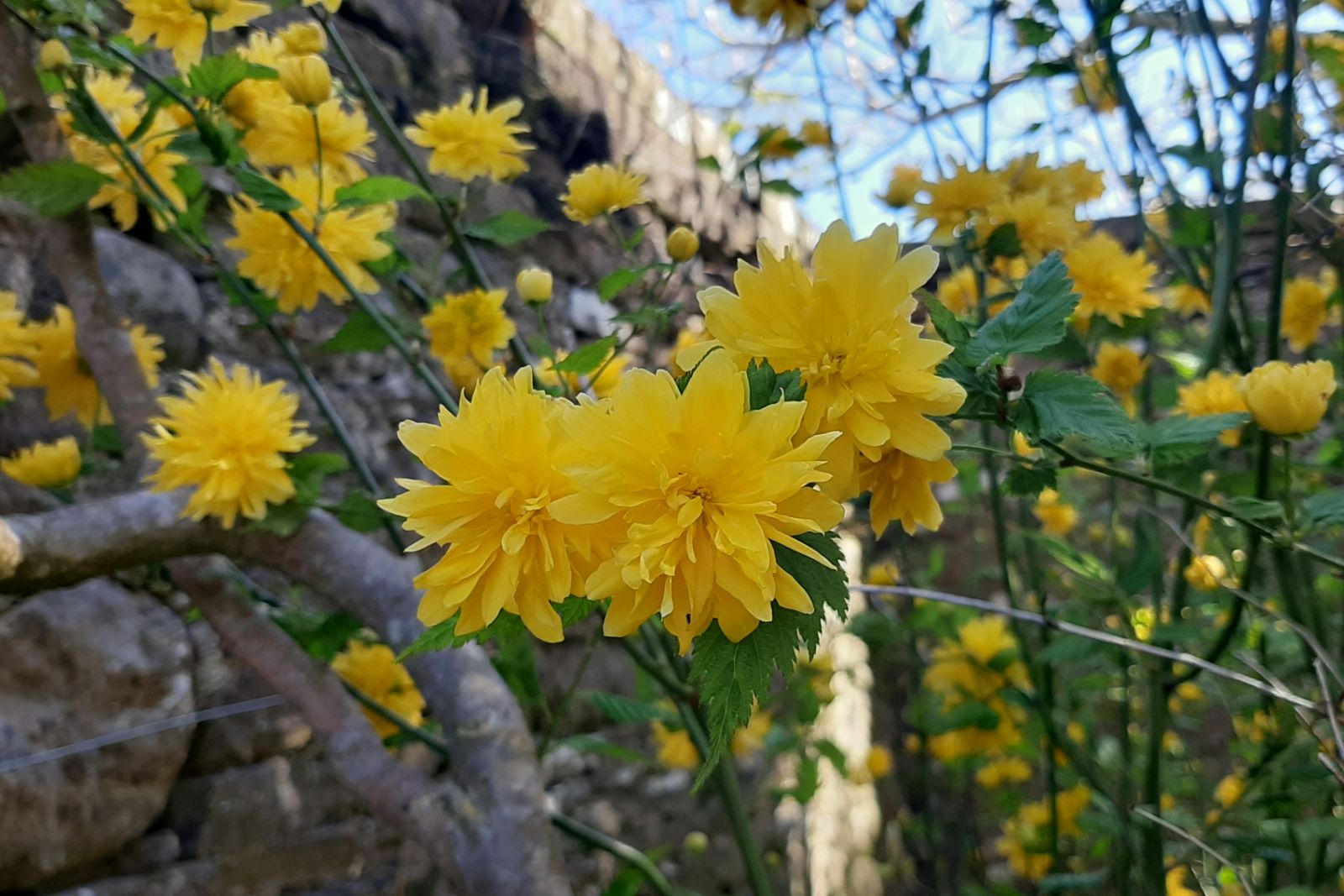
A double-flowered variety, more common in gardens than the type, from which it also differs in being more erect, with stouter branches, though gaunt and rather lanky in habit, lacking the dense twiggy character of the species. Reaches 2–3 m high, and plants 4 m tall have been reported. The flower is a rounded mass of bright yellow petals, almost golden, 2.5–5 cm in diameter, longer lasting than in the type, flowering in late spring and often again in autumn (Dirr 2009; Bean 1981; Phillips & Rix 1989).
This was the first form introduced to Western cultivation in 1805, when it was introduced to Kew by William Kerr. With ‘Golden Guinea’ (see above), one of two K. japonica cultivars distinguished by an Award of Garden Merit.
More vigorous than the species, reaching the larger end of the species range and growing up to 3 m. It leafs out and flowers earlier than the species, with large, single yellow flowers. According to Dirr, it is ‘an all-around better doer than the run-of-the-mill species type’ (Dirr 2009; Stewart 2010).
The name ‘Simplex’ is sometimes seen for single-flowered plants (e.g. Gardiner 2011; Beaulieu 2022; NC State University 2025) but does not appear in older literature, and it is unclear whether plants that might be found under the name represent a unique clone. It may be that it is a coinage to distinguish them from the ubiquitous ‘Pleniflora’.