Jubaea chilensis (Mol.) Baill.

TSO logo

Sponsor

Kindly sponsored by
The Kilchoan Melfort Trust

Credits

Martin F. Gardner & Josefina Hepp (2025)

Recommended citation
Gardner, M.F. & Hepp, J. (2025), 'Jubaea chilensis' from the website Trees and Shrubs Online (treesandshrubsonline.org/articles/jubaea/jubaea-chilensis/). Accessed 2026-09-06.

Family

  • Arecaceae

Genus

Common Names

  • Chilean Wine Palm
  • palmera chilena
  • palma de coquitos
  • palma de miel
  • palma de vino de Chile
  • lilla
  • lillo
  • can-can

Synonyms

  • Cocos chilensis Molina
  • Jubaea spectabilis Kunth
  • Micrococos chilensis (Molina) Phil.
  • Molinaea micrococos Bertero
  • Palma chilensis Molina

Other taxa in genus

    Glossary

    Critically Endangered
    IUCN Red List conservation category: ‘facing an extremely high risk of extinction in the wild’.
    IUCN
    World Conservation Union (formerly the International Union for the Conservation of Nature).
    apex
    (pl. apices) Tip. apical At the apex.
    Extinct
    IUCN Red List conservation category: ‘there is no reasonable doubt that the last individual [of taxon] has died’.
    family
    A group of genera more closely related to each other than to genera in other families. Names of families are identified by the suffix ‘-aceae’ (e.g. Myrtaceae) with a few traditional exceptions (e.g. Leguminosae).
    pollen
    Small grains that contain the male reproductive cells. Produced in the anther.

    References

    Credits

    Martin F. Gardner & Josefina Hepp (2025)

    Recommended citation
    Gardner, M.F. & Hepp, J. (2025), 'Jubaea chilensis' from the website Trees and Shrubs Online (treesandshrubsonline.org/articles/jubaea/jubaea-chilensis/). Accessed 2026-09-06.

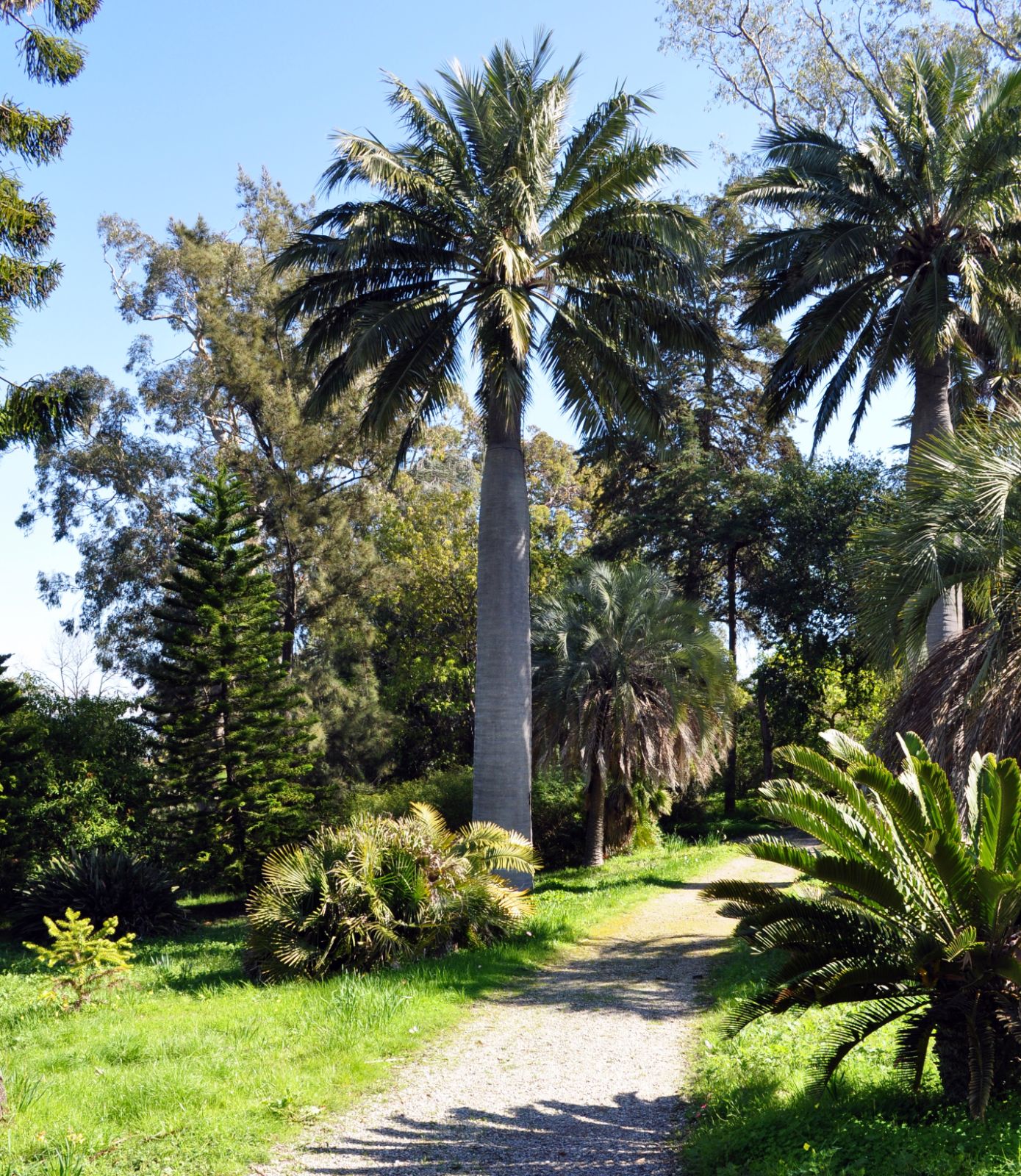
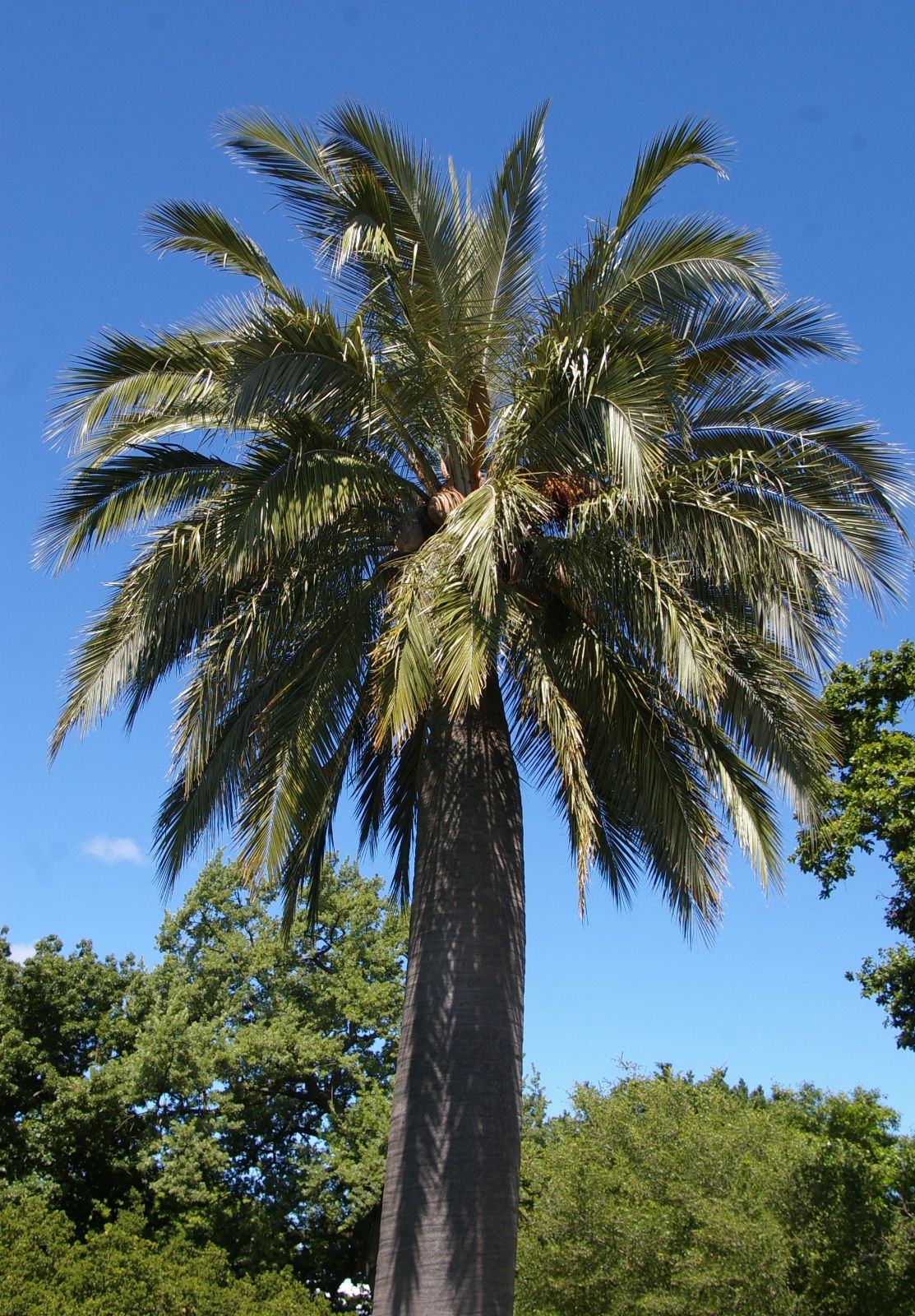
    Forms a massive tall tree from 25–30 m (33 m); trunk solitary, erect, with a distinctive cylindrical shape with irregular swelling at or near the base and generally tapered toward the apex. In mature trees the trunk is at its widest from 1.5–2 m, eventually becoming bare and marked with close, oblique leaf scars and vertical cracking. Leaves 4–5 m long, pinnate, falling after 5–6 years, bright green, or silver- green, sheaths soon disintegrating into fibres; petiole sometimes indistiguishable from the sheath, margin with disintegrating leaf sheath fibres except near the tip where it is almost smooth, upperside flattened, lower rounded or angled, bearing thin or thick white wax or glabrous; rachis rigid or gently curving; leaflets up to 60 cm long, foming a ‘V’ shape, 110–120 on each side, very rigid, the tips often with a reflexed hook-like flange. Inflorescence solitary, to 1 m or more long, borne amongst the leaves; peduncles elongate, maroon when fresh, covered in dense, caducous tomentum; with two major bracts, the lower concealed by leaf-bases, the upper not deeply grooved externally, the axis once-branched. Flowers borne in triads (2 males, 1 female) near the base and with solitary or paired male flowers above, reddish brown, appearing in early summer (May-June in the northern hemisphere, November-December in Chile). Male flowers maroon with a yellow centre, slightly asymmetrical; calyx with a solid, elongate, stalk-like base and 3 narrow, triangular keeled lobes; petals 3, much longer than the calyx, more or less boat-shaped with triangular tips; stamens c.18. Female flowers globular (only slightly larger than the male flowers) with overlapping 3 sepals and 3 petals, staminodes united into a ring and ovary with 3 cells, each with 1 ovule. Fruit usually 1 -seeded, orange-yellow, more or less ovoid, c. 4 × 2.5 cm, endocarp bearing 3 basal pores, starting to ripen in high summer (July in the northern hemisphere,January in Chile). Seed 1, with smooth, hollow endosperm. (Uhl & Dransfield 1987; Grau V. 2004; Cullen, Knees & Cubey 2011).

    Distribution  Chile Regions of Coquimbo, Valparaíso, Mertopolitana, Libertador General Bernardo O'Higgins

    Habitat Jubaea chilensis has a restricted natural range in the coastal mountains of central Chile from the Region of Coquimbo (La Serena, 29°55'S) to Region Maule (Tapihue, 35°22S) . In some locations, such as in La Campana National Park (Ocoa sector), it can form very large populations mixed with sclerophyll vegetation. Some authorities consider that it once had a distribution in Easter Island. See below for further discussion on this topic.

    USDA Hardiness Zone 7b-8a

    RHS Hardiness Rating H5

    Conservation status Endangered (EN)

    Arguably, Jubaea chilensis, along with Araucaria araucana (Monkey Puzzle Tree) and Fitzroya cupressoides (alerce) are the three most emblematic trees native to Chile. All are quite different in appearance but sadly they have one tragic fact in common – each is threatened with extinction! Capable of growing up to 33 m in height (Edwards 1903) and with a colossal trunk up to 2 m in diameter (Rubinstein 1969), J. chilensis is one of the most massive of all palm species, only surpassed by the Borassus palm in Africa (Simonetti 2006). Its massiveness means that it can resist prolonged periods of drought and low temperatures, enabling it to be widely cultivated around the world (Guzmán et al. 2017).

    There is good evidence, from both pollen records and the remains of fruits found on Easter Island (Rapa Nui), that a palm forest once covered much of the island before becoming extinct in the 16th century (Dransfield et al. 1984). Grau (2004), after performing experiments on the buoyancy of J. chilensis seed in sea water, where he found it remained buoyant for four months, concluded this was the species that was once native to Easter Island as it could have reached the shores by floating some 3,500 km across the sea from Chile. However, Dransfield (Dransfield 1991) disputes this and has described Paschalococos disperta as being the palm that was once abundant on Easter Island, but concludes that it was very closely related to J. chilensis.

    Jubaea chilensis was known by European botanists as early as 1623, when it was described by the Swiss botanist Gaspard Bauhin (1560–1624) in his landmark work Pinax theatri botanici (Bauhin 1623) (which incredibly described 6000 plant species) as “palm species with sweet fruit known as Coquillo in Chile”. However, it was not until 1782 that its first scientific name was published by the naturalist Juan Ignacio Molina (1740–1829) (Molina 1782). He named it Palma chilensis and in his description was effusive by saying “… nothing can be more beautiful than to see one of these trees covered with fruit, shaded by the upper branches which bend over in the form of an arch.” However, with advances in the knowledge of palm species and their relationships, many more changes in the naming of this palm came about hence, in his English second edition Molina reclassified the palm as Cocos chilensis. Finally, using material collected in Chile by Alexander von Humboldt (1769–1859) and Aimé Bonpland (1773–1858), Carl Sigismund Kunth (1788–1850) assigned it to a new genus and named it Jubaea spectabilis but at the time did question whether his new species might be the same as Molina’s Cocos chilensis. In recognition that C. chilensis and J. spectabilis were indeed the same species, in 1895 the French botanist Henri Ernest Baillon (1827–895 ) made the new combination Jubaea chilensis (Molina) Baill., the name by which the palm is known today (Zona 2011).

    Often known as the Chilean Wine Palm, J. chilensis is a cut above other cultivated palms, certainly in a garden setting mature specimens, with their quirky, eccentric tapering trunks, are the ‘stand out’ tree that no other palm can match. But how tastes and fortunes have changed, because when Charles Darwin (1809–1882) visited the palms in La Campana (now a National Park) in 1834 he was not entirely impressed by them and wrote These palms are, for their family, ugly trees. Their stem is very large, and of a curious form, being thicker in the middle than at the base or top. They are excessively numerous in some parts of Chile, and valuable on account of a sort of treacle made from the sap” (Darwin 1845).

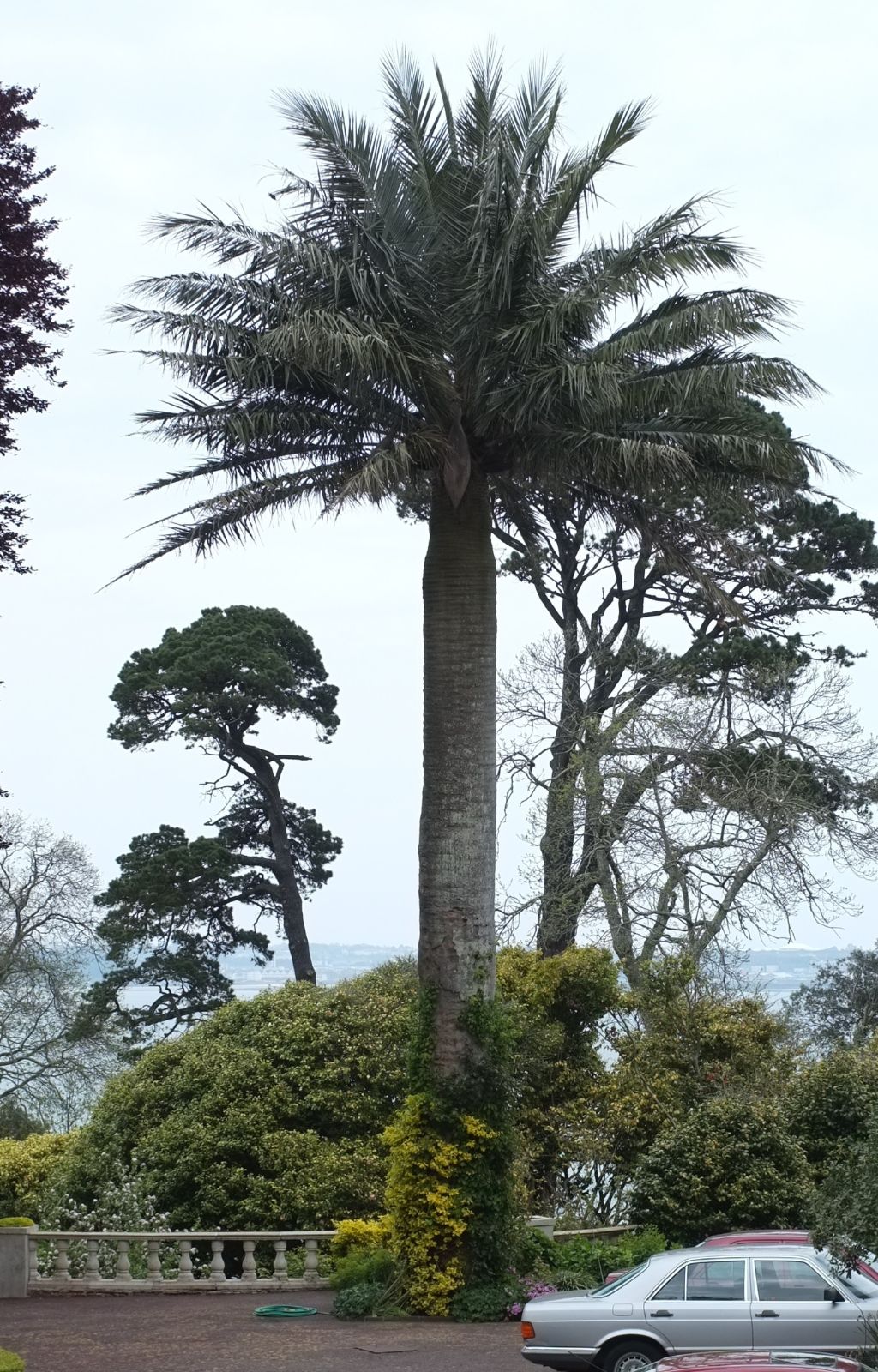
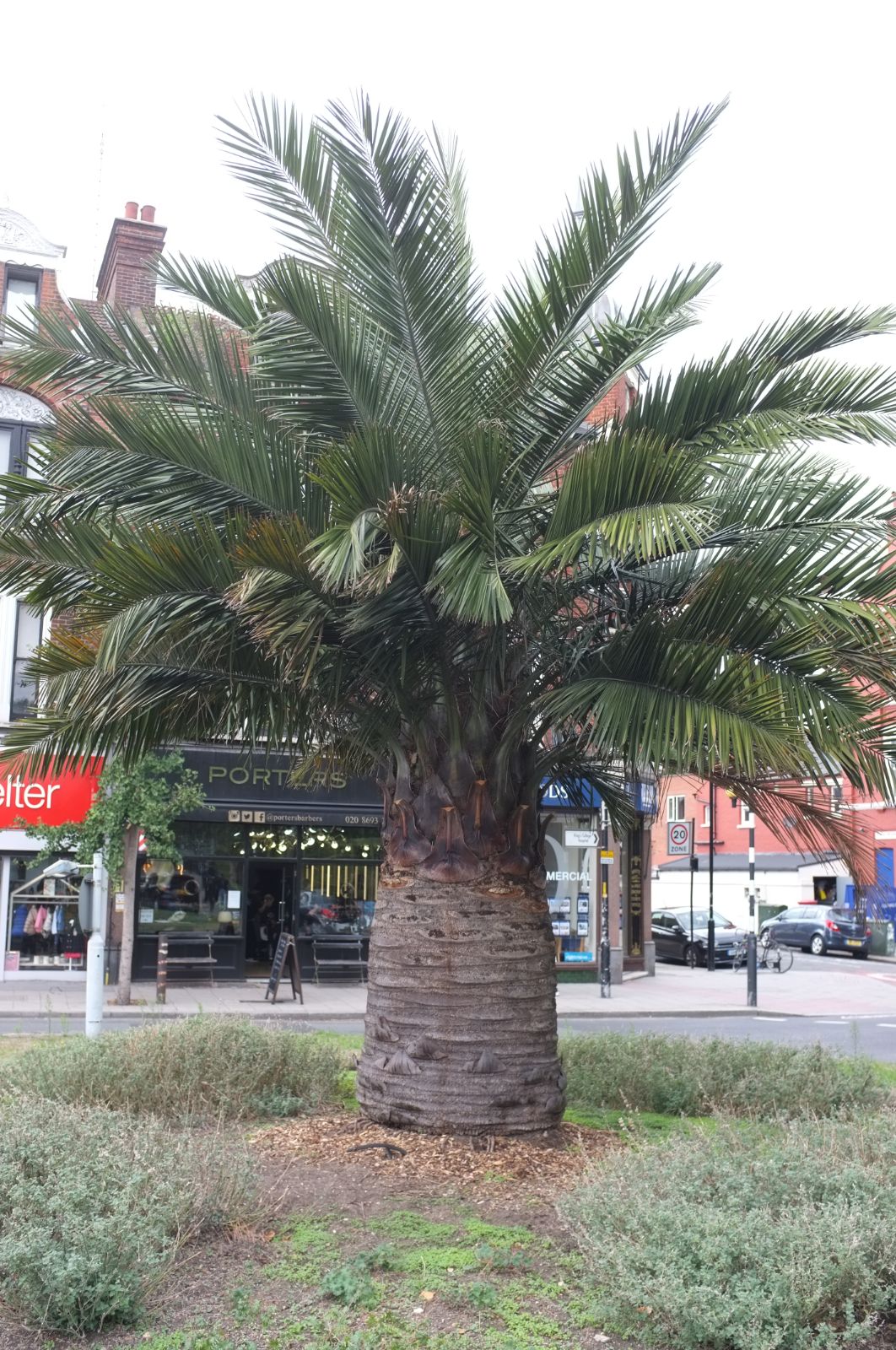
    One of the earliest introductions to cultivation outside of Chile was in 1846 when a plant grown from seed, collected in Chile, was cultivated in the Temperate House at RBG Kew. By 1985 it had grown to 17.67 m tall but in 2013 it had reached the top of the glasshouse and sadly the world’s tallest glasshouse grown specimen of J. chilensis had to be removed during the refurbishment of the building. However, today J. chilensis is more commonly cultivated out of doors, as it soon became clear that this species, although native to a Mediterranean coastal climate, is able to tolerate a wide range of environments; surviving winter temperatures as low as –16C°in France (Swinscoe 1997) and even –22°C in Perpignan, France, in 1956 (Del Cañizo 2011). One of the earliest records of the palm being planted outside in the UK is for a group of three trees in a private garden in Torquay. Bean (Bean 1988) mentions they were planted in about 1900 and the best measured 23 × 10 ft (7 × 3.5 m) in 1972. Today only two trees remain and in 2015 they measured 5.5 m and 8 m (The Tree Register 2025). The champion tree for the UK is a 9 m tall specimen at Tresco Gardens, in the Scilly Isles, which was planted in 1912 and has a trunk measurement of 81 cm across (Andrew Lawson, pers comm. June 2025). However, this is somewhat surpassed by a remarkable tree at Noirmont Manor on Jersey which in May 2013 measured 17 m tall and with a girth of 3.42 m (at 1.50 m) (The Tree Register 2025). There are now several specimens growing happily in London, including at the Chelsea Physic Garden and surprisingly, on a roundabout in Dulwich (which the unwary might take to be Phoenix canariensis, now common throughout London).

    The Travels of Jubaea by Zona ( 2011) gives a comprehensive account of how the palm became adopted in the 19th century by so many countries around the world. In Europe it started to be grown in glasshouses and orangeries, especially in the Netherlands, before making its rightful way to the warmer climes of the Mediterranean and by the mid- to late 19th century it had spread from Portugal to France, Spain and Italy. Specimens at Villa Thuret in the Cote d’ Azur first fruited in 1894, supplying a source of seed for additional plantings along the French Riviera and beyond. It also took North America by storm with the first palms being planted in California in 1877: by the 1880s seeds of Jubaea were being exported from Chile to San Francisco by the ton (Zona 2011).

    Today J. chilensis is cultivated in over 20 countries worldwide, including Argentina, Ecuador, Peru and Uruguay in South America. There also some fine specimens in South Africa, Australia, New Zealand and in Russia’s Sochi Arboretum where J. chilensis is very much at home in the subtropical climate (Guzmán et al. 2017). Since the 18th century J. chilensis has proudly been used as an ornamental species in Chile and is often planted in avenues and at the entrance to important buildings such as the monastery of San Pedro de Alcántara in the Province of Cardenal Caro, built in 1725 (Guzmán et al. 2017). Today this extraordinary palm is much loved by Chileans and is increasingly used as an ornamental tree, especially in public parks and gardens (pers. obs.). The export of mature trees from Chile for use in the horticultural industry is now quite a common practice. For example, in 2022 a 6 m tall tree was imported from Chile, having been displaced by a building development on the outskirts of Valparaíso, and planted at the Packington Estate in Islington, London. For conservation reasons this practice must be strictly regulated.

    However, most plants in cultivation are seed raised, which is a relatively straightforward process. For example, seed has been germinated at Logan Botanic Garden in southwest Scotland by placing them in a plastic bag with a mixture of 50:50% fine bark and sand and kept at a temperature of about 21°C. It took between 4–6 weeks for the seeds to start producing radicles and the germination rate was about 95% (Richard Baines, pers. com., 2025). As a result of this success, Logan has established a planting of about 15 trees on the terrace of the walled garden ,with more to follow in due course.

    In the wild, J. chilensis reaches reproductive maturity at about 50 years old. This happens slightly faster with cultivated trees and the tapering of the stem starts to appear very suddenly and noticeably with the girth of the palm, narrowing by as much as 50 percent (Simonetti 2006). In his intriguing note on the causes of tapering in Jubaea, Simonetti goes on to say “Regular irrigation and fertilizer on cultivated palms may reduce the amount of stem tapering. At many old farm houses, with gardens older than 80 years and under good care, the Jubaea does not exhibit this feature. Therefore, another possible hypothesis for stem tapering is that it is related to periods of drought”.

    The grim statistics associated with the tragic loss of Jubaea chilensis from its native habitat are that in 1550 the population was estimated to be 5 million trees spread in a continuous distribution throughout its natural range. However, today the population has been reduced by 98% (Diaz 2009) and is now highly fragmented: the number of surviving trees does not exceed 120,000 (González et al. 2009). The reasons for this dramatic decline are related to deforestation, urbanisation and wildfires. Certainly the megadrought that started in 2010 (and is ongoing) has seen the longest sequence of dry years since records began in 1912 (Gardner et al. 2025) and has increased the risk of fire. For example, all too often the results of devastating fire events can be seen when driving the main highway to Valparaíso; severe fires have occurred in and around the city in 2010, 2017 and 2022. Even though the internal structure of the trunk is compact, with a high air content that avoids excessive heat generation harming internal tissues and offering protection from fire (Senerman 1970) (Patricio Novoa, pers. com., June 2025), it is the frequency and intensity of the fires that is greatly impacting the ability of trees to recover (J.H., pers. obs.). The harvesting of its fruits and sap for human consumption is also a serious threat but it is still allowed in national parks such as La Campana even though controlled (González et al. 2009). The most destruction process for extracting the sap (often referred to as honey or in Spanish as miel de palma) takes place between October and April when the tree is razed to the ground, the apex is defoliated and a container is attached to collect the sap; yields per tree vary between 80 to 600 litres (Rubinstein 1969). The sap is fermented into palm wine, (hence the vernacular name, Chilean Wine Palm) or more commonly today, into a sweet syrup, which in Chile is considered a delicacy when added to desserts (J.H., pers. obs.).

    Jubaea chilensis has an IUCN conservation category of Endangered and is protected within La Campana and Las Palmas de Cocalán National Park, which together protect over 75,000 individual trees (Chaparro 2021), equating to 60% of the natural population. However, even this level of protection is not always a safeguard, as demonstrated in a recent study. This singled-out Las Palmas de Cocalán National Park as the most severely impacted protected area by large-scale wildfires over the past 20 years, where these devastating events reccurred at an alarming rate of frequency (Pinilla, Soto & Navarro Cerrillo 2023). Following the catastrophic fire that destroyed so much of The National Botanical Garden, Viña del Mar in 2024 (and previous fires), it has been proposed to reforest the central part of the Garden using seed collected from different populations of J. chilensis; hopefully the palm’s adaptations to resist fire will help it survive any future wildfires (Villaseñor & Saiz 1990).

    A further potential threat to the native trees of J. chilensis is from the Red Palm Weevil (Rhynchophorus ferrugineus) which is native to Tropical Asia but, has now spread to Africa and Europe where it is a serious pest. Thankfully, it has not yet been recorded in Chile but it is known to have killed cultivated specimens of J. chilensis; a recent example of this was a much-celebrated veteran tree at Pazo de Meirás in Galicia, Spain (Gasper Bernárdez, pers. comm. 2025).