Kindly sponsored by a generous supporter who loves hydrangeas.
Julian Sutton (2025)
Recommended citation
Sutton, J. (2025), 'Hydrangea platyarguta' from the website Trees and Shrubs Online (treesandshrubsonline.
Deciduous shrub either erect, 0.5–3 m, or prostrate and sometimes rooting at the nodes. Branchlets brown, glabrous or with sparse, short hairs, bark peeling with age. Winter buds narrowly ovoid. Leaves opposite, decussate. Leaf blade membranous to papery, lanceolate to elliptic or oblong, 9–22 × 3–6 cm, with 7–9 secondary veins each side of midvein, both surfaces with appressed hairs, or subglabrous beneath; base cuneate, slightly decurrent; margin serrate; apex acute to acuminate; petiole 1–7 cm. Inflorescence terminal, a little-branched corymbose cyme, subglabrous; bracts linear, persistent; both fertile and sterile flowers present. Sterile flowers on pedicels to 3 cm long, largely consisting of 3–4 broadly ovate petaloid sepals, connate from base to middle and so forming a triangle or square 1–3 cm across, white. Fertile flowers on pedicels to 2.5 cm long; calyx tube turbinate, 4–5 mm, with 4 or 5 triangular teeth, 4–5.5 mm at anthesis, to 7 mm in fruit; petals 4, white, ovate, 7–10 mm, free, present at anthesis but falling later; stamens very numerous, in several whorls, filaments slender and slightly connate at the base; ovary inferior, with 2 locules; styles 2, slender, ~1 cm in fruit; stigmas small, subcapitate. Fruit a capsule, 4 × 8–9 mm, dehiscing at the apex; style persistent. Seeds <1 mm, dark brown, with a short wing. Flowering July–August, fruiting September–October (China, Japan). (Wei & Bartholomew 2001; Ohba 2001; Ohwi 1965; Chinese Academy of Sciences 2023; Bean 1976).
Distribution China Anhui, Fujian, Jiangxi, Zhejiang Japan Honshu, Shikoku, Kyushu
Habitat Sparse forests or thickets in valleys, stream banks, mountain slopes; 200–1800 m asl.
USDA Hardiness Zone 6-9
RHS Hardiness Rating H5
Conservation status Not evaluated (NE)
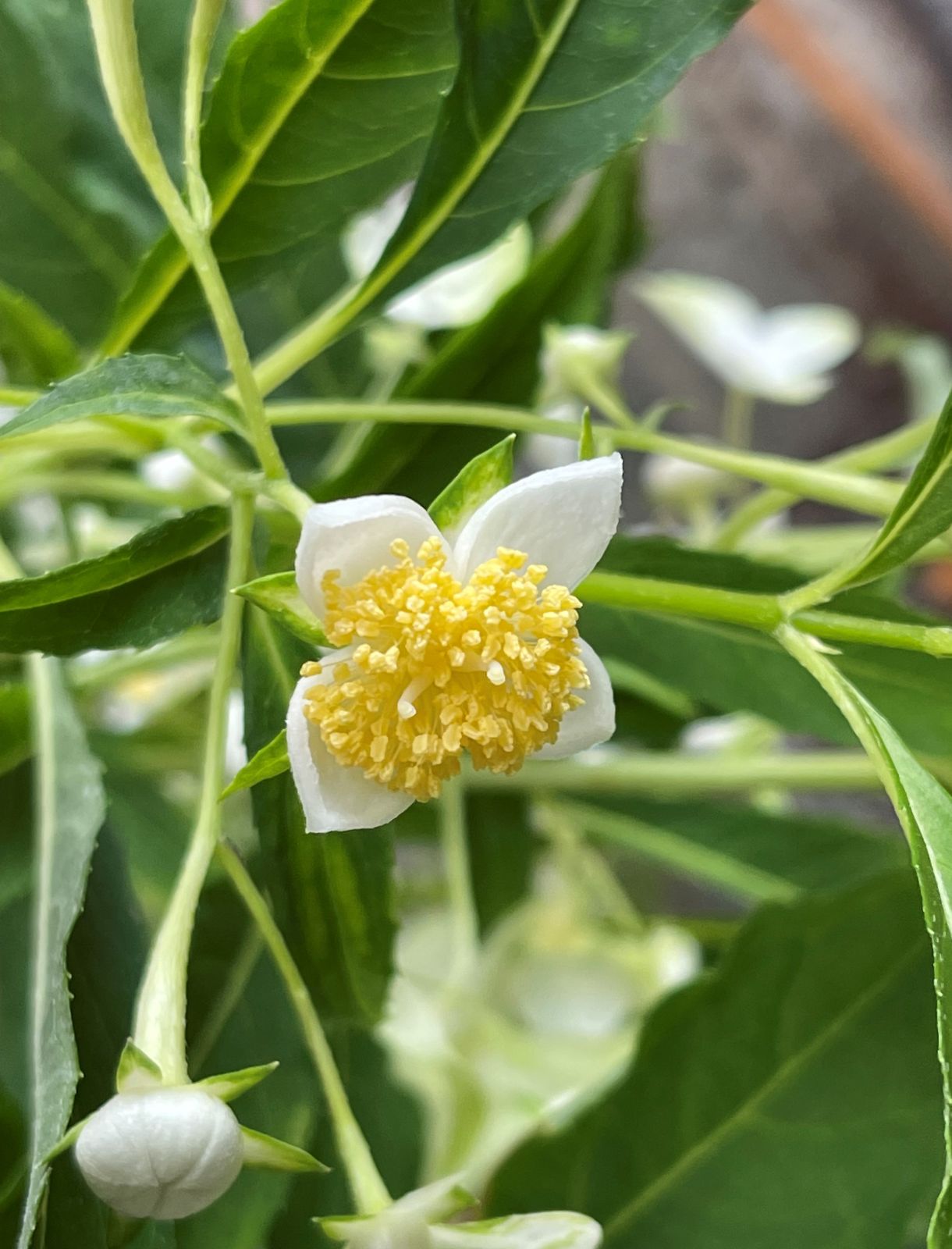
Often seen in gardens as a low-growing, spreading – even creeping – shrub for shade, Hydrangea platyarguta is still better known as Platycrater arguta. It is unusual in that both fertile and sterile flowers are showy, white (sepals in sterile flowers, petals in fertile), with a conspicuous boss of yellow stamens in the fertile ones; they are in loose, few-flowered inflorescences from summer onwards. Yellow autumn colour is a bonus. A refined rather than traffic-stopping plant, to admirers it is ‘one of the sweetest Hydrangeas that exists’ (Hinkley 2024). However, the usual rather small-flowered form of gardens is perhaps less ornamental than some cultivars which are slowly becoming available.

H. platyarguta is a curious plant. While the foliage could at first glance belong to one of many narrow-leaved hydrangeas, two floral features stand out. The fertile flowers are showy, and have numerous stamens (in common with herbaceous Section Deinanthe), while the sterile flowers have sepals which are fused for part of their length, resulting in a peltate, more or less triangular or square calyx. The stamens are yellow and very conspicuous, contrasting with the pure white perianth, an attractive feature. Also, the styles are unusually long. It has been treated as a distinct, monotypic genus since first being described (Siebold & Zuccarini 1835). However, molecular phylogenies place it squarely in Hydrangea, its closest relatives being in Section Asperae, probably as sister to H. sikokiana (De Smet et al. 2015; Yang et al. 2024). In transferring it to Hydrangea (De Smet et al. 2015) the new specific epithet platyarguta was required because Hawaiian Hydrangea arguta (Gaudich.) Y.De Smet & Granados (Section Broussaisia, based on Broussaisia arguta Gaudich.) takes priority.
This is a very local species in the wild, with only a few populations known in Eastern China (notably on Yandangshan, Zhejiang, and the nearby Wuyishan range which is known for its rare and endemic plants as well as fine teas), and in Southern Japan only at all abundant in Kyushu (Qiu et al. 2009). It is considered endangered in China, although not evaluated to date by the IUCN (IUCN 2024). This is probably a relict of a wider Tertiary distribution before the climatic fluctuations of the Pleistocene. Molecular work reveals a Chinese/Japanese genetic disjunction reflecting the geographical one, dating from the early to mid Pleistocene (Qiu et al. 2009). As with Kirengeshoma, another East Asian disjunct in the Hydrangeaceae (Qiu et al. 2009), lack of suitable forest floor habitat probably prevented the sorts of later contact across the East China Sea land bridge which caused more complex (and horticulturally significant) variation patterns in the more ecologically adaptable and easily dispersed Cercidiphyllum (Qi et al. 2012).
Chinese plants have sometimes been distinguished as Platycrater arguta var. sinensis H.Hara (smaller flowers, less hairy leaves, longer petioles, glabrous calyx with ovate lobes – Ohba 2001). The usual plant of gardens outside Japan has few or no sterile flowers and has been called P. a. var. hortensis Maxim. (Bean 1976); the inflorescences are few-flowered, and the fertile flowers on the small side. New combinations have not been published in Hydrangea, and there seems little point to doing so.
H. platyarguta is an understorey plant of warm temperate deciduous forests, sometimes evergreen forests at lower altitudes in Japan (Qiu et al. 2009). It is tolerant of deep shade, but can adapt to brighter light through a suite of structural and physiological leaf changes (Wei et al. 2024). Habitats include springs, streamsides and wet cliffs (Siebold in Siebold & Zuccarini 1835). In the garden, well drained soil in light shade, with constant moisture availability is probably ideal (Dirr 2021a, b). Habit seems to vary in the wild from low, almost creeping, to upright shrubs well above head height. It is not clear how much of this variation is genetic, how much environmental in origin; around 1 m × 1 m seems about the maximum in most gardens but much taller plants are recorded in the American Southeast (Dirr 2021).
Although easy to propagate from softwood cuttings (Bean 1976; Dirr 2021) H. platyarguta has a reputation for fickleness. Experienced woodland gardener Joe Sime in Wales, UK, has given a potted plant greenhouse protection for 14 years, trying to establish rooted cuttings from it in a range of garden positions (pers. comm. 2024). Most survive but do not thrive. Only recently has one flowered, in a raised bed with shelter from an overhanging Indigofera. When suited, it proves remarkably hardy, certainly to USDA Zone 6. It can bloom on old or new wood, and will shoot from the base, so winter shoot death does not prevent flowering. Colder climate examples include one in the Jura, France (Pépinière AOBA 2024); an online image from Wrocław University Botanical Garden, Poland, shows an open-garden shrub flowering on old wood (Kwiecień 2020).
It has long been grown as an ornamental in Japan. In the 1820s Philipp von Siebold knew of it in gardens across Japan, thriving best in the north (Siebold & Zuccarini 1835). It was frequent enough that he could record common plant associations, placed beside ponds with Gardenia jasminoides, and the contrasting foliage of Iris and Alisma, with evergreen azaleas, and on rocky slopes with Ficus pumila. He also noted that infusions were poured across statues of the Buddha to commemorate his birth, in the same way as H. serrata, but in this case not drunk.
H. platyarguta reached European gardens through Karl Maximowicz in St Petersburg, who was sent it by his Japanese colleague Chonosuke (Tschonoski) Sukawa (Maximowicz 1867). It seems to have spread to Western Europe from there (Bean 1976). This was presumably the ‘normal’ small-flowered plant of present day gardens. More diverse, perhaps more exciting forms have been selected in Japan, with larger or pink flowers, fragrance, and differences in plant size and habit. Some are beginning to reach the West, mainly North America to date (see below). Wild provenance introductions include Crûg Farm’s BSWJ 5683 & 6266 (Mt Unzen, Kyushu – (Crûg Farm Plants 2024)
A hybrid with H. sargentiana was raised by Ed Bowen, Rhode Island, before 2013; it has white lacecaps, in autumn for Dan Hinkley in coastal Washington State (Hinkley 2024).
Flowers very large, up to three times bigger even than ‘Kaeda’; fragrant; sepals (sterile flowers) and petals (fertile flowers) white. A seedling of ‘Kaeda’ selected by Rhode Island ‘nano nursery’ Issima, before 2021. (Issima 2024; Dirr 2021a, b)
Flowers about twice the size of usual garden forms; leaves also larger, with very good yellow autumn colour, late November to December in South Carolina. Selected before 2021 at a nursery near Nagoya, Japan, run by the Ishiguro family; introduced to North America by Ted Stephens of Nurseries Caroliniana, SC (Nurseries Caroliniana 2024). It has reached 1.8 × 1.8 m in Atlanta, Georgia, for Ozzie Johnson (Dirr 2021a).
Pink buds open to white, pink-backed sepals and petals; fragrant (Issima 2024; Dirr 2021b)
Sepals (sterile flowers) and petals (fertile flowers) blush pink from bright pink buds. Origin unknown, probably Japanese; it is still an open question whether the latinized cultivar name is old enough to be valid. (Broken Arrow Nursery 2024; Dirr 2021b)