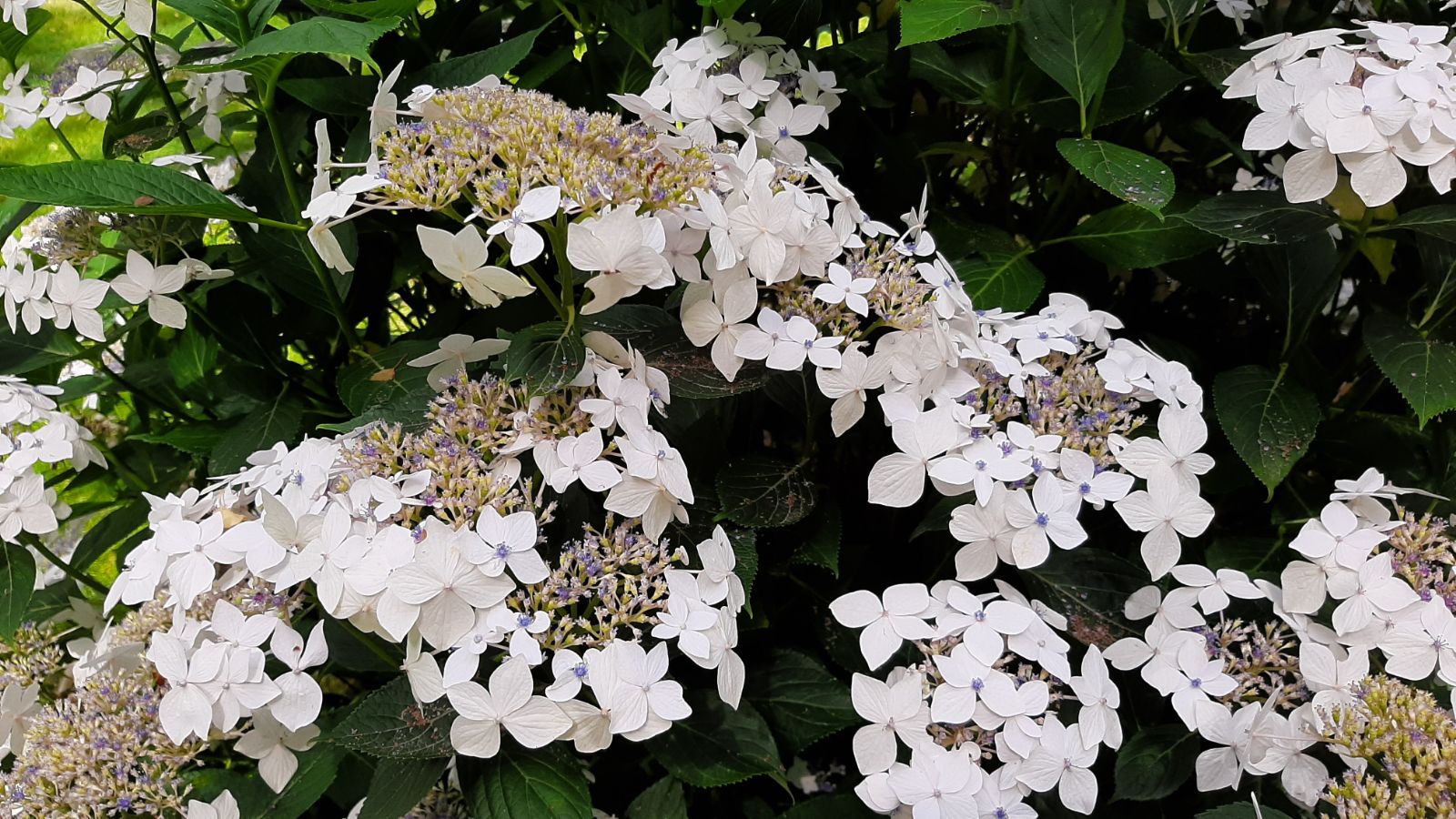
The mop-headed ‘Hortensia’ hydrangeas of gardens descend from plants with normal inflorescences that grow wild in a small area on the east coast of Japan. It was a garden plant of the hortensia kind, known as ‘Otaksa’, from which Thunberg described the species and it is usual to treat the normal wild plants as a variety of this, namely:
From the Supplement (Vol. V)
Garden Varieties
Hortensias
‘Altona’. – From the same raiser, and put into commerce at the same time, is ‘Hamburg’, which also resembles ‘Altona’ in the colour of its flowers, the serrated sepals and the reddish autumn colour of its leaves. But Michael Haworth-Booth points out that it needs some shade and that it is less suitable for the average garden than ‘Altona’.
Lacecaps
† ‘Geoffrey Chadbund’. – Unusually for a lacecap, this has brick-red sterile flowers, at least on neutral or alkaline soils. It received an Award of Merit when exhibited by Messrs Russell in 1974. The original plant was noticed by the late Geoffrey Chadbund growing in a pot in a florist’s shop.
'Altona'
Dense, large heads of cherry-pink or mid-blue of very firm texture on strong stems, lasting well and turning green and then red in autumn. The most effective sort for foundation plantings at the foot of north or west house walls. 3 ft.
A.M. 1957.
'Amethyst'
Double, frilled pale pink or mauve flowers. Perpetual flowering. 2{1/2} ft.
'Ami Pasquier'
Crimson or purplish flowers, less vivid than ‘Westfalen’. 2 ft.
A.M. 1953.
'Ayesha'
Concave lilac-like mauve flowers, not free-flowering. Branch-sport. 3 ft.
'Blue Wave'
Ray-flowers with four wavy-edged sepals, rich blue on very acid soils, otherwise pink or lilac. July-August. A vigorous shrub 6 ft high and as much through, with bold foliage, growing best in light shade. It is a seedling of ‘Mariesii’ raised by Messrs Lemoine and originally distributed by them under the name
H. mariesii perfecta. A.M. 1956. F.C.C. 1965.
'Bouquet Rose'
Like ‘Vibraye’ but inferior on all points. Considered hardier than ‘Vibraye’ in Holland. 5 ft.
'Domotoi'
Double frilled flowers, weak growth. Branch-sport. 2{1/2} ft.
'Europa'
Pink or clear blue, open head. Like a less compact and bluer ‘Altona’. 3 ft.
'Fisher's Silverblue'
Very free-flowering. Ice-blue or pale pink. Compact grower. 2{1/2} ft.
'Frillibet'
Deckle-edged frilly flowers, pale pink or Cambridge blue. Very pretty and effective. 2{1/2} ft.
'Generale Vicomtesse de Vibraye' ('Vibraye')
Hortensia pink or clear blue flowers; hardier and freer flowering than others but stems rather weak. Fine outdoor bushes are now to be found in every county of Britain. 5 ft. A.M. 2947.
'Gentian Dome' ('Enziandom')
Intense vivid deep blue durable flowers. The most colourful deep blue but needs the protection of the wall of an occupied house. 3 ft.
'Kluis Superba'
Deep pink or blue. Very sensitive to any trace element deficiency. 3 ft.
'Lanarth White'
Ray-flowers pure white, fertile flowers blue or pink. Early July-August. Compact and fairly dwarf (to 3 ft high and wide) if grown in sun, which it tolerates. The present stock comes from Lanarth in Cornwall, but where the variety originated is not known. It may be a sport from ‘Thomas Hogg’ (a white hortensia introduced from Japan by the American gardener Thomas Hogg in the 1860s).
'Lilacina'
Ray-flowers with four serrated pink or blue sepals. August-September. A vigorous variety 5 ft high, more in width, raised by Lemoine early this century.
'Maréchal Foch'
Early, free-flowering, deep pink or deep blue. Rather delicate. 3 ft. A.M. 1923.
'Mariesii'
This variety differs from other lacecaps in having a few sterile flowers scattered among the fertile ones but similar in shape to the normal ray-flowers that edge the inflorescence. Sepals of ray-flowers roundish, entire, nearly always pink or mauve-pink (pale blue on very acid soils only). July-August. Leaves rather narrow and evenly tapered. It grows to 4 or 5 ft high. Introduced from Japan by Charles Maries in 1879. Award of Garden Merit 1938.
'Miss Belgium'
Rosy crimson flowers. 2{1/2} ft.
'Mme A Riverain'
Like ‘Vibraye’ but less reliable in colour. Distinguishable by the coloured leaf-stalks. 5 ft.
'Mme E Mouillère'
the best white, perpetual flowering, needs a north house-wall. the flowers blush-pink in sunlight, though the rare fertile flowers stay blue. 6 ft. a.m. 1910.
'Niedersachsen'
Late-flowering, pale pink or pale blue. This would be a valuable sort to succeed ‘Vibraye’ but it is slightly less hardy and needs settled weather for the flowers to last well. 4 ft. A.M. 1968.
'Nigra' ('Mandshurica')
Remarkable only for its almost black stems.
'Otaksa'
Important Chinese foundation variety from Japan; deep blue, red leaf-stalks, weak stems, rather tender. This interesting sort is now rare. The flower stalk bends down with the weight of a wet flower-head. 3 ft.
'Parsifal'
Crimson-pink or deep blue, serrated sepals. The flowers show many strange colour mixtures in heterogeneous soil. 3 ft. A.M. 1922.
'Pia'
A tiny branch-sport, 6 in. high with pink flowers in an irregular small corymb. Requires care.
'Princess Beatrix'
Pink flowers seldom blue; very free-flowering. 2{1/2} ft.
'Quadricolor'
Leaves unusually variegated, showing vivid yellow, cream, pale green, and deep green colourings. Flowers pale pink or blue. 4 ft.
‘Sea Foam’. See p. 391.
'Rosea'
Important Japanese foundation cultivar imported by C. Maries, 1880. Similar to ‘Vibraye’ but weaker in colour and deportment. Still widely grown in Japan. The flower-heads are smaller and tighter than ‘Vibraye’ and of a less pure blue in a given soil pH. 4 ft.
var. normalis Wils.
Synonyms
H. macrophylla f. normalis (Wils.) Hara
H. maritima Haworth-Booth
An almost glabrous shrub 3 to 10 ft high in the wild; young growths stout, pale green. Leaves broad-ovate to broad-obovate, 4 to 8 in. long, about two-thirds as wide, abruptly narrowed at the apex to an acute or acuminate apex, coarsely saw-toothed, lustrous above, greasy to the touch and of rather fleshy texture; stalks {3/4} to 2 in. long. Inflorescence a broad, flat-topped cymose corymb, much branched, with a few ray-flowers round the outside, its branches covered with loosely appressed hairs. Fertile flowers usually blue or pink. Calyx-tube usually tapered at the base into the pedicel, bearing five short, triangular calyx-lobes. Petals narrow-ovate. Stamens ten. Ovary completely enclosed in the calyx-tube when the flowers first expand but later thickening at the apex and projecting above the rim of the calyx-tube. Styles usually three. Capsules {1/4} to {5/16} in. long, including styles. Ray-flowers pink or bluish, entire or toothed, up to 2 in. or slightly more across.A native of Japan, found near the coast on the Chiba peninsula south-east of Tokyo and on the islands south of Tokyo as far as Hachijo. The existence of this wild progenitor of the hortensias appears to have been unknown to western botanists until Wilson called attention to it. He introduced it from Oshima (de Vries Island) in 1917, but whether plants raised from these seeds are still in cultivation in this country is not known. A reintroduction by Michael Haworth-Booth has proved tender and has not yet flowered (1971). Of the established garden varieties the nearest to the wild maritime hydrangea is probably
‘Sea Foam’, which is a sport from the mop-headed hydrangea ‘Sir Joseph Banks’ (see below). This is moderately hardy and flowers quite freely against a house-wall provided the terminal buds are not frosted. The ray-flowers are bluish pink, about 2 in. across, the fertile flowers blue except for the pinkish calyx-tube. The handsome, thick, vivid green leaves persist unchanged on the plant until killed by the first hard frost.As stated above, the type of
H. macrophylla is not the wild ancestral plant, but a garden variety, known as
‘Otaksa’. Thunberg saw and collected this hydrangea during his stay in Japan on Deshima Island and, mistaking it for a viburnum, described it as
Viburnum macrophyllum in his
Flora Japonica (1784).
Hydrangea ‘Otaksa’ was later described more fully, and figured, in Siebold and Zuccarini,
Flora Japonica (1845), p. 105 and t. 52. It had been imported from China, where the Japanese maritime hydrangea had long been cultivated, and was still rare in Japanese gardens when Siebold and Zuccarini published their account. It was introduced to Europe soon after, but has become scarce.
Hydrangea ‘Otaksa’ was, however, not the first variety of
H. macrophylla to be introduced to Europe. Around 1788 Sir Joseph Banks procured from China and presented to Kew a mop-headed plant which Sir James Smith identified as a member of the genus
Hydrangea and described in 1792 under the name
H. hortensis. By 1800, it had become quite frequent in gardens, and less than forty years later there were huge specimens in the milder parts of the British Isles, one ‘as big as a large haycock’ (Loudon,
Arb. et Frut. Brit., Vol. 2 (1838), p. 997). This hydrangea, recently renamed
‘Sir Joseph Banks’, is still common in milder maritime localities.To end this historical account, something must be said about the synonymous name
Hortensia opuloides Lam. This was given by Lamarck in 1789 to a specimen sent to Paris some years earlier by the French naturalist Commerson, who had gathered it from a plant growing on the island of Mauritius. Here the French naturalist and explorer Pierre Poivre (1719–86) had made a famous garden which contained several Chinese species, including this hydrangea, which he may have acquired during his visit to Canton (Bretschneider,
Botanical Discoveries, Vol. 1, pp. 117–20). The generic name
Hortensia, proposed by Commerson, is botanically no more than a synonym of
Hydrangea, but it persisted among French growers and has now become a horticultural name for the mop-headed derivatives of
H. macrophylla. It is believed to commemorate some lady with the Christian name Hortense, and her identity has been the subject of much speculation. She was not, as some have said, Commerson’s mistress, who accompanied him on Bougainville’s expedition round the world, disguised as his manservant. The name of that remarkable woman was Jeanne Baret. Nor, as was pointed out in previous editions, was she Queen Hortense, who was born several years after Commerson’s death. Most authorities have followed Duhamel in stating that the name commemorates Mme Lepaute, a brilliant mathematician and wife of a famous maker of clocks and scientific instruments. Unfortunately for that theory, her Christian name was Nicole-Reine, not Hortense. According to Ebel, in
Hydrangea et Hortensia, the generic name was proposed in honour of the daughter of the Prince of Nassau-Siegen, who (the Prince) took part in Bougainville’s expedition and accompanied Commerson on his botanical explorations.
Garden VarietiesH. macrophylla has given rise to many hundreds of garden varieties, most of which are not really suitable for cultivation outdoors. They were bred as pot-plants and, grown in the open, are either sparse-flowering or produce excessively large and heavy heads, or fail to flower if their terminal buds are killed by spring frosts. However, there is now available in commerce a fairly wide choice of free-flowering varieties, mostly of recent origin some of which have the additional merit of producing inflorescences from axillary buds if the terminal buds are killed. There are, too, a number of varieties which have the normal inflorescences of wild plants, with a centre of fertile flowers and comparatively few ray-flowers round the circumference. These varieties, of which ‘Blue Wave’ is the best known, are useful for natural plantings, where the mop-headed hortensias would be put out of place. To distinguish them from the hortensias, these varieties are now widely known in Britain as lacecaps.The hortensias and lacecaps (except the white-flowered sorts) have the peculiarity that the colouring of the flowers, especially of the ray-flowers, is governed by the concentration of aluminium ions in the soil-water. This depends in turn on the acidity of the soil, being highest on very acid soils and lowest where the soil is alkaline. The colour range depends on the variety, but the bluest shades are always produced on the most acid soils. For example, ‘Vibraye’ will be pure blue on a very acid soil, but an indifferent shade of pink or bluish pink on slightly acid or neutral soils. Crimson varieties develop their characteristic colouring where the soil is near to neutral and often become violet-coloured on good ‘blueing soils’. Where the soil is neutral or slightly acid it is possible to induce or intensify the blueness of the flowers by top-dressing the plants with alum, or watering them with a solution of that substance, or by using a proprietary hydrangea colourant. For a practical discussion of this matter see M. Haworth-Booth,
The Hydrangeas, pp. 135–42.It is very probable that many of the modern hortensias and lacecaps are not unmixed derivatives of
H. macrophylla but rather hybrids between it and the woodland hydrangea (
H. serrata). Wilson considered and rejected this possibility, but when he wrote his study of this group (
Journ. Arn. Arb., Vol. 4 (1923), pp. 233–46) the varieties that show the influence of the woodland hydrangea most clearly were still very new or had still to be raised. This hypothesis, even if proved, would present no nomenclatural difficulties if modern authorities were followed in placing the woodland hydrangea under
H. macrophylla as a variety or subspecies, since the hybridity would then be ‘within the species’. In practice, however, it is not a matter of much horticultural importance, either way, since it is perfectly legitimate to put the cultivar name directly after the generic name, e.g.,
H. ‘Ami Pasquier’ or, more formally, to write
H. (Hortensia) ‘Ami Pasquier’.For the following notes and descriptions we are indebted to Michael Haworth-Booth.
HortensiasThe following, with flower-heads forming a globose corymb, are a selection of the hardier sorts suitable for outdoor growing. With most, the protection afforded by the north or west wall of an occupied house will be found to be necessary for reliable freedom of flower. On the other hand, ‘Generale Vicomtesse de Vibraye’ (shortened in practice to ‘Vibraye’) and ‘Altona’ are usually hardy and are satisfactorily grown in the open in most parts of the British Isles.
'Veitchii'
Ray-flowers white with three or four large, entire sepals. Fertile flowers blue. July-August. A very beautiful hydrangea of rather lax habit, up to 5 ft high, needing light shade. It was first shown in 1903 by Messrs Robert Veitch of Exeter, who probably imported it from Japan. They described it in their catalogue for 1905 and in 1915 it was mentioned by Rehder in Bailey’s
Cyclopaedia under the name
Hydrangea opuloides veitchii. Unfortunately, Wilson later published the name
H. macrophylla f.
veitchii for the hortensia ‘Rosea’, thus causing confusion.
'Violetta'
Unusually vivid violet flowers in compact head. 3 ft.
'Westfalen'
The richest colour of all; pure vivid crimson or deep purple-blue. Free and perpetual flowering. 2{1/2} ft.
LacecapsAs noted above, this group consists of varieties in which the flower-head, instead of being globose and almost wholly composed of sterile flowers, has a form similar to that of the wild prototype. Those described below are the only varieties widely available in commerce at present. See also
H. serrata.
'White Wave'
Another beautiful white-flowered lacecap, differing from ‘Veitchii’ in having the sepals of the ray-flowers toothed and always four in number. It is very free-flowering in an open situation. It was raised by Messrs Lemoine from ‘Mariesii’ and distributed by them under the name
H. mariesii grandiflora. A.M. 1948.