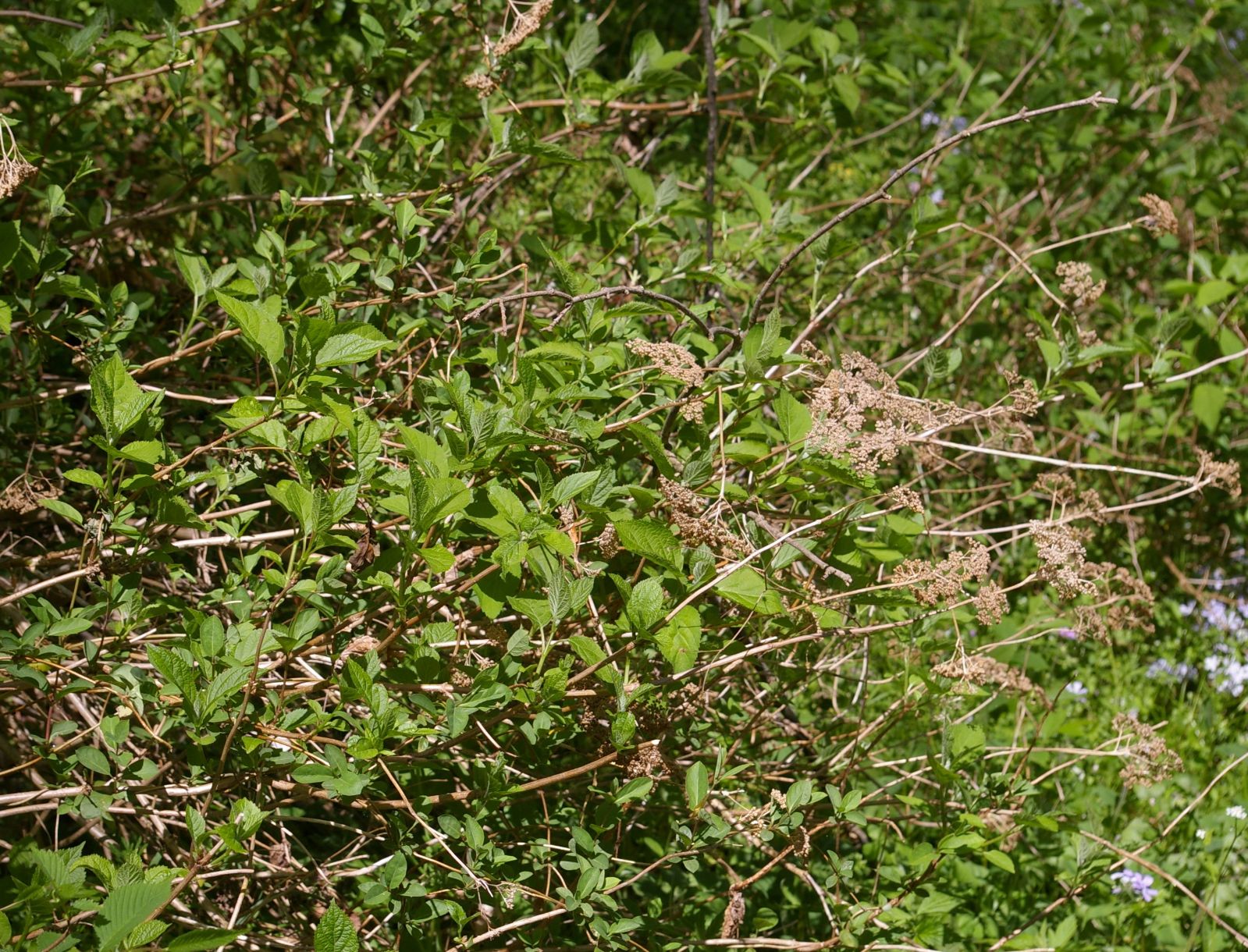
Hydrangea arborescens L.

TSO logo

Sponsor

Kindly sponsored by a generous supporter who loves hydrangeas.

Credits

Julian Sutton (2025)

Recommended citation
Sutton, J. (2025), 'Hydrangea arborescens' from the website Trees and Shrubs Online (treesandshrubsonline.org/articles/hydrangea/hydrangea-arborescens/). Accessed 2026-09-03.

Family

  • Hydrangeaceae

Genus

Common Names

  • Smooth Hydrangea
  • Sevenbark

Other taxa in genus

Glossary

ovary
Lowest part of the carpel containing the ovules; later developing into the fruit.
backcross
Cross between hybrid and one of the parent species.
entire
With an unbroken margin.
glabrous
Lacking hairs smooth. glabrescent Becoming hairless.
indigenous
Native to an area; not introduced.
indumentum
A covering of hairs or scales.
inflorescence
Flower-bearing part of a plant; arrangement of flowers on the floral axis.
morphology
The visible form of an organism.
pollination
Act of placing pollen on the stigma. Various agents may initiate pollination including animals and the wind.
subspecies
(subsp.) Taxonomic rank for a group of organisms showing the principal characters of a species but with significant definable morphological differentiation. A subspecies occurs in populations that can occupy a distinct geographical range or habitat.

References

Credits

Julian Sutton (2025)

Recommended citation
Sutton, J. (2025), 'Hydrangea arborescens' from the website Trees and Shrubs Online (treesandshrubsonline.org/articles/hydrangea/hydrangea-arborescens/). Accessed 2026-09-03.

Deciduous shrub, 1–3 m. Bark brown or grey, peeling on older stems. Branchlets with stiff, spreading or adpressed hairs. Leaves opposite. Leaf blade ovate, (3–)6–18 × (1.5–)2.5–12(–15.5) cm; base cordate, truncate, or cuneate; margin dentate to serrate; apex acute to acuminate; upper surface green, glabrous or sparsely hirsute; lower surface green, glabrous, glabrescent, or sparsely hairy along major veins; petiole 1.5–8.5(–11.5) cm, glabrous, or sparsely tomentose above. Inflorescence terminal, a much-branched dome-shaped structure (3–)4–14 × 3.5–12 cm, with 100–500 flowers; sterile flowers present in some individuals; peduncle 1.5–8 cm. Sterile flowers largely consisting of 3–4(–5) large, petaloid sepals, white, sometimes with a greenish or yellowish tint, obovate to broadly ovate, round, or elliptic, 0.4–1.5 × 0.2–1.4 cm. Fertile flowers with calyx tube ~1 mm, and very small deltate to triangular calyx lobes; petals white or cream (very rarely pinkish), ~1 mm long, free, falling early; stamens 10, 1.5–4.5 mm, five about twice as long as the others; ovary inferior, with 2(–3) locules; styles 2(–3), distinct, ~1 mm. Fruit a hemispherical capsule, ~2 × 2 mm, dehiscing at the apex between the styles. Seeds brown, <1 mm. Flowering (May–)June–July (United States). (Freeman 2016; McClintock 1957).

Distribution  United States broadly Eastern

Habitat Moist to dry deciduous forests and woods, moist slopes, shaded bluffs, ledges, stream banks; 70–2000 m asl.

USDA Hardiness Zone 3-9

RHS Hardiness Rating H6

Conservation status Not evaluated (NE)

This very hardy species was among the first hydrangeas grown in Western gardens. A fairly small shrub spreading freely underground, it can be grown in shade or sun, and mixes well with herbaceous plants in the garden. Like H. paniculata it blooms on current year’s growth and can be heavily pruned, even cut right to the base in winter, without sacrificing flowers. Throughout the 20th century a few mopheaded cultivars dominated, but some excellent clones with lacecap (wild type) inflorescences are now becoming available.

Hydrangea arborescens is one of just four non-climbing North American hydrangeas, along with HH. cinerea, radiata and quercifolia. Molecular work supports a close relationship between them, long-presumed from their morphology and distribution (De Smet et al. 2015; Yang et al. 2024). H. quercifolia is easily distinguished by its lobed leaves and pyramidal rather than flat or domed inflorescences. The remaining three species look far more alike, but are distinguished by the undersides of their unlobed leaves. In H. arborescens the green undersurface is glabrous, at least when mature, or may have sparse hairs only on the veins. In H. cinerea it is greyish with hairs, sometimes quite densely but never enough to be matted. H. radiata has the palest leaf underside, silvery or white with a matted, felt-like indumentum (Freeman 2016; McClintock 1957). H. arborescens is widespread in eastern North America, from the southeastern coastal plain and the Ozarks through southern Appalachia and the lower Midwest to Illinois and New York, and is sometimes naturalized further north in New England and maritime Canada. H. cinerea extends less far north, its range centred on the Southern Appalachians, while H. radiata has a still narrower Appalachian range in the Blue Ridge and Smoky Mountains, extending somewhat into the piedmont area.

H. cinerea and H. radiata were treated by the usually influential McClintock (1957) as subspecies discolor and radiata of H. arborescens, but this was never universally adopted by American botanists. Pilatowski (1982) makes a powerful case for their being distinct, reproductively isolated species, showing that there are strong (though not insurmountable) barriers to interbreeding, that they remain morphologically distinct even in habitats where two or all three species are present, and that apparent intermediates are rare in the wild. We take this line, along with Flora of North America (Freeman 2016), Plants of the World Online (Royal Botanic Gardens Kew 2024) and most other current opinion. However, the experience of breeders is that hybridization is possible. Because some cultivars cannot certainly be attributed to species, one or two are undoubted hybrids (e.g. ‘Smnhalr’), and because the single species treatment is still used by some gardeners and breeders, confusing naming, we list cultivars of the entire group together (see below).

‘Common as rocks’ in the southern Appalachians and Piedmont (Dirr 2004), Smooth Hydrangea was well known to indigenous people. The peeling bark especially was used to treat diverse ailments by the Cherokee and others, either as an infusion or chewed (Moerman 2003). H. arborescens is the type species of the genus, described scientifically by Linnaeus (1753). It was already in European gardens, introduced to Britain in 1736, probably from Virginia, by the well-connected and plantsmanly London gardener and textile merchant Peter Collinson (Loudon 1838), who was in contact with such colonial American figures as Benjamin Franklin, Mark Catesby and John Bartram. By the end of the century it was commonly grown (Curtis 1799). As an American garden plant Loudon (1838) was able to give a market price in New York. Many more recent wild collections from across the range can be seen in botanic gardens on both sides of the Atlantic (e.g. Royal Botanic Garden Edinburgh 2024; Arnold Arboretum 2024); some wild finds have made a much wider impact.under cultivar names (e.g. ‘Grandiflora’, ‘Annabelle’).

Light shade and consistently moist soil are ideal in the garden, reflecting wild conditions. However this species can be grown in full sun or quite heavy shade. In hot-summer areas such as the American Southeast leaf scorching and premature senescence of flowers is an issue in sun, making shade more important; some cultivars are more sensitive than others (Mt. Cuba Center 2021; Dirr 2021). Established garden stocks are widely hardy in Europe (including parts of Scandinavia – NTNU University Museum 2024; Arboretum Mustila 2024) and in North America away from the driest areas. Despite sometimes being recommended in the coastal gardening literature, H. arborescens is rather easily damaged by salt spray on the leaves (Conolly, Bassuk & MacRae 2010).

Unusually for a hydrangea, H. arborescens spreads by underground stems, sometimes making broad thickets in the wild (Dirr 2004); dense, slowly spreading clumps are the norm in gardens. This makes it one of very few hydrangeas which can be propagated by division when dormant, at least on a domestic scale (Curtis 1799; Dirr 2021). In cold areas such as Finland aerial growth is usually killed in winter, but the plant regrows from underground buds (Arboretum Mustila 2024). Elsewhere gardeners often choose to cut the stems back to ground level at the end of winter; the plant then behaves almost as a herbaceous perennial with a spreading rootstock. Cut-back plants tend to grow less tall, and the vigorous first-year stems have larger inflorescences, potentially eye-catching but prone to flopping in weaker stemmed cultivars (Hoadley 2021), just as in H. paniculata. Otherwise, old inflorescences can be tidied away in winter, leaving the framework of stems intact.

Flowers are in flat to domed terminal inflorescences on the current year’s growth and have a light, sweetish smell; in wild plants sterile flowers are often small and few or absent. Like other hydrangeas it has a generalist pollination strategy, flowers attracting diverse insects, especially bees and flies (Robertson 1892; Pilatowski 1982). With very few exceptions, mophead cultivars were less visited by insects than wild type (lacecap) forms in a Delaware, USA, garden setting (Hoadley 2021).

Cultivars have always been dominated by mophead forms, with large numbers of sterile flowers spread through the inflorescence and usually hiding the fertile flowers. Two wild finds from around the turn of the 19th/20th centuries have been very widely grown and sold by nurseries, first ‘Grandiflora’ then the more spectacular ‘Annabelle’. A floppy habit, with stems too weak to support the heavy heads, has always been a problem with these. Stronger stemmed counterparts such as ‘Abetwo’ have been a breeding aim. Elite lacecap clones such as ‘Mary Nell’ and ‘Haas’ Halo’, with good habit and large, conspicuous sterile flowers have proved less commercial, but are available and can be very beautiful. Three pinkish flowered discoveries, ‘Eco Puff Pink’, ‘Pink Pincushion’ and ‘Wesser Falls’ have not set the world alight, but provided genes for modern pink mopheads. The most successful such breeding programme was carried out by Tom Ranney and colleagues at North Carolina State University (NCSU) in the early 21st century. We discuss this in some detail as an example of a serious, focused breeding effort: these breeders have made public more information than most, particularly in patent applications for the cultivar series ‘Ncha1’ to ‘Ncha8’ (Google Patents 2024), and these are the major references for the detail outlined below.

The starting point for all released NCSU cultivars was ‘Annabelle’; it is self fertile and most seedlings from it are white mopheads (Dirr 2004). ‘Annabelle’ was crossed with ‘Wesser Falls’; one selected seedling was then crossed with ‘Eco Puff Pink’. This gave rise to a seedling population which was the basis for all successful work; some of these were crossed amongst themselves in various ways. ‘Ncha1’ (PINK ANNABELLE / INVINCIBELLE® SPIRIT), a diploid, was a result of this. All the other ‘Ncha’ cultivars are triploids with low fertility, a great advantage to commercially minded breeders who do not want to make life easy for competitors. This was achieved by first raising induced tetraploid seedlings from the basis population. The final cross in producing each cultivar involved a diploid and one of these tetraploids (each bringing genes for both pinking and mophead form from different seedlings in the basis population, thus limiting inbreeding), giving near-sterile triploid seedlings for selection and trial. In ‘Ncha2’ the diploid parent was a seedling selected from a backcross between ‘Annabelle’ and the basis population. In all subsequent releases strong-stemmed ‘Abetwo’ replaced ‘Annabelle’ as grandparent. With seedlings able to flower within 12 months, much can be acheived in a few years, but there is no substitute for large scale and hard graft in raising, comparing, selecting and trialling quantities of seedlings.

A good range of established, newer and scarce cultivars was trialled over 5 years at Mt Cuba Center, Delaware, USA, taking into account attractiveness to insects for ‘pollinator friendly’ gardening, as well as aesthetics and plant constitution (Mt. Cuba Center 2021; Hoadley 2021,2022).

H. arborescens is a diploid (2n=36) (Cerbah et al. 2001). Apart from garden hybrids with closely related H. cinerea and H. radiata, it does not easily cross with other species. Its hardiness makes it a desirable parent, however. Ovary culture has been used in making viable hybrids with H. quercifolia (Bak & Han 2022) and H. macrophylla (Cai et al. 2015), both confirmed genetically. The latter cross, H. macrophylla ‘Blue Diamond’ × H. arborescens ‘Annabelle’ gave mophead seedlings with pigmented sepals. The ability to flower on first year growth is also attractive to breeders; the genes underlying this are under investigation (Huang et al. 2023).

All cultivars of HH. arborescens, cinerea and radiata, plus known and possible possible hybrids between them are listed together on alphabetical pages ‘Hydrangea arborescens Species Complex Cultivars A–M’ etc. The great majority are probably pure H. arborescens, but it is impossible to rule out hybridity.