IDS Trees and Shrubs Online has become a fundamental source of reliable information about cultivated woody plants, freely available to everyone, everywhere. We hope you find it useful.
For the first time we are asking our users if you could support us.
If everyone who uses TSO during May 2026 gives just £10, we would cover our costs for a whole year, enabling us to accelerate our work.
Roderick Cameron (2025)
Recommended citation
Cameron, R. (2025), 'Exochorda racemosa' from the website Trees and Shrubs Online (treesandshrubsonline.
Deciduous shrubs, 1–5 m high, branchlets red-brown when young, later brown; young shoots erect, slender, glabrous and reddish-brownish, old shoots brownish; buds triangular-ovate, with several imbricate scales, apex obtuse or acute, glabrous, purplish-reddish. Leaves petiolate, elliptic, oblong-elliptic to oblong-obovate, entire, sparsely serrate above the middle, apex rounded-obtuse, acute or somewhat apiculate, base cuneate or broad-cuneate, glabrous above and below; stipules absent or small and caducous. Inflorescence in a terminal raceme. Flowers 3–12, large (2+ cm in diameter); bracts small, broad-lanceolate. Hypanthium shallowly bell-shaped. Sepals 5, very short and broad. Petals 5, imbricate, whitish, obovate, apex obtuse, base clawed. Stamens 9–37, 2–7 inserted at the margin of the disk, opposite to the petals. Carpels 5, connate; styles free. Fruit a capsule, turbinate, glabrous with 5 spines, purple-brownish at maturity. Seeds 1 or 2, half-rounded, winged. (Gao 1998; Gu & Alexander 2003).
Distribution China Central, East & Northeast: Anhui, Gansu, Hebei, Henan, Hubei, Jiangsu, Jilin, Liaoning, Shaanxi, Shanxi, Zhejiang North Korea South Korea Kyrgyzstan Russia Southern Far East: Primorsky Krai Tajikistan Uzbekistan
Habitat Hills, slopes, and valleys, or forest edge; 0–2000 m.
USDA Hardiness Zone 4-9
RHS Hardiness Rating H6
Conservation status Not evaluated (NE)
Taxonomic note The taxa that for some authors are E. giraldii and E. serratifolia are here treated as subspecies (see below), following Gao’s 1998 revision. The hybrid name E. × macrantha, applied to the cross between the formerly recognised E. korolkowii and E. racemosa, is mentioned under the cultivar ‘The Bride’, but other (unselected) progeny from this cross may still be in cultivation as E. × macrantha.
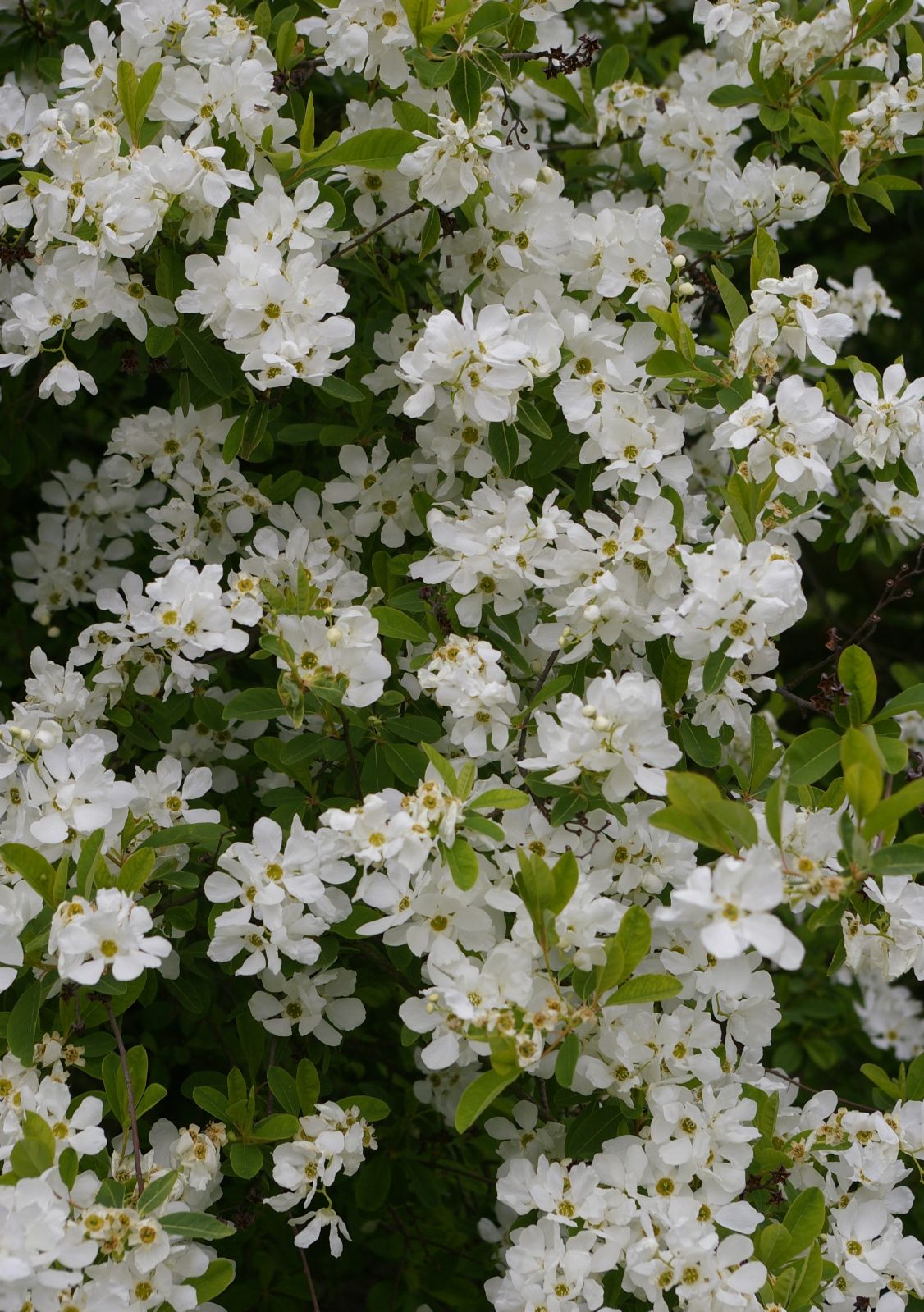
This deciduous shrub catches the eye in spring with its cascades of snowy white flowers – as it did Robert Fortune’s on a hillside in North China in 1845 – then it recedes into oblivion for the rest of the year. But the flower effect is enough to endear the plant to garden enthusiasts. The white spherical buds that precede the blooms appear along the stems like pearls on a necklace, earning the plant its common name, Pearlbush.
It is easy to grow, thrives in the sun, survives in shade, and prefers acidic, fertile, light, well-drained soil. It also prefers a continental climate with hot summers and cold winters and appreciates a site protected from wind. Pruning is best immediately after flowering, as it flowers on old wood from previous year’s growth, so pruning at other times could reduce blooming (Stewart 2011). Bean (1976) encourages the removal of weaker shoots in order to reduce the number of stems in case of overcrowding. Dirr (1998) recommends the species for flower effect in the shrub border, as it can be spectacular in flower but soon fades into oblivion. In the southeastern United States, he claims, it thrives with neglect and tolerates heat and drought.
It can be propagated from seed, which will germinate sporadically when sown directly. Germination improves with 30–60-day stratification. Softwood cuttings collected in summer can be dipped in rooting hormone for best results (Dirr 1998). It is generally free of pests and diseases. According to the Royal Horticultural Society (2025), it may be susceptible on rare occasions to honey fungus (Armillaria sp.), though in California E. racemosa has been found to be resistant to it (Rabe 2008).
Exochorda racemosa has a disjunct distribution in East Asia and Central Asia. The centre of geographical distribution and diversity is in the East, principally China. Fossil evidence is scant, limited to one fossil found in Liaoning, China, but it suggests the species may have originated in the temperate mountain zone of East Asia, perhaps in the Early Tertiary. This likely happened prior to the emergence of the Taklamakan Desert in northern China. The taxon, formerly distributed across a large area in the northern hemisphere of Asia, would have become separated into different regions as intervening areas were depopulated by the rigours of the climate. The isolated populations would then have been subjected to divergent evolution. The current disjunction may thus represent the relict of an originally wide and continuous distribution (Gao 1998).
The species is found on riverbanks, moist slopes, thickets, scrubland, forest margins and open woodland. Plants tend to be short and small in exposed or dry environments, and larger and more vigorous in moister conditions. In cultivation it is not demanding as regards to soil, but calcareous soils are less suitable (Gao 1998), though there may be some variation in this (Edwards & Marshall 2019).
It was first collected by Fortune in 1845, according to a specimen he marked ‘a dwarf shrub, flowering in March, North China, 1845’ (Bretschneider 1898). The type specimen at Kew is labelled 1846, and according to Gao (1998) was collected ‘in the mountains near Ningbo, Zheijan province, China.’ Lindley published the name Amelanchier racemosa in reference to this specimen, which Fortune ‘did not succeed in bringing home alive’ (Lindley 1847). Fortune mentioned seeing it in 1849, in the mountains near Ningbo, referring to it as a shrub ‘new to botanists, and scarcely yet known in Europe, called Amelanchier racemosa, not less beautiful than the azalea, and rivalling it in its masses of flowers of the purest snowy white’ (Fortune 1852). Then in 1854, W.J. Hooker wrote of a plant ‘sent by Fortune under the name Amelanchier racemosa, from the North of China, to Messrs. Standish and Noble, of the Bagshot Nursery, where it bears the open air, blossoming in May, 1854’ (Hooker 1854), It may be inferred, therefore, that Fortune introduced the plant in 1849 or shortly thereafter (Miln 1997).
The specific epithet racemosa means ‘full of clusters’, in reference to the flowers. The word derives from Latin racemus (‘cluster, bunch’) and is related to the ancient Greek ῥᾱ́ξ (rhā́x, ‘grape’) (wiktionary.org 2025).
Common Names
Red Pearlbush
红柄白鹃梅 hong bing bai juan mei
Synonyms
Exochorda giraldii Hesse
Shrubs to 5 m tall. Branchlets green when young, red-brown when old; buds red-brown, pubescent at scale margins, apex obtuse. Leaves ovate, long-ovate or long-obovate, 3–4 cm by 1.5–3 cm, glabrous above and below or pubescent below, apex rounded, obtuse or apiculate, base wide-cuneate, rarely oblique, entire, sparsely serrate above the middle, glabrous; petioles slender, base reddish or green, glabrous, 15–25 mm. Raceme 5.5–11 cm long, flowers 5–12, 30–45 mm in diameter, pedicels about 1 mm long or nearly absent; petals obovate or oblong-obovate 20–28 mm × 9–17 mm, base attenuate into a long claw, apex rounded; stamens 20–30. Capsule glabrous, 10–12 mm × 10–12 mm, seeds 8–10 mm × 4–6 mm. (Gao 1998; Gu & Alexander 2003).
Distribution China Northwest & Central: Anhui, Gansu, Hebei, Henan, Hubei, Shaanxi, Shanxi, Sichuan, Zhejiang.
RHS Hardiness Rating: H6
USDA Hardiness Zone: 4-9
Exochorda giraldii caused a stir among German horticulturists when it first emerged, apparently described from cultivated plants. Once the dust settled, the name was applied to a shrub of vigorous growth and notably large flowers, with petals that taper towards the base, ending in a long claw. It has been recognised as ‘a superior shrub for gardens’ (Bean 1916) but remains rarer in cultivation than subsp. racemosa. It is usually found as the var. wilsonii, said to have the largest flowers of the genus (Edwards & Marshall (eds) 2019).
This subspecies occurs in Central China, sandwiched between the disjunct population of subsp. racemosa, and found at higher elevation, giving it a ‘more montane character’ (Gao 1998). Though Gao limits the distribution of the subspecies to Gansu, Shaanxi and Shanxi, she does not seem to consider var. wilsonii, which she synonymised under this subspecies and which was collected further south in western Hubei. Gu and Alexander (2003) in Flora of China give a wider distribution for subsp. giraldii (as E. giraldii) and in it include var. wilsonii, occurring in the southern area of the distribution (Anhui, Hubei, Sichuan, Zhejiang) and at lower elevation: 600–1300 m, compared to 1000–2000 m for the autonym var. giraldii.
The taxon was first introduced from seed sent to Ludwig Beissner, inspector of the botanical gardens of Bonn, by Father Giuseppe Giraldi, a Franciscan friar and botanist. Beissner forwarded the seed, which Giraldi collected in Shaanxi, to Hermann Hesse (no relation to the novelist!), a nurseryman in Weener, northwest Germany, for propagation. Plants from these seeds were cultivated around 1904 in Hesse’s nursery (Beissner 1908). Exochorda giraldii was first described by Hesse from what appears to have been a chance seedling with unique characteristics that were not typical of the plant in the wild. Hesse described his plants in 1908 in a note in German: under the name E. giraldii, he refers to a species ‘developed’ by Giraldi in China from seeds he collected (Eine neue, von Pater Giraldi … entstandene Art), and that Hesse has seen in his own plants petals that are ‘split’ (geschlitzten) and ‘cherry-red spotted’ (kirschrot gefleckten), as well as small flowers of ‘other colours’ (Hesse 1908). The Latin protologue included in the same publication mentions rounded or obovate leaves and large flowers to 6 cm across, and describes the white petals as laciniate and red-spotted (laciniatis, rubro-maculatis) (Schwerin (ed) 1908). The following year, Hesse published a fuller account, raving about ‘A completely new, still unknown, nowhere to be found species developed by Father Giraldi.’ He mentions pink young shoots, pinkish-red petioles, veins, and terminal tips that retain their colour, large flowers with partly slit petals, broad and narrowing to a claw at the base, and bracts that are cherry-red inside. He concludes this is ‘Eine wirkliche großartige Seltenheit’ (a truly magnificent rarity) and announces that among the seedlings he has found one with double flowers (Hesse 1909). While the description of the leaves, which were earlier compared to Cotinus by Beissner (1908), matches current plants in this taxon, the laciniate, red-spotted petals seem to have been lost (which some might consider a blessing!). Double flowers are sometimes reported on the cultivar ‘The Bride´ (see below).
When Rehder published Exochorda racemosa in 1913, he included Hesse’s plant as a variety of it. In his description, he maintains the distinctive features of slender red petioles, but remarks that the reference to ‘rubro-maculata’ petals in the original description was apparently an error, as the petals are normally white (Sargent 1913). In an article published the following year in the same German journal where Hesse had published his description, Rehder described the plant as E. giraldii, with petals often incised or slashed and narrower, tapering more gradually to the claw, resulting in the corolla being more open in the center, allowing the sepals, which are usually reddish on the inside, to be visible (Rehder 1914). According to Bean (1916), it was introduced to England in 1909 and is distinguished by the pink young shoots and persistently pinkish petioles and leaf veins. He mentioned the red margin on the calyx, but the petals were described as pure white. The type specimen, collected in Shaanxi by Giraldi in 1897, bears fruit but no flowers. It is not clear it is the type corresponding to Hesse’s publication, which seems to be based on his own cultivated plants.
Despite the confusion surrounding the original description of this taxon, the current consensus is that subsp. giraldii (or E. giraldii in Flora of China) applies to the plants found in Northwest and Central China, bearing larger flowers, usually with reddish petioles, but with greenish ones in the case of those found in the southern part of the distribution, which correspond to var. wilsonii.
Common Names
Wilson's Pearlbush
Synonyms
Exochorda racemosa var. wilsonii Rehder
Distinguished in subsp. giraldii by its larger flowers (5 cm across), greenish petioles, sometimes serrate margins, and fewer stamens (20–25) (Gu & Alexander 2003).
Distribution China Anhui, Hubei, Sichuan, Zhejiang
First introduced from seed collected by Wilson in 1907 in western Hubei (Wilson 397) and cultivated in the Arnold Arboretum. A 1916 account reported that in cultivation the variety, which in habitat is a wide-spreading shrub, grew like a tree with a single straight stem and relatively short branches, forming a narrow pyramidal head (Arnold Arboretum 1916). According to Rehder, the plants were larger in every part and more vigorous, with flowers open in the centre due to the longer and narrower claws of the petals; some of the flowers on plants from this collection were occasionally tinged pink (Sargent 1913). Plants from Wilson 397 were also grown at Kew from material received in 1913. They were described by Taylor (1986) as distinguished by the uniform bright green foliage and the petioles and midveins not tinged with red, as in typical subsp. giraldii var. giraldii.
A notable specimen of var. wilsonii grows at Mt. Auburn Cemetery, Cambridge, Massachusetts, where it has reached 5.5 m tall and around 6.5–7.5 m wide. When in full flower, it visually dominates the immediate location where it stands (Gorman 2025). For Dirr (2009), this was the finest Exochorda he had observed. Given that plants from Wilson 397 were growing in other gardens in Cambridge, Massachusetts in 1916, this plant may be of the same origin (Arnold Arboretum 1916).
Common Names
Pearlbush
Pearl Bush
白鹃梅 bai jian mei
Synonyms
Albertia simplicifolia Regel ex O.Fedtsch. & B.Fedtsch
Exochorda alberti Regel
Exochorda dentata Chenault ex Rehder
Exochorda grandiflora Lindl.
Exochorda korolkowii Lavallée
Exochorda tianschanica Gontsch.
Spiraea grandiflora Hook., not Sweet
Shrubs to 3 m tall. Leaves elliptic, oblong-elliptic to oblong-obovate, 3–6 cm by 1.5–4 cm, entire, sparsely serrate above the middle, apex rounded-obtuse, acute or somewhat apiculate, base cuneate or broad-cuneate, glabrous above and below; petioles 5–15 mm long or nearly absent. Raceme 8–14 cm, flowers 5–12, glabrous, pedicels 3–8 mm, flowers 25–45 mm in diameter. Hypanthium glabrous, about 2 mm long, apex acute or obtuse. Petals 23 mm × 18 mm, apex obtuse, base shortly clawed; stamens 9–27, 2–6 inserted at the margin of the disk. Capsules glabrous, 9–13 mm × 9–13 mm; seeds 8–10 mm × 4–6 mm. (Gao 1998; Gu & Alexander 2003)
Distribution China East: Anhui, Henan, Hubei, Jiangsu, Jiangxi, Zhejiang Kyrgyzstan Tajikistan Uzbekistan
RHS Hardiness Rating: H6
USDA Hardiness Zone: 4-9
The autonymous subspecies is the best known and is widely cultivated. It has a disjunct distribution, with populations in Eastern China and Central Asia, presumed to be a relict of a former wide, continuous distribution pattern. Plants referred to as E. korlokowii, E. alberti, and E. tianshanica correspond to the Central Asian populations and belong here (Gao 1998).
In contrast to the other subspecies, this is not suitable for shallow chalk soil (Edwards & Marshall (eds) 2019). For other details on introduction to cultivation and horticultural characteristics, see species article.
Common Names
Korean Pearlbush
齿叶白鹃梅 chi ye bai juan mei
까침박달 kkachim-bakdal
Synonyms
Exochorda serratifolia S.Moore
Exochorda serratifolia var. polytricha C.S.Zhu
Exochorda serratifolia var. oligantha Nakai
Exochorda serratifolia var. typica Nakai
Shrubs to 2 m tall. Branchlets red-purple when young, later dark purple; buds purple-red. Leaves elliptic or long-obovate, 5–9 cm × 2–4 cm, apex acute or rounded-obtuse, base cuneate or broad-cuneate, serrate above the middle, entire beneath the middle, young leaves somewhat pubescent below when young, later glabrous above and below, leaf venation pinnate, lateral nerves somewhat curved; petioles 10–20 mm, glabrous. Raceme 3.5–8.5 cm long, flowers 3–7, glabrous, pedicels 2–3 mm long, glabrous; flowers 30–40 mm in diameter. Petals oblong to obovate 10–19 mm × 5–10 mm; stamens 13–29. Capsule glabrous 8–10 × 10–13 mm; seeds 6–10 mm × 5–6 mm. (Gao 1998; Gu & Alexander 2003)
Distribution China Northeast: Hebei, Jilin, Liaoning North Korea South Korea Russia Southern Far East: Primorsky Krai
RHS Hardiness Rating: H6
USDA Hardiness Zone: 4-9
Taxonomic note Exochorda serratifolia var. polytricha, described from north Henan (Jiyuan Xian), was said to differ in having the current year’s branchlets, petioles, leaf undersides, inflorescence rachis, and pedicels all densely covered in white crispate pubescence Gu & Alexander 2003. According to Gao (1998), this pubescence falls within the range of subsp. racemosa. She suggested this variety probably should be recognised, but the description is not clear and she was not able to inspect the type.
This is the only subspecies that is native to the Korean Peninsula, hence the common name; it is also found in northeastern China. It is distinguished from the other subspecies principally by the leaves, which have a serrated margin above the middle. It also is better adapted to cooler climates, as befits its more northern distribution. It has been the subject of several studies in Korea. Lee et al. (1987) found that plants transplanted into shaded environments performed well, leading them to suggest it could be cultivated as a shade-tolerant landscape plant.
Unlike subsp. racemosa, subsp. serratifolia thrives on shallow chalk. According to The Hillier Manual, it forms an elegant, medium-sized bush and flowers freely (Edwards & Marshall (eds) 2019). For Dirr, however, it was ‘the least impressive in flower’ in comparison to other Pearlbushes at the Arnold Arboretum (Dirr 1998).
It was described as E. serratifolia in 1878 by S. Moore, who in addition to the serrated leaf margins pointed to the longer and comparatively narrower petals as characters that made the taxon ‘abundantly distinct’ from E. racemosa, at the time the only other species in the genus (Moore 1877–1879). The type specimen was collected in Liaoning in 1876 (Gao 1998). Dirr (1998) gives 1918 as the year of introduction, but this is not corroborated in other sources.
The epithet serratifolia derives from Latin and means saw-toothed leaf: from serratus (‘serrated’ from serra = ‘saw’) + folium (‘leaf’) (wiktionary.org 2025).
Numerous cultivars of Exochorda have been selected, some of more-or-less known parentage, while in others this is far from clear. We treat them all here as unattributed cultivars, with an indication of ancestry where known.
The familiar name Exochorda × macrantha disappears in the Gao (1998) treatment of the genus adopted here. Information about its origins will be found under the entry for ‘The Bride’.
Synonyms / alternative names
Exochora racemosa FIRST EDITIONS® LOTUS MOONTM
A selection of compact, upright, mounded habit, with white blooms that completely cover the plant. Bred by Don Selinger and introduced in 2013 by Bailey Nurseries in Minnesota, USA, under the trade designation LOTUS MOONTM, part of the registered trademark FIRST EDITIONS® (Bailey Nurseries 2021).
Synonyms / alternative names
Exochorda racemosa SNOW DAY® BLIZZARD
Raised by Tom Ranney of North Carolina State University, this selection is distinguished by its compact size and larger flower diameter. It is a cross between subsp. serratifolia and ‘The Bride’ (see below), thus combining the genetics of populations from the western limit of the distribution of the species in Central Asia (from the female parent of ‘The Bride’) with those from the eastern limit in the Korean Peninsula. It is extremely floriferous with flowers that can be twice as large as other Pearlbushes (5–6.4 cm in diameter). Selected in 2003 and patented in 2013. Molecular analysis showed that ‘Blizzard’ is polyploid, with a genome approximately double the size of its parents (Ranney 2013). It is traded under the trademark PROVEN WINNERS® SNOW DAY® registered by Spring Meadows Nursery, Grand Haven, Michigan.
Synonyms / alternative names
Exochorda racemosa BLUSHING PEARLTM
A selection with buds tinged with pink, though the flowers are pure white, blooming along the whole branch. Leaves and flowers are larger than normal, and the plant has an upright habit. Bred by Nico Huisman of Huisman Boomkwekerij, Boskoop, the Netherlands, and introduced in 2018. Patented in 2021 and offered under the trade designation BLUSHING PEARLTM (Tax 2024; Zahradnicví Safro milan davis 2025).
Synonyms / alternative names
Exochorda racemosa 'The Pearl'
An old cultivar, raised from seed at National Botanic Gardens Glasnevin, Dublin, before 1933, from a cross between what was then E. giraldii var. wilsonii and E. racemosa. It features 8–10 flowers on each raceme, about 4–5 cm in diameter, closely arranged on the very long stems (50–90 cm long). It is listed as an Irish Heritage Plant, but it has been extinct for about a decade (S. O’Brien pers. comm. 2025). In a 2015 listing, only one nursery in Ireland was offering it (Irish Garden Plant Society 2015; Nelson 2000; Gao 1998; Dirr 2009).
Synonyms / alternative names
Exochorda racemosa MAGICAL® SPRINGTIME
A cultivar of compact, upright habit, forming a narrowly vase-shaped shrub. It is distinguished by the fact that it flowers from top to bottom of the plant on old and new wood, so it will bloom abundantly even without pruning. In addition to flowering in spring, it is said to often produce a second flush in summer. Bred in 2013 by Peter Rudolf Koster of Boskoop, the Netherlands, and sold under the trade name MAGICAL® SPRINGTIME. Patented in Europe in 2016 (Zahradnictví Safro milan havlis 2025; Sapho – des plantes de bonne nature 2025)
Synonyms / alternative names
Exochorda racemosa SNOW DAY ® SURPRISE
Raised by Herman Geers of Boskoop, the Netherlands, this selection has a compact, upright, outwardly spreading and mounding habit. It bears cascades (hence the name?) of white flowers and is said to be easy to propagate. It originated as a backcross of ‘The Bride’ with an unnamed selection of subsp. racemosa as the pollen parent (Geers 2009). It can be seen as an improvement on ‘The Bride’, which is difficult to propagate and has a tendency to flop as a young plant (Wood 2010). In the United States, it is sold under the tradename SNOW DAY® SURPRISE, included in Spring Meadows Nursery’s registered trademark.
USDA Hardiness Zone: 3-8
A selection of subsp. serratifolia introduced in 1995 by Minnesota Landscape Arboretum, bred for cold hardiness and Minnesotan winters. According to Stewart (2011), it is hardy to USDA Zone 3. Slightly smaller than other cultivars, about 1.5 to 2.2 m tall (Cappiello 2009).
Synonyms / alternative names
Exochorda racemosa SNOW MOUNTAINPBR
Raised by Herman Greers of Boskoop, the Netherlands, as a cross between ‘The Bride’ as female parent and an unnamed selection of subsp. racemosa as the male parent. Distinguished by being very floriferous with flowers growing from the base to the tip of each branch, and from the lowest branch to the top. It has an upright, compact habit, up to 1.6 m, and is easy to propagate from softwood cuttings. Bred in 1994 and selected in 1997; patented in the United States in 2015 (Geers 2015; Herman Geers dwerg & miniatuurplanten 2025).
A selection of subsp. serratifolia, with a rounded, dense habit, supported by slightly arched branches, reaching 2.5 m on average, but taller on fertile soils (Promesse des Fleurs 2025). According to Gao (1998), it boasts ‘purest white flowers’ and was listed in a 1997 catalogue by Esveld Nursery, Boskoop, the Netherlands, though it is not clear where it originated.
Synonyms / alternative names
Exochorda × macrantha (Lemoine) C.K.Schneid., in part.
Awards
Award of Garden Merit
This well-known cultivar was selected by Grootendorst nursery in Boskoop, the Netherlands, around 1938 (Phillips & Rix 1989). It is a selection of what was called Exochorda × macrantha, a hybrid of two formerly recognised species: E. alberti and E. grandiflora. E. alberti, a synonym of E. korolkowii, was applied to plants from Central Asia, while E. grandiflora is a synonym of what is now known as E. racemosa subsp. racemosa. The hybrid was raised by Victor Lemoine of France around 1900 and first published in his nursery’s catalogue in 1902 as E. alberti macrantha (Schneider 1906; Gao 1998). He fertilised E. alberti with pollen of E. grandiflora, breeding ‘a shrub of great beauty, producing a raceme of flowers from every bud of the previous year’s growth’ (Bean 1916).
‘The Bride’ is a small to medium-sized dense bush of weeping habit (Edwards & Marshall (eds) 2019). It reaches around 1.2 m × 1.2 m, sometimes taller, and according to Gao (1998) it is the only known genotype with pendulous branches. For Dirr (2009), it is ‘typically somewhat floppy, loose and stringy’, and he suggests it could be improved by breeding a plant with a more compact, uniform habit (the cultivar ‘Niagara’ may have done just that, see above). According to Gao (1998), the cultivar is functionally female, which she remarks is ‘very appropriate for a bride.’ Its abundant late spring bloom, with masses of large white flowers, reminiscent presumably of a bridal dress or wreath, seems to test for some the limits of good taste: it has been referred to as ‘some sort of crass class-less hawthorn alternative that is somehow “too white”’ (Ballyrobert Gardens 2025). Given its popularity in gardens, this appears to be a minority view. It received the Award of Garden Merit in 1993.