
Euonymus latifolius
Credits
Article from Bean's Trees and Shrubs Hardy in the British Isles
Recommended citation
'Euonymus latifolius' from the website Trees and Shrubs Online (treesandshrubsonline.
Genus
Synonyms
- Euonymus europaeus var. latifolius L.
- Kalonymus latifolia (Mill.) Prokhanov
Other taxa in genus
- Euonymus alatus
- Euonymus americanus
- Euonymus atropurpureus
- Euonymus bungeanus
- Euonymus cornutus
- Euonymus europaeus
- Euonymus fortunei
- Euonymus frigidus
- Euonymus grandiflorus
- Euonymus hamiltonianus
- Euonymus japonicus
- Euonymus kiautschovicus
- Euonymus lucidus
- Euonymus macropterus
- Euonymus myrianthus
- Euonymus nanus
- Euonymus obovatus
- Euonymus oresbius
- Euonymus oxyphyllus
- Euonymus pendulus
- Euonymus phellomanus
- Euonymus planipes
- Euonymus porphyreus
- Euonymus sanguineus
- Euonymus semenowii
- Euonymus theifolius
- Euonymus tingens
- Euonymus verrucosus
- Euonymus wilsonii
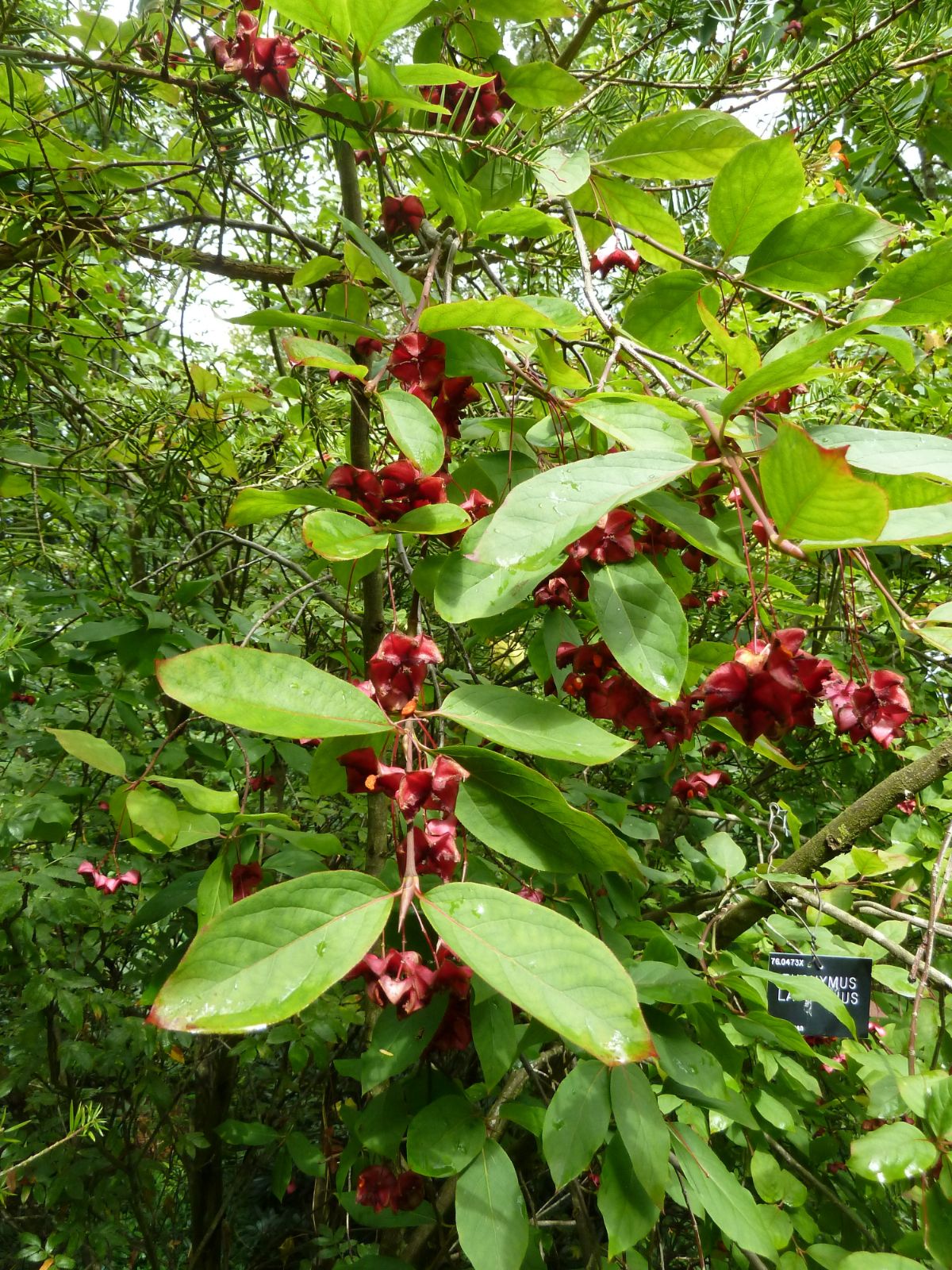
A deciduous shrub or small tree 10 ft or more high, with a spreading, loose head of branches, glabrous in all its parts; young shoots angled, winter buds elongated. Leaves oval, oblong or obovate, 3 to 5 in. long, 11⁄2 to 21⁄4 in. wide, rounded or wedge-shaped at the base, pointed, very finely and evenly toothed; stalk about 1⁄4 in. long. Flowers greenish, about 3⁄8 in. across, the parts normally in fives, produced in early May, seven to fifteen together, on very slender-stalked cymes 2 to 3 ins. long. Fruits pendulous, 3⁄4 in. across before bursting, rich rosy red with five, sometimes four, winged lobes; aril orange-coloured. Bot. Mag., t. 2384.
Native of Europe; introduced in 1730. Excepting the native E. europaeus, this is the most ornamental of all the genus in our gardens; its individual fruit is much larger and more effective than that of the common spindle-tree but is not borne in such profusion. Grown as a small tree in rich deep soil, it will reach 20 ft in height, and such a specimen, hung with its long-stalked fruit in September, is one of the most beautiful objects of autumn.
From the Supplement (Vol. V)
The distribution of this species is wider than stated in earlier editions and in the first impression of the present one: Europe, Anatolia, the Caucasus and northern Iran.
† E. leiophloeus Stev. – Kalonymus leiophloea (Stev.) Prokhanov; E. sempervirens Rupr. ex Boiss. – Very near to E. latifolius, but fruits said to be usually four-lobed, with longer wings. Native of the Caucasus region; introduced by Roy Lancaster from the hills above Novy Afon on the Black Sea in 1979. Plants from this introduction have thick, semi-persistent leaves that colour purple, crimson and scarlet in the autumn. One plant at least also has the remarkable character of completing its growth in early spring, when most shrubs are just showing green.