
Euonymus kiautschovicus
Credits
Article from Bean's Trees and Shrubs Hardy in the British Isles
Recommended citation
'Euonymus kiautschovicus' from the website Trees and Shrubs Online (treesandshrubsonline.
Genus
Synonyms
- E. patens Rehd.
Other taxa in genus
- Euonymus alatus
- Euonymus americanus
- Euonymus atropurpureus
- Euonymus bungeanus
- Euonymus cornutus
- Euonymus europaeus
- Euonymus fortunei
- Euonymus frigidus
- Euonymus grandiflorus
- Euonymus hamiltonianus
- Euonymus japonicus
- Euonymus latifolius
- Euonymus lucidus
- Euonymus macropterus
- Euonymus myrianthus
- Euonymus nanus
- Euonymus obovatus
- Euonymus oresbius
- Euonymus oxyphyllus
- Euonymus pendulus
- Euonymus phellomanus
- Euonymus planipes
- Euonymus porphyreus
- Euonymus sanguineus
- Euonymus semenowii
- Euonymus theifolius
- Euonymus tingens
- Euonymus verrucosus
- Euonymus wilsonii
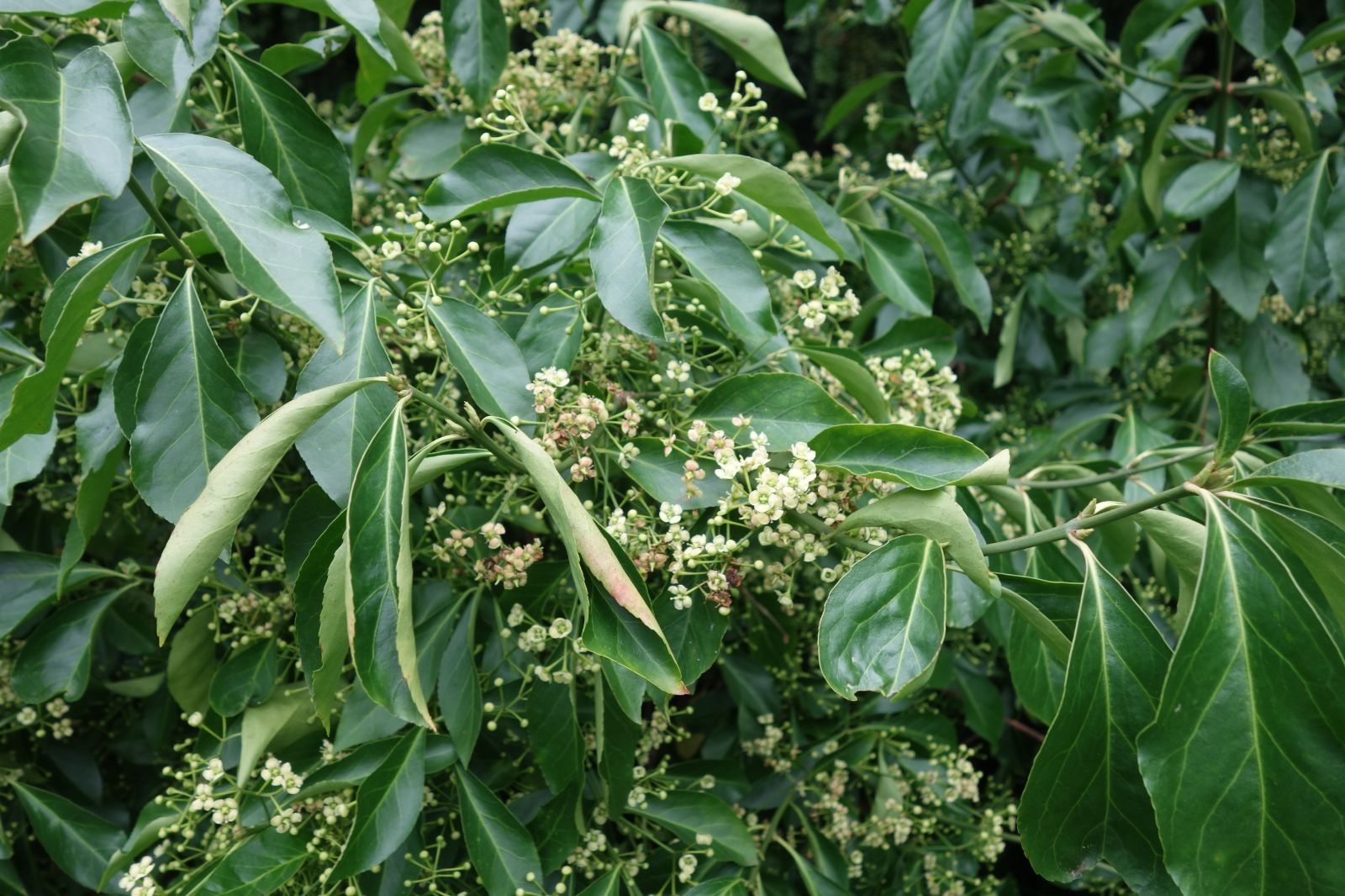
An evergreen or semi-deciduous shrub up to 9 or 10 ft high, of spreading habit, not downy in any part. Leaves oval or obovate, 2 to 3 in. long, 3⁄4 to 13⁄4 in. wide; tapered at the base, pointed or bluntish at the apex, round-toothed, of firm texture, and bright green; stalk 1⁄4 in. or less long. Flowers greenish white, 1⁄3 in. across, four-parted, numerous, on loose erect cymes 11⁄2 to 4 in. wide, on a main-stalk 1 to 11⁄2 in. long. Fruit nearly 1⁄2 in. across, pink, glabrous and not lobed; aril orange-red.
A native of China, whence it was introduced into the United States, about 1860, by Dr G. R. Hall. Small plants were sent to Kew in 1905, but it may have been in cultivation before as E. japonicus. To that species it is very closely akin, but is probably hardier. It has a wider inflorescence, and its habit is laxer than in E. japonicus, the lower branches often taking root. The leaves are thinner, more pointed, and more finely toothed. It fruits late in the autumn, November 28 being the date on which it received an Award of Merit when shown from Regent’s Park in 1961.