
Daphne × houtteana
Credits
Article from Bean's Trees and Shrubs Hardy in the British Isles
Recommended citation
'Daphne × houtteana' from the website Trees and Shrubs Online (treesandshrubsonline.
Genus
Synonyms
- D. laureola purpurea Hort.
- D. mezereum var. atropurpurea Dipp.
Other taxa in genus
- Daphne acutiloba
- Daphne alpina
- Daphne altaica
- Daphne aurantiaca
- Daphne bholua
- Daphne blagayana
- Daphne × burkwoodii
- Daphne caucasica
- Daphne cneorum
- Daphne collina
- Daphne genkwa
- Daphne giraldii
- Daphne × hybrida
- Daphne jezoensis
- Daphne laureola
- Daphne mezereum
- Daphne × napolitana
- Daphne × neapolitana
- Daphne odora
- Daphne oleoides
- Daphne petraea
- Daphne pontica
- Daphne pseudomezereum
- Daphne retusa
- Daphne rodriguezii
- Daphne × rossetii
- Daphne sophia
- Daphne striata
- Daphne tangutica
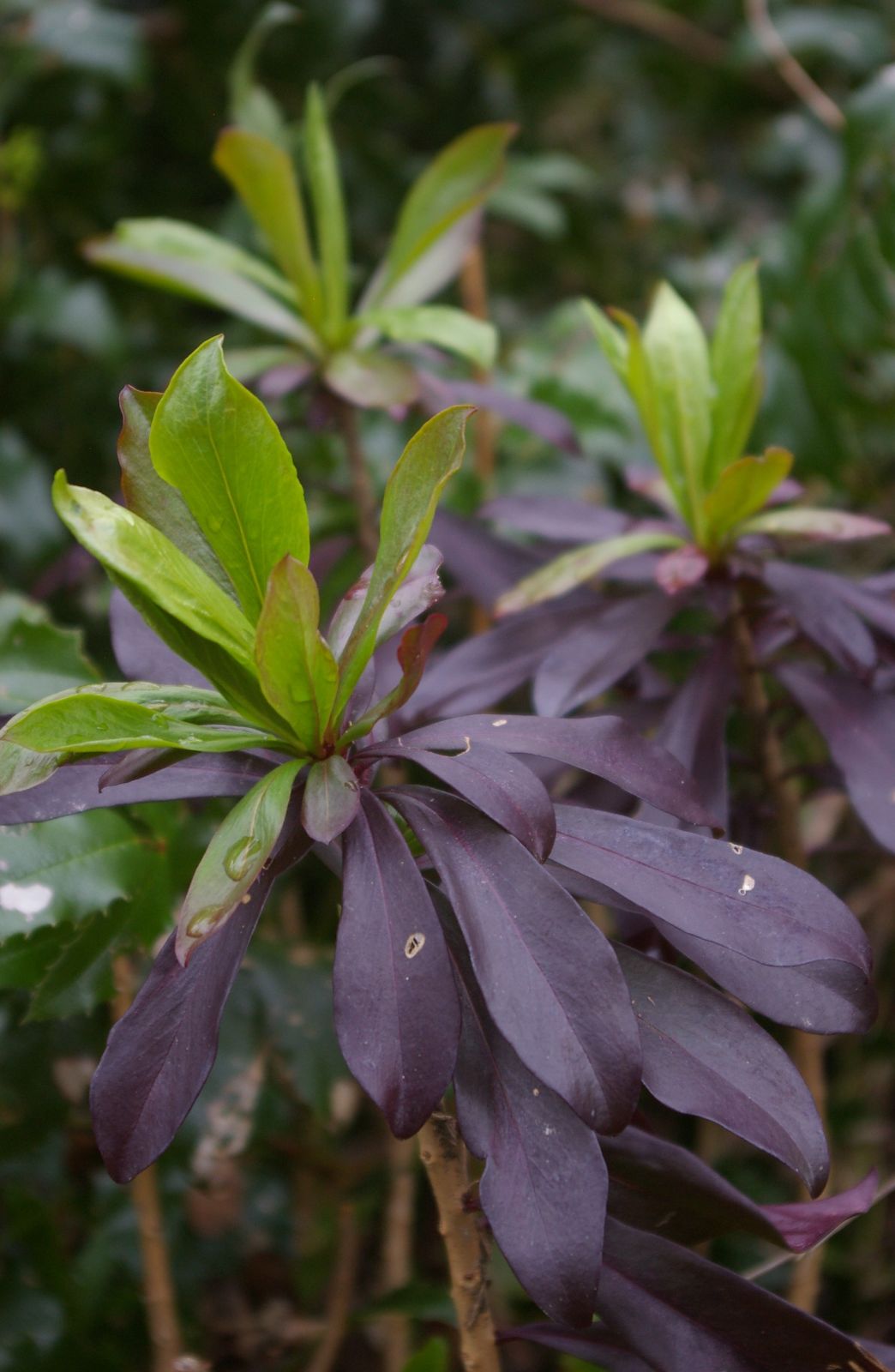
There seems to be little doubt that this is a hybrid between D. mezereum and D. laureola. It was first described and figured by Louis Van Houtte, in the Flore des Serres, t. 592, in 1850, but he did not know its origin or even venture to give it a name. He alludes to it as “D. mezereum foliis atropurpureis of several gardens”. It has since been mostly called D. laureola purpurea, but is distinct from both species.
A partially evergreen shrub, 2 to 4 ft high, with stiff, erect branches. Leaves usually crowded towards the tip of the shoot, and resembling those of D. laureola in size, shape, and texture, but of a dark purplish tinge. Flowers pale lilac, produced two to five together in short-stalked clusters. At the time of flowering (April) there usually remain a few purple leaves of the preceding summer’s growth. It is from the axils of these and the buds beneath them that the flowers are borne. There is also a form with deep-purple flowers.
From the Supplement (Vol. V)
This hybrid is now very rare in gardens, being susceptible to virus attack – a character no doubt inherited from D. mezereum.