
Daphne oleoides
Credits
Article from Bean's Trees and Shrubs Hardy in the British Isles
Recommended citation
'Daphne oleoides' from the website Trees and Shrubs Online (treesandshrubsonline.
Genus
Synonyms
- D. glandulosa Bertol.
- D. buxifolia Vahl
- D. oleoides var. glandulosa (Bertol.) Keissler
- D. 0, var. buxifolia (Vahl) Keissler
- D.jasminea sensu Griseb., not Sibth. & Sm.
- D. 0. var. brachyloba Meissn.
- D. 0. var. jasminea Meissn.
Infraspecifics
Other taxa in genus
- Daphne acutiloba
- Daphne alpina
- Daphne altaica
- Daphne aurantiaca
- Daphne bholua
- Daphne blagayana
- Daphne × burkwoodii
- Daphne caucasica
- Daphne cneorum
- Daphne collina
- Daphne genkwa
- Daphne giraldii
- Daphne × houtteana
- Daphne × hybrida
- Daphne jezoensis
- Daphne laureola
- Daphne mezereum
- Daphne × napolitana
- Daphne × neapolitana
- Daphne odora
- Daphne petraea
- Daphne pontica
- Daphne pseudomezereum
- Daphne retusa
- Daphne rodriguezii
- Daphne × rossetii
- Daphne sophia
- Daphne striata
- Daphne tangutica
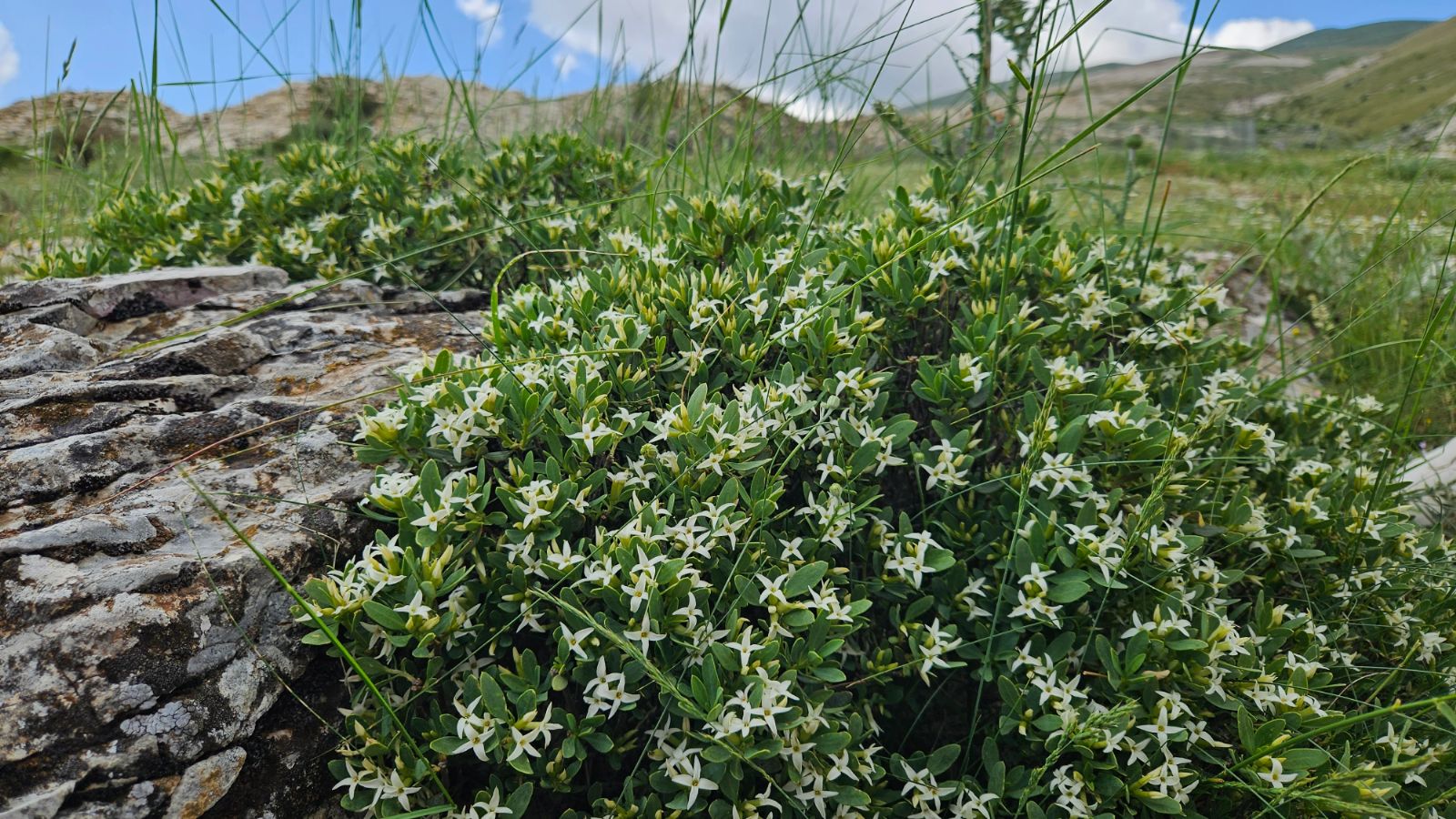
An evergreen shrub usually under 2 ft high; young shoots hairy, at least when young. Leaves varying in shape, being broadest at, above or below the middle, obtuse or acute at the apex, usually tapered at the base, 1⁄2 to 13⁄4 in. long, 1⁄8 to 1⁄2 in. wide, more or less hairy on both sides when young, usually becoming glabrous and glossy above when mature, but sometimes permanently downy on both sides. Flowers usually white, cream or yellowish, sometimes tinged with pink, fragrant, borne in May and June in terminal clusters of three to eight; bracts none; tube of perianth hairy on the outside, 1⁄4 to 1⁄2 in. long, lobes lanceolate to ovate, acute or obtuse at the apex, varying in length from almost as long as the tube to one-third as long. Fruits red, enclosed in the perianth tube until almost ripe.
D. oleoides, originally described from Crete, has a wide distribution from Spain and N. Africa through southern Europe to Asia Minor. It is a very variable species, especially in degree of hairiness of the shoots and leaves and in the length and shape of the perianth-lobes, but it is impossible to subdivide it satisfactorily into varieties or subspecies.
D. oleoides was probably introduced early in the 19th century, though Keissler doubted whether the cultivated plant figured in Bot. Mag., t. 1971 (1818) really was D. oleoides, as it was thought to be. It is not common in gardens and less attractive than either D. collina or D. × neapolitana.
D gnidium L
An erect, bushy, evergreen shrub to 4 ft high. Branchlets densely clad with leaves throughout their length, downy when young. Leaves thick and brittle, glabrous, linear to lanceolate, terminated by a prickly point and up to 1{3/5} in. long. Flowers fragrant, borne in short racemes at the ends of the shoots and in the uppermost leaf-axils, forming all together a terminal, leafy panicle; perianth tube white. Native of the Mediterranean region and the Canary Islands; introduced in the 16th century. It is not so much cultivated today as formerly, but is said to be hardy.D jasminea Sibth. & Sm
This species has recently been introduced to cultivation. It is a gnarled shrublet inhabiting rock-faces and stony places in parts of S. Greece (W. Euboea and Mt Parnassus) and has nothing to do with the D. jasminea of Grisebach, nor with the D. oleoides var. jasminea of Meissner, both of which are forms merely of D. oleoides. For an account of D. jasminea by Brian Mathews see Bull.A.G.S., Vol. 35, Sept. 1967, pp. 199–200.D kosaninii (Stoyanov) Stoyanov
Synonyms
D. oleoides var. kosaninii Stoyanov