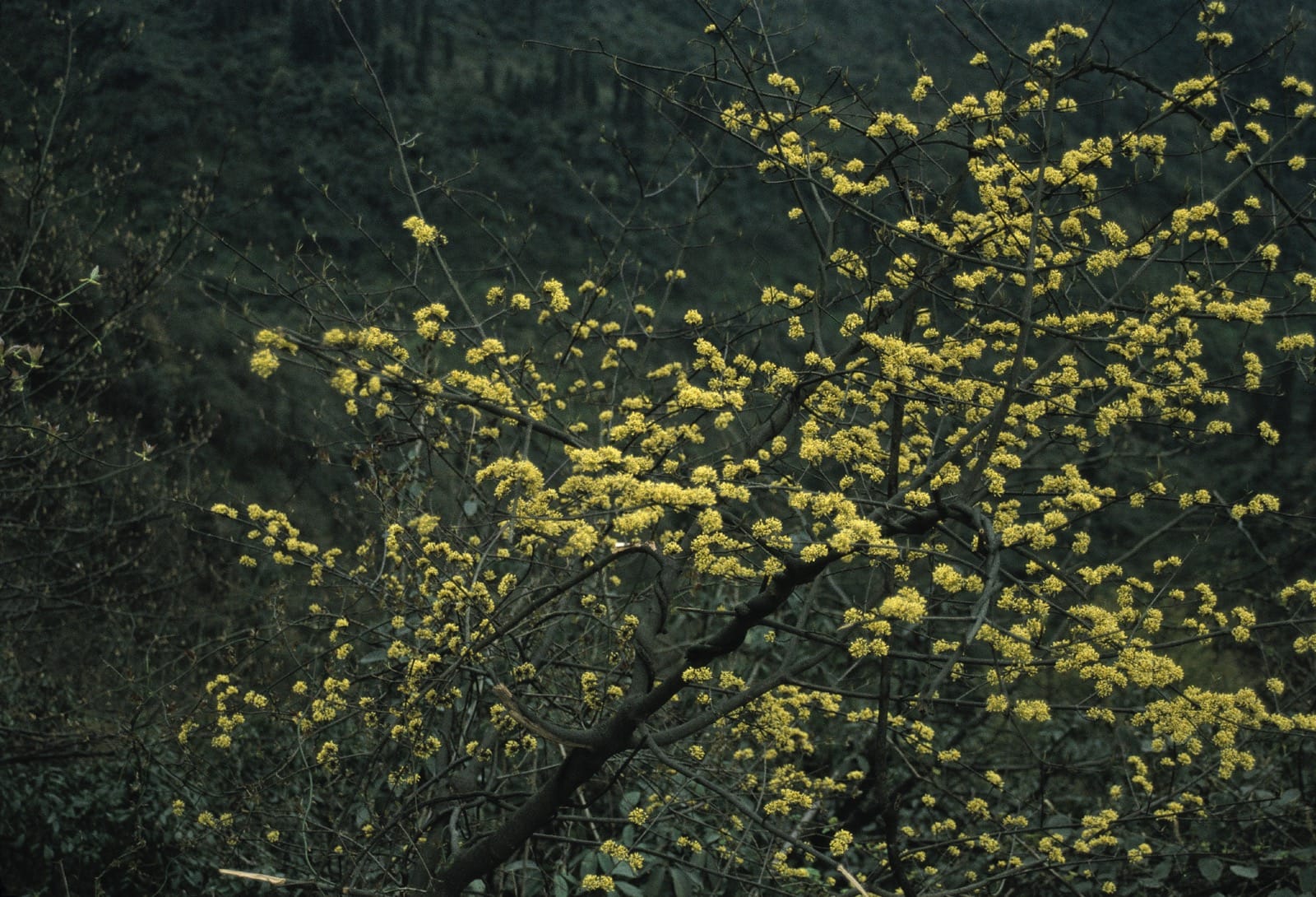
Cornus chinensis Wangerin

TSO logo

Sponsor

Kindly sponsored by
Hugh and Judy Johnson

Credits

Martin Deasy, Dan Crowley, Jack Aldridge & Răzvan Chişu (2026)

Recommended citation
Deasy, M., Crowley, D., Aldridge, J. & Chişu, R. (2026), 'Cornus chinensis' from the website Trees and Shrubs Online (treesandshrubsonline.org/articles/cornus/cornus-chinensis/). Accessed 2026-07-14.

Family

  • Cornaceae

Genus

Common Names

  • chuan e shan zhu yu

Synonyms

  • Cornus chinensis f. jinyangensis (W.K.Hu) W.K.Hu
  • Macrocarpium chinense (Wangerin) Hutch.

Glossary

strobilus
Cone. Used here to indicate male pollen-producing structure in conifers which may or may not be cone-shaped.
Tibet
Traditional English name for the formerly independent state known to its people as Bod now the Tibet (Xizang) Autonomous Region of the People’s Republic of China. The name Xizang is used in lists of Chinese provinces.
USDA
United States Department of Agriculture.
asl
Above sea-level.
herbarium
A collection of preserved plant specimens; also the building in which such specimens are housed.
indumentum
A covering of hairs or scales.
ovate
Egg-shaped; broadest towards the stem.

References

Credits

Martin Deasy, Dan Crowley, Jack Aldridge & Răzvan Chişu (2026)

Recommended citation
Deasy, M., Crowley, D., Aldridge, J. & Chişu, R. (2026), 'Cornus chinensis' from the website Trees and Shrubs Online (treesandshrubsonline.org/articles/cornus/cornus-chinensis/). Accessed 2026-07-14.

A deciduous, single-stemmed tree to 10 m. Bark dark brown. Branchlets dark brown. Leaf buds terminal or axillary, conical; floral buds lateral and in pairs, covered in yellowish-brown trichomes. Leaves 6–11(–30) × 2.8–5.5 cm, elliptic to lanceolate, upper surface glabrous with deeply impressed veins, lower surface with dense greyish white trichomes, clusters of long grey trichomes in vein axils, five to six secondary veins on each side of the midvein, margins entire, apex acuminate to caudate; petiole 1.2–2.5 cm long. Inflorescence umbellate and lateral, produced before the leaves, 2–3 cm diameter with 25–50 flowers; floral bracts papery or leathery, inconspicuous, pubescent, 0.6–0.7 cm long. Flowers hermaphrodite, rather inconspicuous, with lanceolate petals to 0.4 cm long. Fruit a black drupe, 0.6–1 × 0.4 cm; stones ribbed. Flowering March to April, fruiting September (China). (Weaver 1976; Gardener 1979; Xiang et al. 2003; Cappiello & Shadow 2005; Xiang & Boufford 2005).

Distribution  Myanmar Kachin State China Gansu, Guangdong, Guizhou, Henan, Hubei, Shaanxi, Sichuan, Xizang, Yunnan, Zhejiang India

Habitat Dense forest and forest margins on slopes between 700 and 3500 m asl.

USDA Hardiness Zone 8-9

RHS Hardiness Rating H4

Conservation status Least concern (LC)

A refined and elegant tree, Cornus chinensis is one of the most exciting species in the genus, still not often encountered in cultivation, though this is gradually changing as hardier material becomes available. Strikingly beautiful in flower, when it is covered in mop-like yellow inflorescences, it can also make a spectacular foliage plant, the large elliptic-ovate leaves with heavily impressed veins and prominent drip tips giving an almost subtropical appearance. In plants from milder locations at the extreme west of the species range, on the border of Tibet and Arunachal Pradesh, these leaves can reach 30 cm in length. In the horticultural trade, the name is often misapplied to the more familiar but only distantly related C. kousa var. chinensis.

Cornus chinensis is allied to C. mas and C. officinalis in subgenus Cornus, both of which it resembles in its early display of umbellate flowerheads on naked branches, though the striking leaves (with pale grey indumentum beneath) and showy inflorescences are substantially larger than in either of those species. Another difference is in the much smaller fruits, which ripen through red to black – or ‘wine-purple’, as Frank Kingdon-Ward poetically described them (1952). The large inflorescences can be very conspicuous when fully open. The flowers themselves are sulphur-yellow, and the inflorescences have a distinctly ‘stalked’ appearance, borne on peduncles more than twice the length of those in C. mas (Xiang & Boufford 2005; Rushforth 2021); the sepals are also longer and more tapered (Bean 1976). In cultivation, flowering is typically a week or two later than in C. mas. Comparison of plants cultivated under this name suggests that there is clearly considerable variation within what is currently treated as a discrete species. The buds on cultivated Chinese plants from Sichuan (SICH 307 at Kew, Acc. 1988–8692) and Guizhou (DJHG 11046 at Wespelaar Arboretum) are orientated downwards on characteristically curving peduncles.

Cornus chinensis is a relatively widespread species throughout China, growing in mixed forest, open thickets and streams; in the western part of its range, it inhabits steep ravines. It has also been found in northern Myanmar, from where a herbarium specimen (KW 9312) was collected by Kingdon-Ward in the Adung valley, Kachin State (Rushforth 2021). The fruits are used medicinally in the same way as those of C. officinalis (Xiang & Boufford 2005). Augustine Henry collected C. chinensis in 1889 in Hupeh and Sichuan (Henry 5733; Henry 5733A), and the species was first described by Walther Wangerin from collections by Wilson in western Hupeh (Wilson 55), and A. E. Pratt in West Sichuan and near Kangding/Dartsedo (Tachienlou) on the Tibetan frontier (Pratt 66, 797) (Sargent 1913). Wilson came across it on several other occasions in Sichuan, around Baoxing, and on both Wa Shan and Emei Shan (Rehder 1940), while Forrest made several collections between 1917–19 in Yunnan, including F 16548 (on the Mekong-Salween divide) and F 18026 (Shweli-Salween divide) (from Wisley herbarium records). Whether living plants were ever successfully raised from any of these collections is uncertain, but at least one plant from a later Forrest collection (F 29072) grew at Borde Hill, Sussex at one time, in the shelter of Gores Wood. Seed of Sichuan provenance was received by the US Bureau of Plant Industry in 1936, from Nanking (PI 114731), though again its fate is not known (USDA 1941).

The quest for Cornus chinensis was the principal reason for Frank Kingdon-Ward’s presence in Tibet, near the border with India, during August 1950 when he was caught up in the massive 8.7 magnitude Assam-Tibet earthquake, an experience vividly recounted in both his and his wife Jean’s travel accounts (Kingdon-Ward 1960; Kingdon-Ward 1952). His botanical quarry had proven always tantalisingly out of reach in steep ravines, but while the expedition was contemplating its predicament hemmed in by landslides in the Lohit valley near Rima, the guide Phag Tsering finally succeeded in finding and gathering fruiting branches (Kingdon-Ward 1952). Kingdon-Ward jested that ‘Cornus terratremula’ would have been a more appropriate name for the species.

Most of the plants raised in Britain from this seed (KW 19300) did not survive the brutally severe winter of 1955–1956, though they were successful under glass (notably at the Savill Garden, Windsor Great Park). A cutting from the Windsor tree reached 5 m (without flowering) on a south-facing wall at the Hillier Arboretum, while at Ventnor Botanic Garden on the Isle of Wight it grew to 6 m in a sheltered glade before perishing in the cold winter of 1986–1987 (Lancaster 2008). Described by Jean Kingdon-Ward as ‘incomparably better than the original specimens from China and north Burma’ (Kingdon-Ward 1952), the ‘Rima Dogwood’ produced leaves of prodigious size – 30 cm long on the specimen at the Savill Garden, where it ‘assumed the aspect of a tree of some tropical rain-forest’ (Bean 1976); that this is no exaggeration is borne out by the photograph of the Ventnor tree in Roy Lancaster’s Plantsman’s Paradise (Lancaster 2008) – see also the images of the Gwavas plant below. The only known plants remaining from KW 19300 now grow on the North Island of New Zealand, one at Pukeiti, Taranaki, the other at Gwavas Garden, Hawkes’ Bay, where the benign climate has suited them well. The Pukeiti specimen was cut down (accidentally) several years ago, but has regrown from the stump. Several attempts have been made to propagate the Gwavas tree, but this has proved difficult (T. Hudson, pers. comm. 2024, 2025). A 6 m specimen at Hackfalls Arboretum, Gisborne, North Island, New Zealand, acquired from Cave’s Tree Nursery in 1990 but of unknown ultimate provenance, may be from KW 19300.

Only relatively recently have considerably hardier introductions from western China become well established in cultivation. Expeditions organised by Royal Botanic Gardens Kew made two collections in Sichuan, in 1988 and 1992 respectively, from trees growing in rich broad-leaved forests at between 2400 and 2500 m asl. Both are represented at Kew, where a plant from SICH 307 has made a shy-flowering 8 m tree by the lake (TROBI 2024), while one from SICH 1222 (in a border outside the toilets, near Kew Palace) has formed a lower-growing, multi-stem shrub, but flowers more freely. At UBC Botanic Garden, Vancouver, seed from SICH 1222 and SICH 307 has produced thriving understorey trees of 7 m and 9 m respectively, both fruiting (A. Hill, pers. comm. 2025).

A Maurice Foster collection from near Baoxing, central Sichuan (MF 97090) has grown for over twenty years in an open position at White House Farm, Kent, coming through several cold winters undamaged (M. Foster, pers. comm.). Elsewhere in Britain, Cornus chinensis is grown as far north as coastal Cumbria, where a 1993 collection by Alan Clark from southwest Yunnan has grown to 8 m at Muncaster Castle (TROBI 2024). Two other Yunnanese trees collected by Tom Hudson grow at Tregrehan, Cornwall, one from Zi Ben Shan near Caojian on the Mekong-Salween Divide (TH 2966), the other from the western side of the Gaoligong Shan north of Tengchong (TH 0481) (T. Hudson, pers. comm. 2024, 2025).

On the continent, TH 0481 is grown at the Jardín Botánico de Iturraran, Spain (P. Garin & J. Almandoz, pers. comm. 2024). In Belgium, Ghent University Botanic Garden has a plant grown from a 2001 collection by Ronnie Viane (RV 09375) from west of Weixi, Yunnan at 2700m (K. Bauters, pers. comm. 2025), from an area with a climate very similar to where KW 19300 was collected in Rima (Beck et al. 2023). Trees derived from seed collected by Dan Hinkley, Ozzie Johnson & Scott McMahan in Guizhou (DJHG 11046) are prospering at Wespelaar Arboretum and at the neighbouring Herkenrode estate. The Wespelaar specimen (acc. 19343) had already made a vigorous single-stemmed tree 3m in height after ten years; its recent progress is described as ‘spectacular’, with the caveat that recent winters have been very mild (K. Camelbeke, pers. comm. 2025).

It is not known whether viable seedlings have been raised from cultivated plants in Europe, though the Ghent tree (RV 09375) has produced fruit. The closely related species Cornus mas and C. officinalis are both self-fertile, but spontaneous hybridisation between them is documented from botanical collections – worth bearing in mind for those who grow C. chinensis (Morozowska, Gawrońska & Woźnicka 2013). Propagation by semi-ripe cuttings taken around midsummer, under polythene with additional bottom heat, is straightforward and successful (pers. obs.), while grafting onto C. mas understocks in winter has also proved successful (R. Lenaerts, pers. comm. 2023).