Kindly sponsored by
Hugh and Judy Johnson
Martin Deasy, Dan Crowley, Jack Aldridge & Răzvan Chişu (2026)
Recommended citation
Deasy, M., Crowley, D., Aldridge, J. & Chişu, R. (2026), 'Cornus alternifolia' from the website Trees and Shrubs Online (treesandshrubsonline.
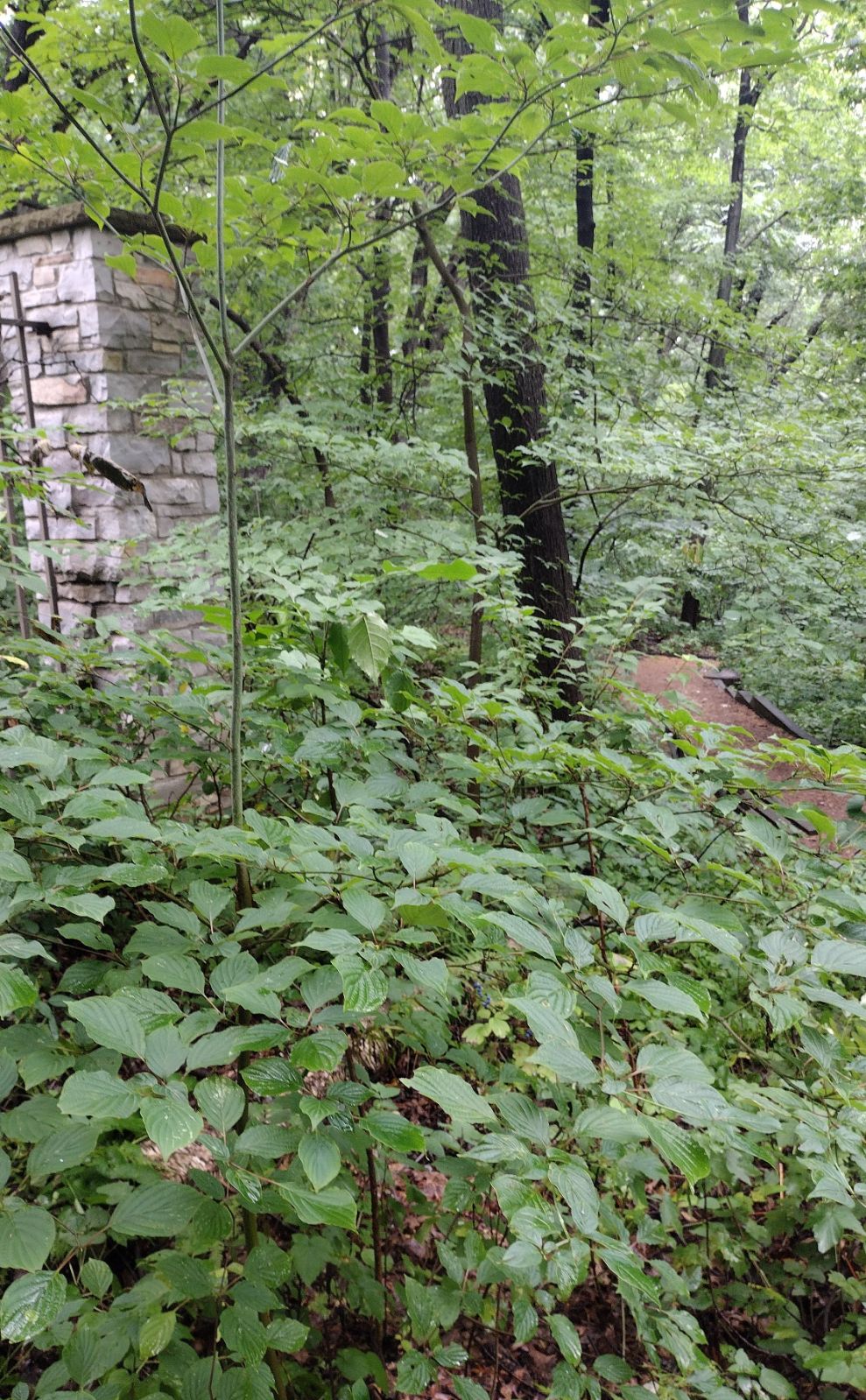
Deciduous shrub or tree to 12 m. Bark corky, with rectangular plates. Branchlets yellowish-green to green or reddish-brown, with pale trichomes at first, glabrous, lenticels lenticular; pith white. Leaves non-opposite, 4–12 × 2.3–7 cm, chartaceous, narrowly to broadly ovate or obovate, base cuneate to rounded, upper surface dull green, lower surface yellowish green, papillose, with appressed trichomes, five to six secondary veins on each side of the midvein, margins entire, apex acute to acuminate; petiole to 2–5 cm long. Inflorescence flat, cymose, 50–100-flowered, 3–15 cm diameter, pedicels yellow green, later red, pubescent; bracts minute, non-petal-like. Flowers hermaphrodite, petals ~0.3–0.4 cm long. Fruits globose, 0.5–0.8 cm diameter, bluish-black at maturity, with one stone, with cavity at apex. Flowering April to June, fruiting June to August (North America). (Bean 1976; Wann 2011; Murrell & Poindexter 2015).
Distribution Canada Manitoba, New Brunswick, Newfoundland and Labrador, Nova Scotia, Ontario, Prince Edward Island, Quebec United States Alabama, Arkansas, Connecticut, Delaware, District of Columbia, Florida, Georgia, Illinois, Indiana., Iowa, Kentucky, Maine, Maryland, Massachusetts, Michigan, Minnesota, Mississippi, Missouri, New Hampshire, New Jersey, New York, North Carolina, Ohio, Pennsylvania, Rhode Island, South Carolina, Tennessee, Vermont, Virginia, West Virginia, Wisconsin Saint Pierre and Miquelon
Habitat Broadleaved deciduous forest, often bordering streams or swamps, usually on mesic or dry-mesic loamy soils and rocky slopes between 10 and 2000 m asl.
USDA Hardiness Zone 3-7
RHS Hardiness Rating H6
Conservation status Least concern (LC)
Distinguished from all other dogwood species by their non-opposite leaves, Cornus alternifolia from eastern North America and its East Asian counterpart C. controversa both exhibit a distinctively tiered structure that has earned them both the common names Pagoda Dogwood and Wedding Cake Tree. This tabular branch habit, sometimes emphasised by judicious pruning, is particularly marked in younger trees, which can appear similar enough to perplex the unwary. Of the two, C. alternifolia is always less substantial, with smaller inflorescences, fewer-veined leaves, and a less arborescent habit. Cornus controversa can form a reasonably tall, airy tree, but cultivated C. alternifolia tends towards the shrubbier end of the spectrum, forming at best a small tree (occasionally to 9 m) with a characteristically flat-topped crown and short trunk.
Cornus alternifolia and its East Asian sister species are the only members of an early-diverging lineage of the blue-fruited dogwoods, recognised at subgeneric rank as Mesomora Raf., the two species having branched off from a common ancestor relatively recently (approx. 9 Ma) (Du et al. 2023). Their disjunct distribution is typical of lineages with a wide range during the Paleogene and Neogene (66–2.6 Ma) – fruit stones with the deep apical pits characteristic of the subgenus have been identified in Tertiary fossil beds in Europe dated to the Middle Miocene (c. 16–11.6 Ma) (Eyde 1988). The two species share a derived chromosome number (2n = 20, against the plesiomorphic 2n = 22 in the rest of the blue-fruited species), as well as many aspects of gross morphology and architecture (Clay & Nath 1971).
The species’ anomalous phyllotaxy and pagoda-like habit are closely related. It is worth emphasising that the epithet ‘alternifolia’ applies in a negative sense, reflecting an arrangement of leaves that contrasts with the opposite leaf-pairing characteristic of the rest of the genus, but that does not approach the regular alternation of leaves seen on the shoots of, say, Ilex or Fagus. It would perhaps be more accurate to say that the leaves of C. alternifolia are disposed in a subopposite pattern, often condensed into an irregular pseudo-whorl by a series of shortened internodes at branch tips. Applied to the main stem, this growth pattern – involving an extended first internode (hypopodium) that rockets up vertically before producing a cluster of buds that will produce horizontal (plagiotropic) shoots – is the basis of the species’ characteristic tiered architecture in which horizontal layers of foliage are separated by increments of clear stem. In vigorously growing plants, the secondary shoots sometimes extend during the season contemporaneously with the main axis without forming resting buds, a phenomenon known as ‘syllepsis’, common in tropical trees but rare as a constant feature of temperate woody species (Hallé, Oldeman & Tomlinson 1978). The resulting pagoda-like habit (Fagerlind’s model of tree growth) is seen in only a handful of non-tropical species. The two dogwoods differ slightly from the tropical Ur-model in that the main trunk is not a strict monopodium, the vertical axis being continued by a replacement bud if the terminal bud dies – Hallé, Oldeman and Tomlinson describe this as an ‘unstable monopodium’.
According to Aiton (1789), Cornus alternifolia was brought into cultivation by James Gordon of Mile End Nursery in 1760; its omission in the last edition of the Gardeners Dictionary (Miller 1768) is therefore rather surprising – perhaps the young trees may not yet have begun to exhibit their interesting architecture. Lamarck (1786) reported that the species (‘from Siberia’) had been cultivated in France at the Jardin du Roi for more than fifteen years – his geographical solecism stems from confusion with the alternate-leaved Rhamnus davurica (syn. Cornus citrifolia Weston), mistakenly placed in synonymy in the 1776 supplement to Diderot and d’Alembert’s dictionary (Robinet et al. 1776; see also Hess & Stearn 1979).
As might be expected of a species of woodland understorey and canopy gaps, Cornus alternifolia grows well in both sunny and woodland conditions. It does best in slightly acidic, reliably moist soils, and thrive in areas with cool summer temperatures (Cappiello & Shadow 2005). By contrast, in regions with hotter summers, afternoon shade may be necessary to ensure success; this is especially true of the commonly grown variegated or yellow-leaved cultivars.
Grown as untrained shrubs, plants require little maintenance. If a small tree is required then intervention will be required to select a leader early on (Brown & Kirkham 2004), or to progressively remove side growth on established plants to reveal a clean trunk. The latter method, which results in a stronger plant, may be found advantageous, since young trees can be slow to make headway at first. Mature root-balled specimens have been found to establish very successfully (Junker Nursery 2022).
Good seed germination can be achieved following three to five months of cold stratification, and a reasonable proportion (up to 60%) of softwood cuttings root if kept under fog and treated with a rooting hormone (6000 ppm K-IBA is recommended). Cultivars are typically grafted, seedling Cornus alternifolia or C. controversa being the most compatible rootstocks; cutting-raised C. alba are also widely used as understocks, but are more prone to suckering (Cappiello & Shadow 2005; Humphrey 2019). Spontaneous hybridisation with Cornus controversa has been documented where the two species are grown together in cultivation (Gawrońska et al. 2019).
The principal drawback of Cornus alternifolia is Golden Canker caused by Aurantioporthe corni (Wehm.) G.L. Beier & Blanchette (syn. Cryptodiaporthe corni). This ascomycete fungus coexists as an (often asymptomatic) endophyte of the species, manifesting as a pathogen only in certain circumstances (Beier et al. 2015). Aurantioporthe corni is present throughout the natural range of the host species, as well as in landscape plantings elsewhere in North America, but has not been identified as a pathogen outside the United States, and is not known to affect other species in the genus. The initial symptom of infection is the characterististic bright yellow or orange appearance of the (normally dark red) branchlets, and a raised appearance in the lenticels, followed by dieback beginning at branch tips before the canker advances into the main stem which is often killed back. Distinctive small orange fruiting bodies may be seen on the cankered wood.The infection is spread by spores, as well as by vegetative propagation from asymptomatic stock (Redlin & Rossman 1991; Beier et al. 2015). The fungus appears to become pathogenic only in plants that are low in vigour, so maintaining good general plant health and nutrition is the principal recommendation for minimising disease (Redlin & Rossman 1991).
A sport from ‘Argentea’, with larger leaves that may be plain green, green with white margins or green with pink margins; selected by Danilo Bonacchi of San Pierino Casa al Vescova, near Pistoia, Italy, and named after André Gayraud, dogwood enthusiast and author of a useful guide to the genus as cultivated in Europe (Gayraud 2013).
Synonyms / alternative names
Cornus alternifolia 'Variegata'
Awards
AGM
RHS Hardiness Rating: H6
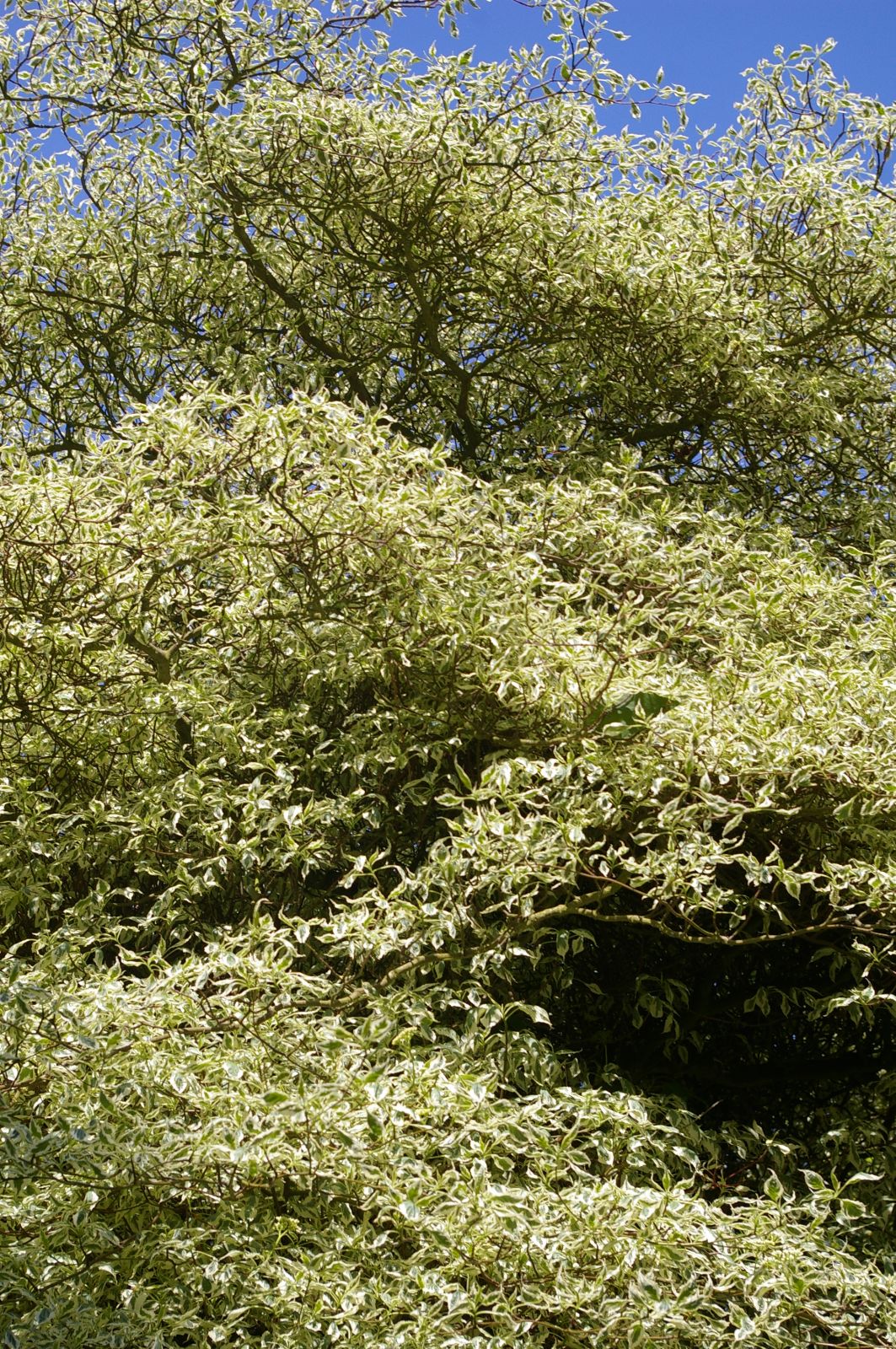
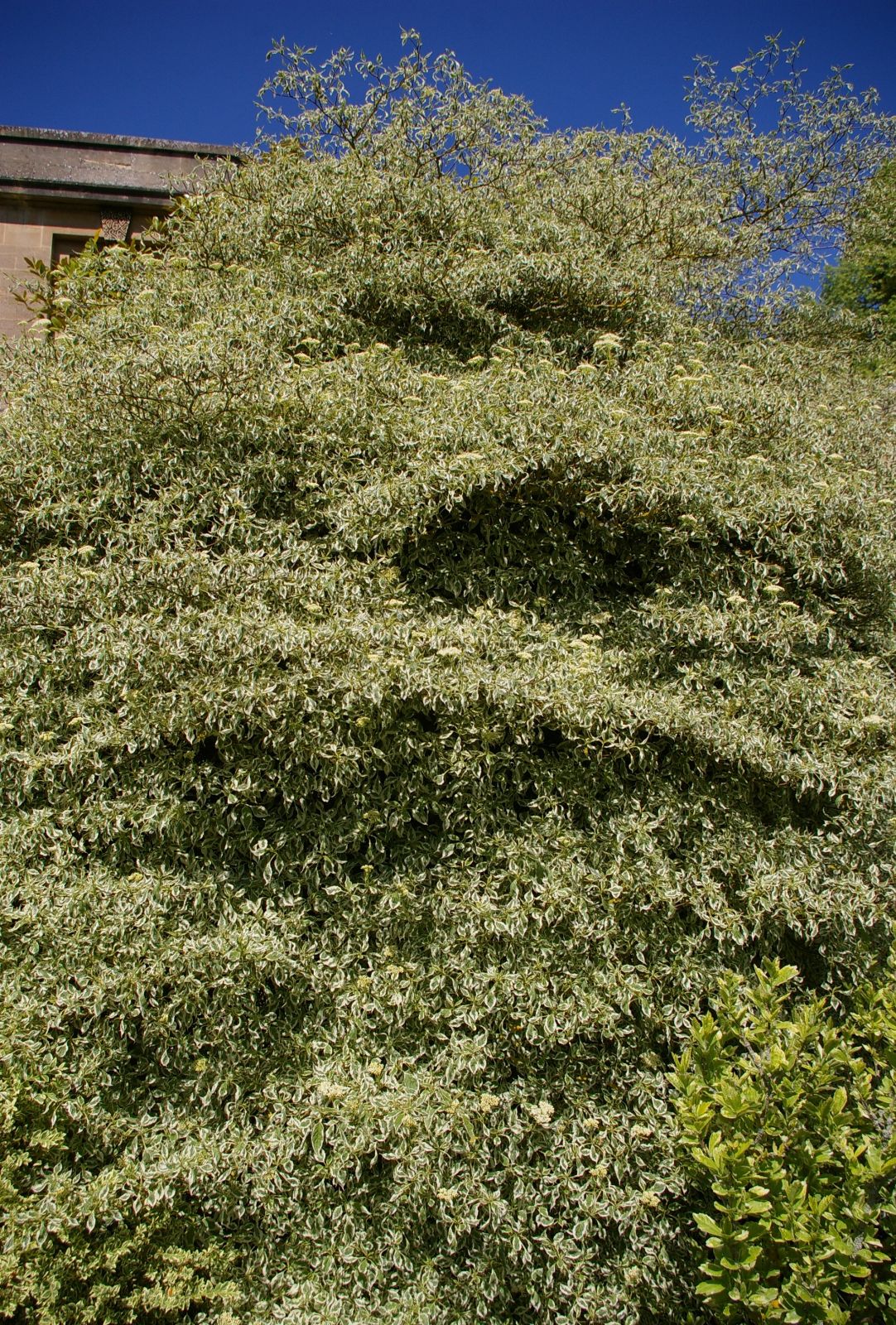
A widely grown, less vigorous (generally grafted) cultivar introduced by by Temple and Beard in 1890 from a sport discovered on a tree in Vermont (Bailey 1891). Leaves small with silvery-cream edges, ‘one of the handsomest of variegated shrubs’ (Bean 1976). Needs plenty of moisture and best grown in acidic soils (Gayraud 2013).
Synonyms / alternative names
Cornus alternifolia Gold BullionTM
A selection with striking chartreuse to golden-yellow foliage (Dirr 2009), discovered as a chance seedling by Chicago plantsman Kris Bachtell (Broken Arrow Nursery 2026).
Synonyms / alternative names
Cornus alternifolia Big Chocolate ChipTM
A fast-growing selection (to 7 m) with unusual ‘chocolate-coloured’ (i.e. brown) bark and good burgundy autumnal colour; introduced by Lake County Nursery, Ohio, USA in 2009 (Dirr & Warren 2019; Lake County Nursery 2009).
A slow growing and compact selection, the leaves dark green with a light green edge, red-tipped new growth and dark purple-brown stems; selected by H. Kolster, Boskoop (Kolster 2026; Junker Nursery 2022).
A less vigorous sport of ‘Illusion’ (to 2 m), leaves with yellow marginal variegation (Kolster 2026; Junker Nursery 2022).
A seedling selection with irregularly blotched variegation in various shades, and orange young growth; reported to be ‘surprisingly vigorous’ for a variegated form (to 2.5–3 m) (Junker Nursery 2022; Kolster 2026).
Synonyms / alternative names
Cornus alternifolia Pinky Spot®
RHS Hardiness Rating: H6
Green leaves edged in white and pink, rounded in habit, to 4 m in 10 years; introduced in 2007 by Pépinières Minier, France (Pépinières Minier 2020).
USDA Hardiness Zone: 2
An American variegated selection, resembling ‘Argentea’, but the markings more richly pink-tinted, especially the young foliage (Junker Nursery 2022). Upright with a good tiered structure, introduced by Buchholz Nursery, Oregon (Buchholz Nursery 2026).
Synonyms / alternative names
Cornus alternifolia PistachioTM
A very floriferous selection, with mint-green stems and burgundy-red young leaves that mature to a dark, glossy green. Grows to 6 m in a rounded shape; introduced by Lake County Nursery, Ohio (Lake County Nursery 2009).
USDA Hardiness Zone: 2
Variegated leaves with a pale yellow (almost white) margin and a central green blaze, the whole leaf variously flushed in shades of pink; introduced by Buchholz Nursery, Oregon (Buchholz Nursery 2026).
A vigorous sport from ‘Argentea’, subtly variegated, with silvery white margins on a greyish green field with larger, greyish-green leaves that may be slightly pink-edged. Selected and introduced by Junker Nursery, UK (Junker Nursery 2022).
The name Cornus alternifolia variegata was in use in the United States and France as early as 1913 (Jackson & Perkins 1913), a German article of this period describing the plant as having white-edged leaves (late to be shed in the autumn) – this description clearly refers to the plant otherwise known as ‘Argentea’ (Waracek 1915). Cornus alternifolia ‘Variegata’ was placed in synonymy with C. alternifolia ‘Argentea’ by Rehder (1949), reflecting the fact that the two names were (and are still are) often used interchangeably.
Under the name ‘Variegata’, the Belgian nursery Pépinière Le Try offers what its online catalogue makes clear is a new variety, still under evaluation (Pépinière Le Try 2026). This new selection, originally acquired from the Belgian nurseryman Antoine Bultinck-Meuleman at the De Ceder nursery, Vlierzele, was discussed by Gayraud (2013), described as having pink and white speckles towards the leaf margin, the leaves and plant much larger than ‘Argentea’. Since the cultivar name ‘Variegata’ is unavailable, a new name is required for this selection.
Noted for its orange-coloured young stems, especially striking in winter, apart from which it is largely indistinguishable from the type species. Propagated from a green-reverting branch sport of ‘Argentea’ by Dutch nurseryman Wil van Ooi in 1995. A good, well-grown specimen can be seen in the Winter Garden at Sir Harold Hillier Gardens, Hampshire, UK.
Similar sports with orange-pigmented stems have been known to crop up from time to time. Some appear unstable, but others have been named and propagated (e.g. ‘Winter Surprise’). A very early example is Cornus alternifolia var. corallina (‘Red-twig’d Alternate-leav’d Dogwood’) listed by Aiton as cultivated at Kew – that form appears not to have persisted for long in cultivation, since even Loudon, a punctilious recorder of variants, fails to mention it (Aiton 1789, Loudon 1838).
Subtle golden variegation on otherwise mostly green leaves, selected by Junkers Nursery, UK. Unusually for Cornus alternifolia, this cultivar provides winter interest from its golden coral-coloured stems, described by the breeder as ‘nearly as good as the fabled stem Cornus’ (Junker Nursery 2022).
Synonyms / alternative names
Cornus alternifolia Golden Shadows™
Cornus alternifolia Ombre d'Or™
Cornus alternifolia 'Golden Shadow'
RHS Hardiness Rating: H6
A vigorous, variegated cultivar to 3 m, the leaves with a green central blaze and golden yellow margins that turn creamy-white as they mature (Dirr & Warren 2019). It has a distinctive horizontal branching habit, the leaves less puckered than ‘Argentea’ (US PP11287 P). Gayraud (2013) describes it as producing a ‘very luminous golden mass’, heavier and less refined in effect than ‘Argentea’. Discovered as a sport of Cornus alternifolia by Walter Stackman, of West Chicago, Illinois. Popular on both sides of the Atlantic, sometimes listed as ‘W. Stackman’.
A free-flowering yellow-leaved selection – striking, though it lacks the tiered structure typical of the species, and the foliage can burn in full sun. The leaves flush orange in spring, becoming greenish in summer, and turn a good yellow in autumn (Gayraud 2013; Junker Nursery 2022; pers. obs.). The plant obtained by John Massey (pers. comm. 2024) from Le Vasterival, France that has been propagated and distributed in a small way by Ashwood Nurseries, UK as Cornus alternifolia ‘Aurea’ likely represents the same cultivar, which may have originated in France.