Colquhounia coccinea
Credits
Article from Bean's Trees and Shrubs Hardy in the British Isles
Recommended citation
'Colquhounia coccinea' from the website Trees and Shrubs Online (treesandshrubsonline.
Genus
Other taxa in genus

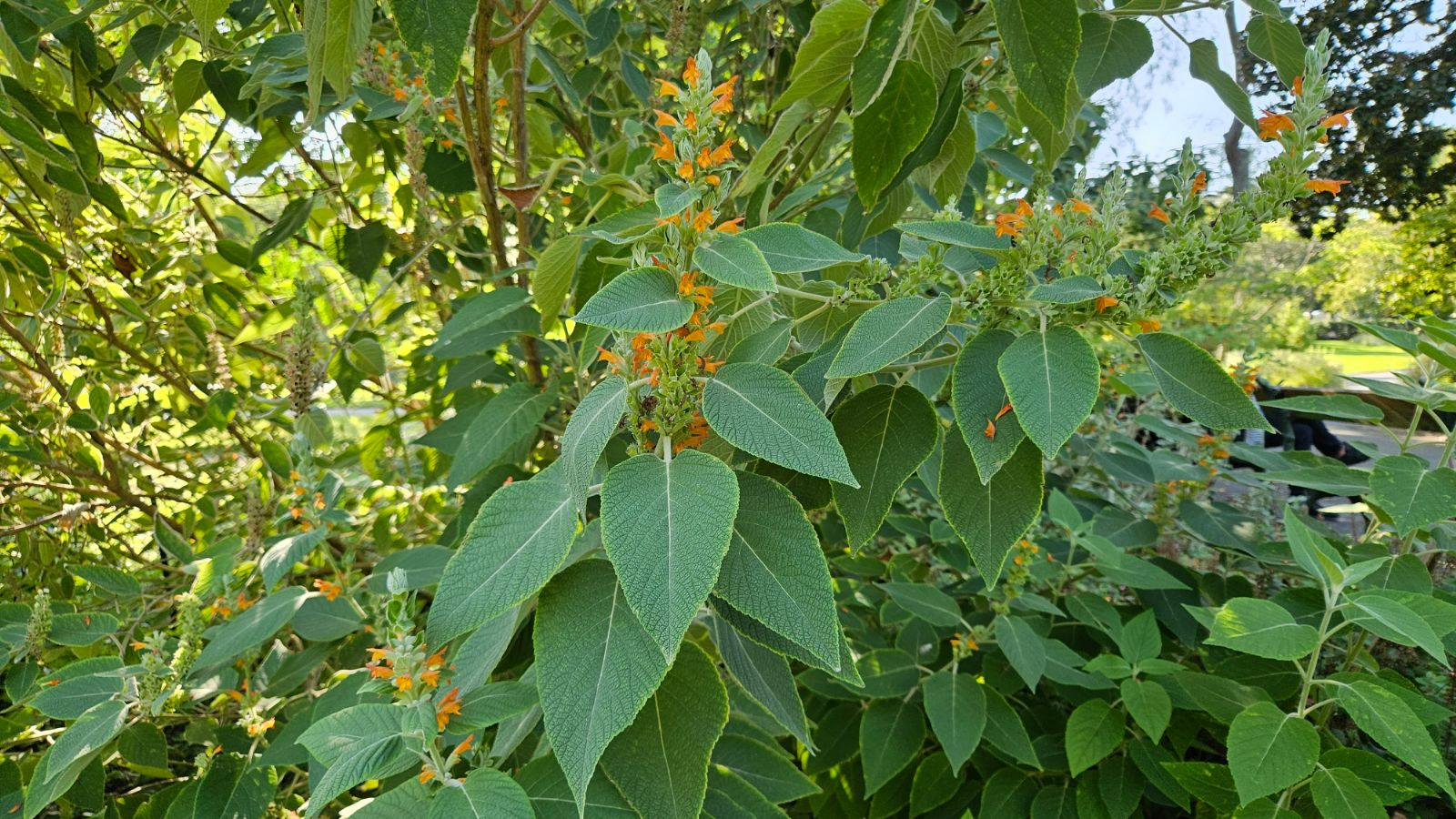
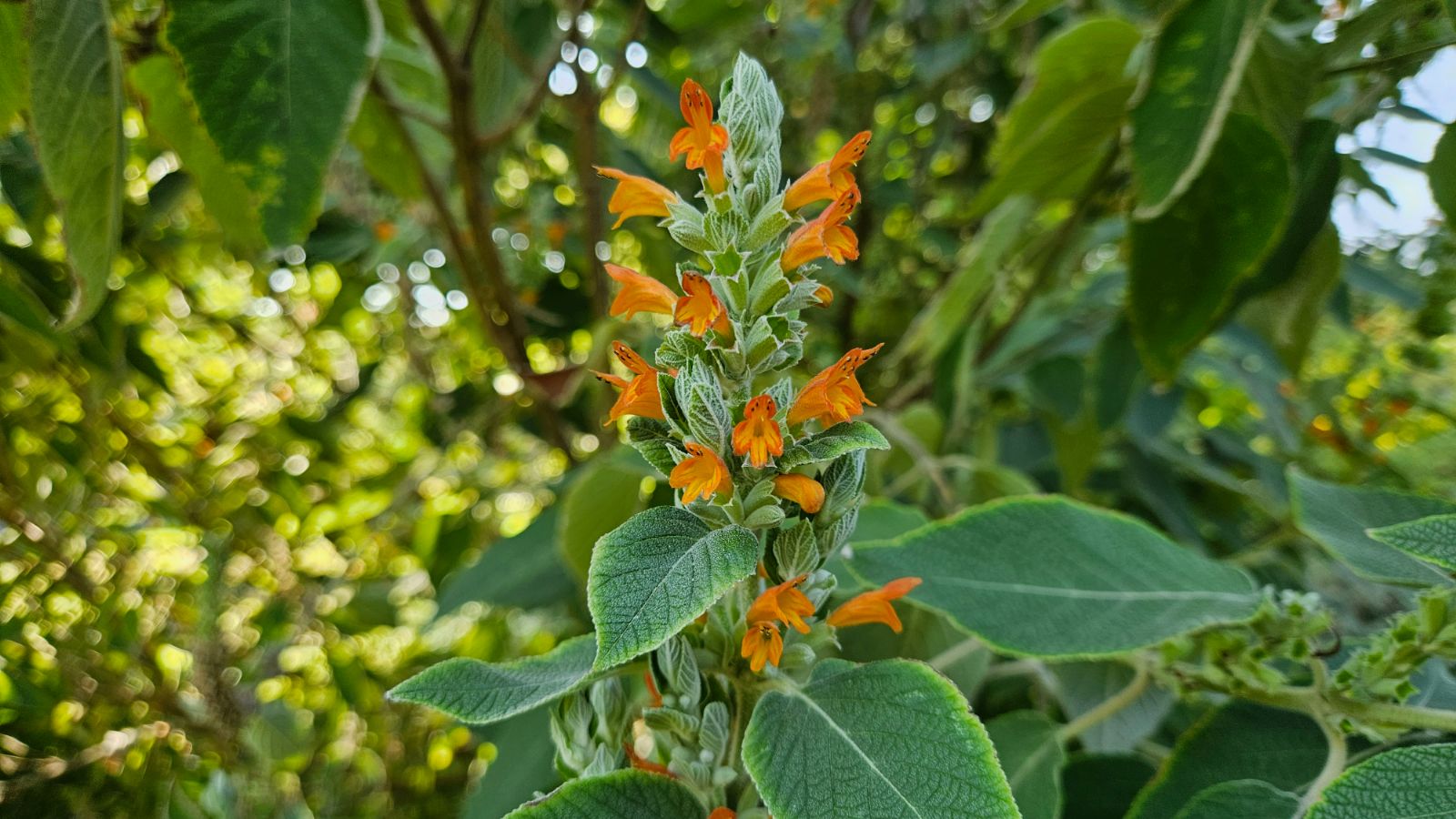
A shrub of lax, open, straggly habit, up to 8 or 10 ft high, with obscurely four-angled, downy shoots and leaves very variable in size and shape. The latter range from 2 to 8 in. in length, 1 to 5 in. in width, and from lanceolate to heart-shaped in outline; dull green and downy above, grey or even whitish beneath with a felt-like down. Flowers produced on the shoots of the current season from August onwards to October in the axils of the terminal leaves and in whorls on a spike at the end of the shoot, the whole making a slender panicle of blossom sometimes one foot long. The corolla is scarlet or orange-red, funnel-shaped, 1 in. long, downy, ending in a conspicuously two-lipped mouth; the lower and larger lip is three-lobed and yellowish inside. Calyx funnel-shaped, 1⁄2 in. long, five-toothed, grey with down like the flower-stalks. The whole plant when crushed has a pleasant apple-like scent. Bot. Mag., t. 4514; n.s., t. 115.
Native of the Himalaya, W. China and other parts of E. Asia; introduced before 1850. It is a rather variable species in such characters as the degree of denseness of the indumentum, and also in hardiness. One form, of uncertain origin, is usually grown as var. vestita (Prain) Wall., though it differs but little from the type. It is, however, fairly hardy and thrives at Borde Hill, Sussex, in a sheltered position in the open ground. A form with large trusses was introduced by Kingdon Ward from the Assam Himalaya in 1938. This is perhaps more tender but grows at Highdown, Sussex, on a south wall and is figured in Bot. Mag., n.s., t. 115. All the forms so far introduced should live through ordinary winters if planted in some warm corner protected from north and east winds, especially if a mat can be thrown over the plant during very severe spells of cold.