
Clematis crispa
Credits
Article from Bean's Trees and Shrubs Hardy in the British Isles
Recommended citation
'Clematis crispa' from the website Trees and Shrubs Online (treesandshrubsonline.
Genus
Other taxa in genus
- Clematis acutangula
- Clematis aethusifolia
- Clematis afoliata
- Clematis akebioides
- Clematis alpina
- Clematis apiifolia
- Clematis armandii
- Clematis × aromatica
- Clematis campaniflora
- Clematis chinensis
- Clematis chrysocoma
- Clematis cirrhosa
- Clematis connata
- Clematis × durandii
- Clematis × eriostemon
- Clematis fargesii
- Clematis finetiana
- Clematis flammula
- Clematis florida
- Clematis fusca
- Clematis gracilifolia
- Clematis grata
- Clematis heracleifolia
- Clematis integrifolia
- Clematis × jackmanii
- Clematis × jouiniana
- Clematis lanuginosa
- Clematis lasiandra
- Clematis ligusticifolia
- Clematis macropetala
- Clematis maximowicziana
- Clematis meyeniana
- Clematis montana
- Clematis nannophylla
- Clematis napaulensis
- Clematis orientalis
- Clematis paniculata
- Clematis patens
- Clematis phlebantha
- Clematis pitcheri
- Clematis quinquefoliata
- Clematis ranunculoides
- Clematis rehderiana
- Clematis serratifolia
- Clematis songarica
- Clematis stans
- Clematis tangutica
- Clematis texensis
- Clematis tibetana
- Clematis uncinata
- Clematis × vedrariensis
- Clematis verticillaris
- Clematis viorna
- Clematis virginiana
- Clematis vitalba
- Clematis viticella
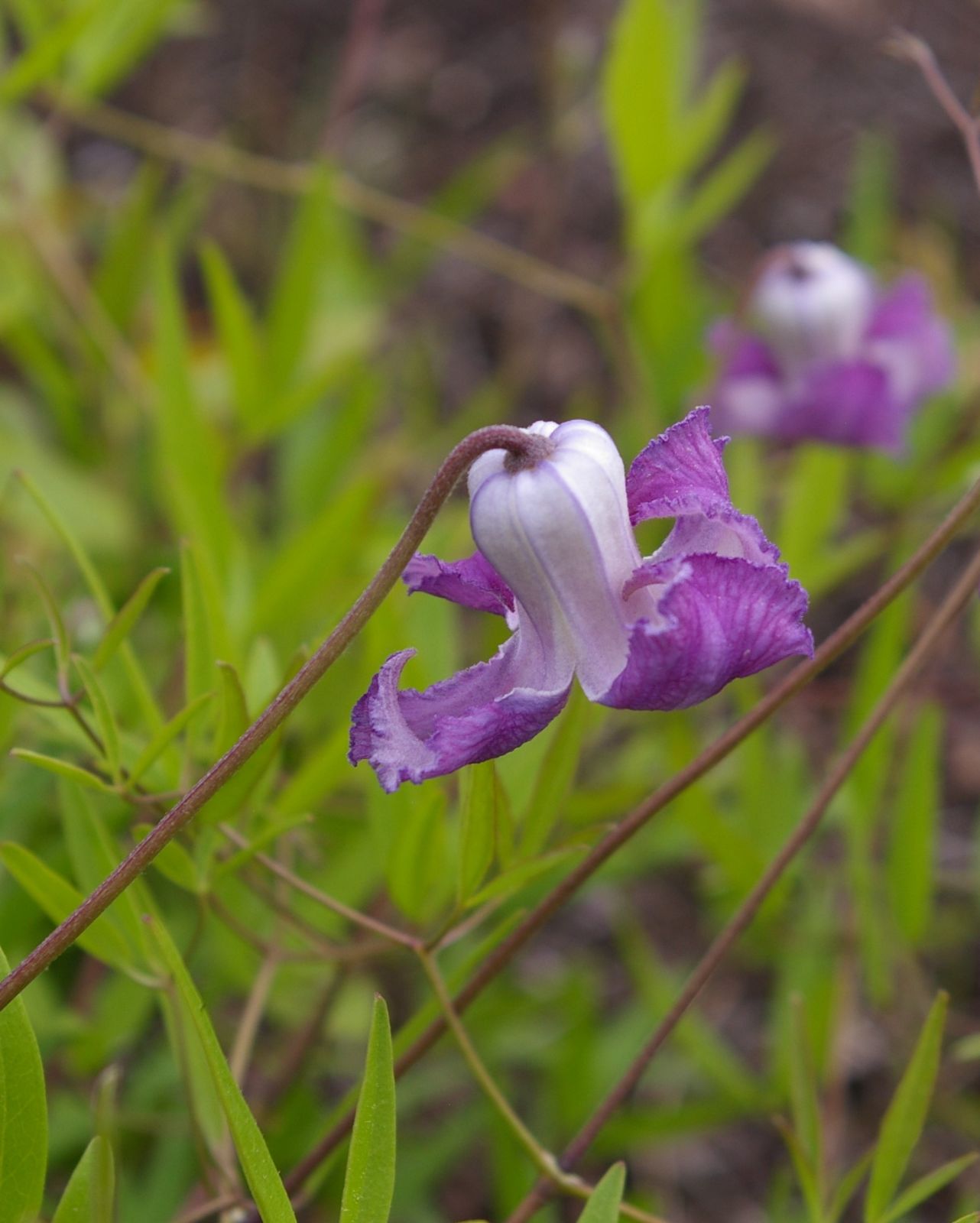
A deciduous, half-woody climber, varying from 3 to 8 ft high. Leaves pinnate, consisting of three, five, or seven leaflets; these leaflets are themselves often trifoliolate or variously lobed, but not toothed, varying from lance-shaped to broadly ovate with a heart-shaped base, and from 1 to 3 in. long by 1⁄3 to 11⁄2 in. wide, thin and glabrous. The larger leaves are altogether 6 to 8 in. long. Flowers solitary on stalks 1 to 3 in. long, fragrant; sepals 11⁄4 to 2 in. long, convergent below, spreading and separate towards the points, 1⁄3 to 1⁄2 in. wide, thin and wavy at the margins, partially downy at the back, bluish purple, nearly white at the margins. Seed-vessel either silky or becoming nearly glabrous. Bot. Mag., t. 1892.
Native of the south-eastern United States; introduced in 1726. This is regarded as one of the Viorna group, but is amply distinguished by the upper half of the sepals expanding widely and being much broadened and wavy at the margin. It flowers from June to August.