Betula × caerulea Blanch.

TSO logo

Sponsor

Kindly sponsored by the Banks family in memory of Lawrence Banks CBE DL VMH

Credits

Hugh A. McAllister, Kenneth Ashburner, Paul Bartlett & Martin Deasy (2026)

Recommended citation
McAllister, H. A., Ashburner, K., Bartlett, P. & Deasy M. (2026), 'Betula × caerulea' from the website Trees and Shrubs Online (treesandshrubsonline.org/articles/betula/betula-x-caerulea/). Accessed 2026-06-17.

Family

  • Betulaceae

Genus

  • Betula
  • Subgenus Betula section Betula

Common Names

  • Blue Birch

Synonyms

  • Betula caerulea-grandis Blanch.
  • Betula coerulea-grandis Blanch., orth. var.
  • Betula coerulea var. blanchardii Sarg.
  • Betula coerulea var. grandis Blanch.
  • Betula × caerulea var. cunninghamii B.Boivin

Glossary

glandular
Bearing glands.
ovate
Egg-shaped; broadest towards the stem.
synonym
(syn.) (botanical) An alternative or former name for a taxon usually considered to be invalid (often given in brackets). Synonyms arise when a taxon has been described more than once (the prior name usually being the one accepted as correct) or if an article of the International Code of Botanical Nomenclature has been contravened requiring the publishing of a new name. Developments in taxonomic thought may be reflected in an increasing list of synonyms as generic or specific concepts change over time.

Credits

Hugh A. McAllister, Kenneth Ashburner, Paul Bartlett & Martin Deasy (2026)

Recommended citation
McAllister, H. A., Ashburner, K., Bartlett, P. & Deasy M. (2026), 'Betula × caerulea' from the website Trees and Shrubs Online (treesandshrubsonline.org/articles/betula/betula-x-caerulea/). Accessed 2026-06-17.

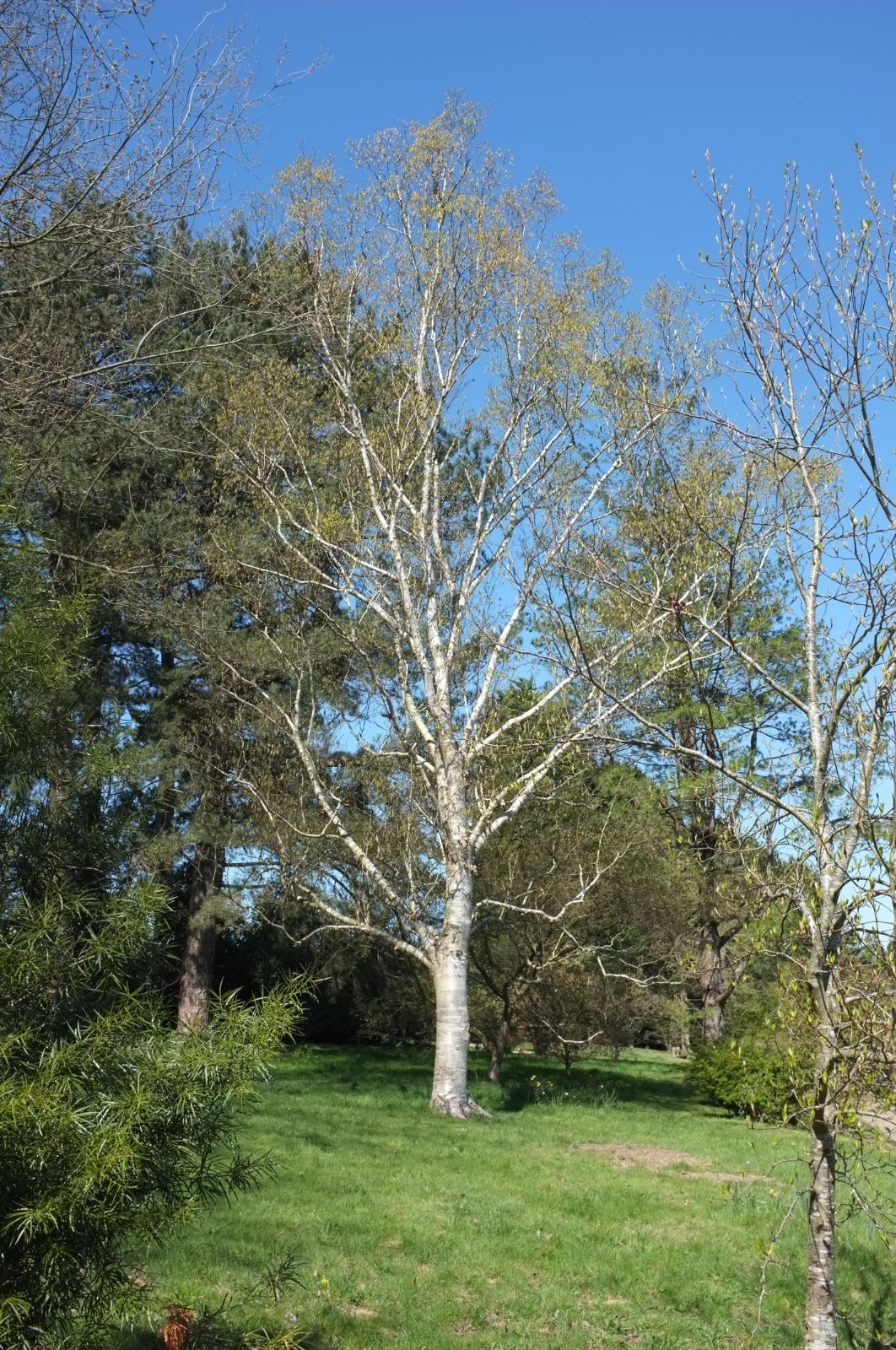
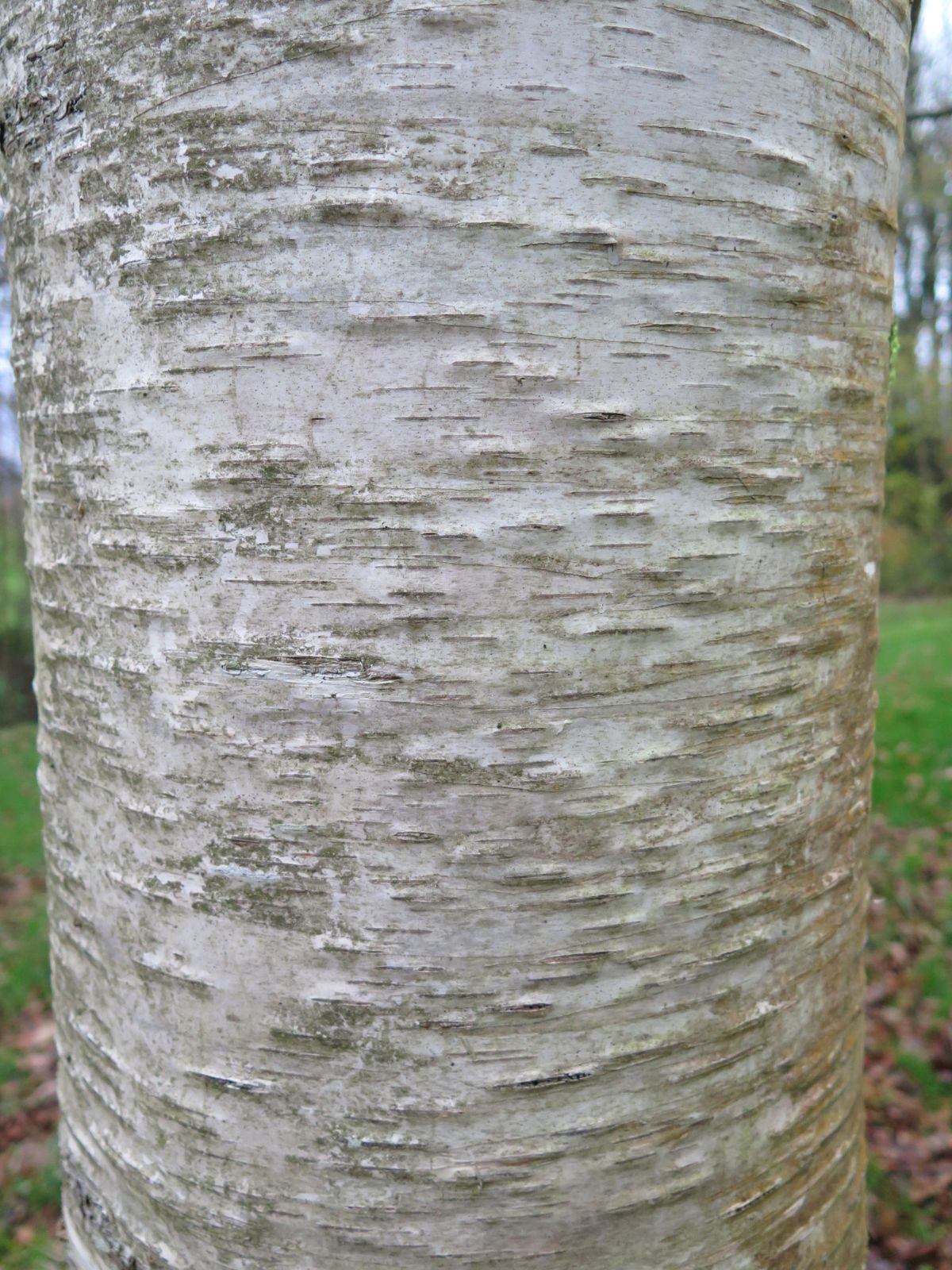
Tree up to c. 10 m, with upright habit, sometimes quite twisted; bark on twigs and branches pale brown to brown, tight; on trunks often reddish, pinkish, white or very white. Lenticels on bark thin to somewhat swollen, not so closely superimposed as in B. populifolia, and sometimes cinnamon as in subsp. szechuanica. Twigs rough with many glandular warts, or sometimes rather smooth even when young and strong, owing to a lack of glands. Buds to 6 mm. Leaves similar to those of B. populifolia, acuminate, but longer and larger, to 120 mm long, rather straight-sided, and with 5–7 pairs of lateral veins, liberally dotted with glands, not deeply double-toothed, truncate, cuneate or often subcordate at the base. Male catkins to 3.5 cm, slightly curved and usually paired, though occasionally in threes or single. Female catkins thin and erect at flowering, at fruiting short-cylindrical to somewhat ovate as in B. populifolia, but larger, equally persistent and all hanging vertically. Scales to 5 × 5 mm, with body about equal to middle lobe, lateral lobes spreading, recurved. Nutlet elliptical, scarcely 1 mm, with wing as slightly wider than the nutlet. 2n=28

Distribution  CanadaUnited States

Habitat In secondary forest, usually with the parents but sometimes forming populations of the stabilised hybrid.

The Blue Birch, Betula × caerulea is a beautiful tree with brilliant white bark that occurs in eastern North America from Massachusetts northward to Maine and New Brunswick and from New York State to Nova Scotia. The vernacular name, Blue Birch, comes from the liberal covering of glands on the leaves; the trunk has pronounced ‘eyebrows’ as conspicuous as those found on the trunks of B. populifolia. Stands of B. × caerulea may be seen in cut-over and burned openings in secondary forest in the area where both the parent species grow. Betula × caerulea was originally named as a species by Blanchard in 1904. In the same year Blanchard also named B. caerulea-grandis, here treated as a synonym of B. × caerulea. It has been shown that both are stabilised hybrids between B. populifolia and B. cordifolia (Brittain & Grant 1967, 1969, 1972; Guerriero et al. 1970; Koshy et al. 1972; Grant & Thompson 1975; De Hond & Campbell 1989).

The differences between Betula populifolia and B. × caerulea can be subtle: trees of B. × caerulea have an upright habit, with a coarser silhouette than B. populifolia owing to thicker twigs, which are rough with many glandular warts. Bark on twigs and branches is pale brown to brown, tight, on trunks often pinkish, white or very white. Lenticels on the bark are thin to somewhat swollen, not as closely superimposed as in B. populifolia, and sometimes cinnamon-coloured. The leaves are often much like those of B. populifolia, but longer and larger, and often subcordate at the base. The male catkins are quite long, up to 3.5 cm, not much curved and usually paired; the female flowers thin and erect, developing into fruiting catkins which are shortly cylindrical to somewhat ovate as in B. populifolia, but larger, equally persistent but not so hard and all hanging vertically.

In cultivation in the British Isles, individuals of wild origin have been planted in various arboreta, but none are yet of any great size. It seems that the large tree called Betula × caerulea at Hergest Croft cited in Bean (1970) and now dead, was in fact B. pendula subsp. mandshurica – many authors (e.g. Britton & Brown 1913) have commented on the similarity between Betula × caerulea and B. pendula.