Kindly sponsored by the Banks family in memory of Lawrence Banks CBE DL VMH
Hugh A. McAllister, Kenneth Ashburner, Paul Bartlett & Martin Deasy (2026)
Recommended citation
McAllister, H. A., Ashburner, K., Bartlett, P. & Deasy M. (2026), 'Betula pumila' from the website Trees and Shrubs Online (treesandshrubsonline.
This TSO article is an edited digest of the species account in Kenneth Ashburner and Hugh McAllister, The Genus Betula: A Taxonomic Revision of Birches (2013; repr. 2016).
Trees and Shrubs Online, 23 June 2026
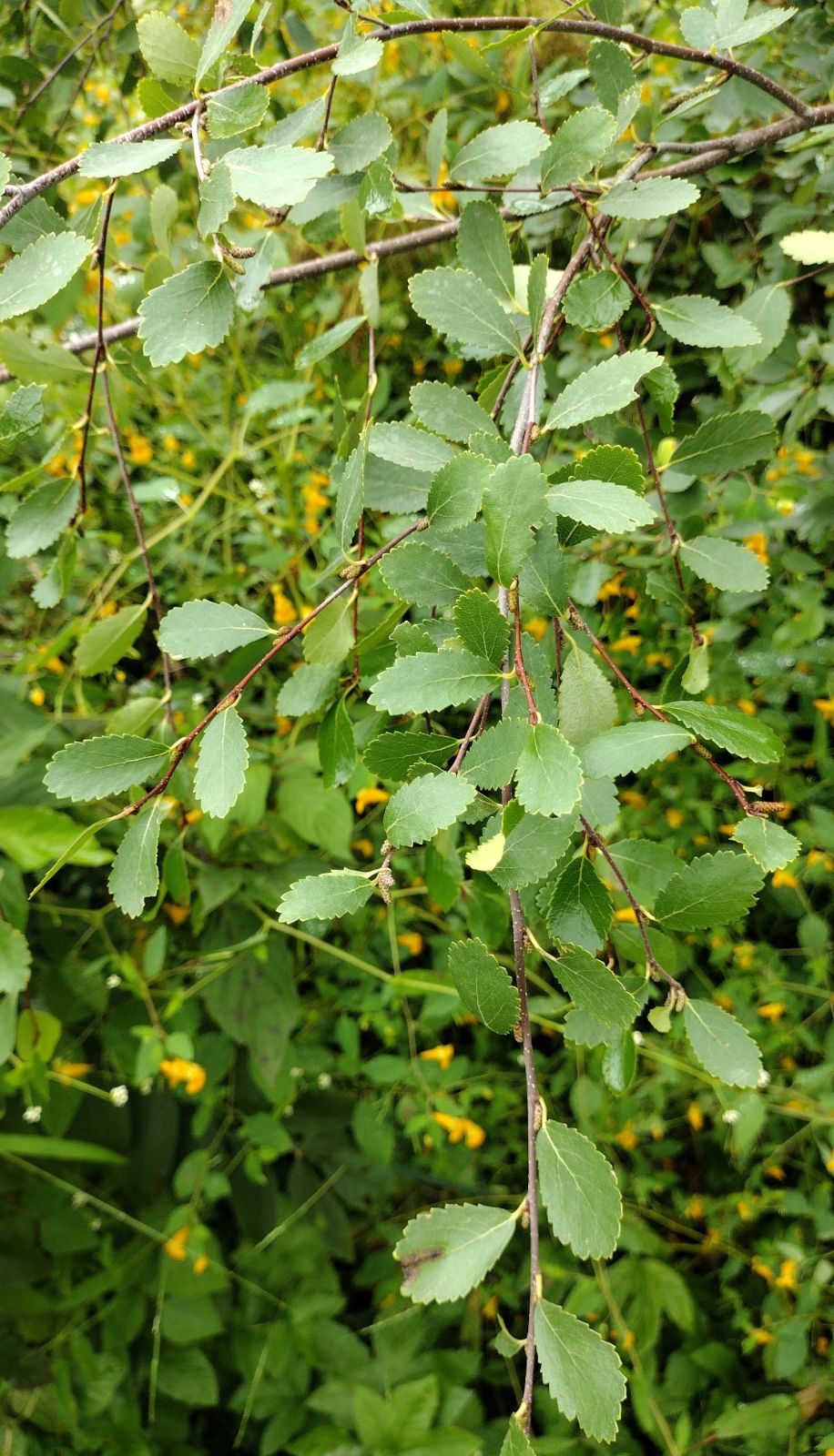
Shrubs to 4 m, often rather straggling or spreading. Twigs stout, to 4 mm across at base, midbrown, slightly shining, typically densely hairy with longer (to 0.5 mm) hairs than Betula glandulosa (0.05 mm) present at least in bud axils (B. glandulosa may have occasional longer silky hairs on young shoots) and sometimes eglandular in the east. Buds ovoid, rounded, c. 4 × 2 mm, narrower than twig, scales brownish-black, fringed with hairs. Leaves on longshoots larger than preformed spur-shoot and basal long-shoot leaves, elliptic to obovate to sometimes almost orbicular (especially when stressed) with cuneate bases, 18–58(–70) × 13–40(–50) mm, with 2–6 pairs of veins often branching before reaching the margin and kinked where the tertiaries join, teeth often ± triangular and less rounded than in B. glandulosa. Male catkins to 3 terminal on short extension growths of the previous year, 2.5–5 × 2.5–3.5 mm, vigorous long shoots often with numerous, clustered, lateral males towards base of current year’s extension growth below buds which will give rise to female catkins or towards tip of previous year’s growth, erect to somewhat pendulous at anthesis. Fruiting catkins to 20 (–30) × 10 mm, often smaller. Scales 3–4.5 × 3.5–5 mm. Seed 1.6–2.5 × 2.5–3.2 mm, with wing narrower than the nutlet. 2n=56.
Distribution Canada Newfoundland and eastern Canada, westwards to Vancouver United States northeastern states with scattered occurrences westward to the Pacific coast
Habitat Wet ground, whether acid bog or calcareous fen or streamside.
Erect in habit, the North American Betula pumila is the ecological analogue of Eurasian B. humilis, occurring in bogs and on the fringes of lakes or bordering creeks; it appears to be the only regularly tetraploid birch species in North America. In the wild it is probably much confused with B. glandulosa of drier habitats, from which it is distinguished by the often densely hairy and usually stiffer twigs with persistent coarse crisped hairs (≥0.5 mm and longer, against 0.05 mm with few longer silky hairs in B. glandulosa), coarser and sharper leaf teeth, shorter male catkins, and the arrangement of catkins with lateral males below females. In cultivation it could be mistaken for B. humilis, but is more vigorous, with stouter twigs, bigger buds and more-or-less obovate leaves. The typical form – with hairy twigs and leaves that soon become eglandular – is more or less confined to the northeastern corner of North America, perhaps as relatively isolated populations. However, populations of less hairy shrubs with more persistently glandular leaves occur sporadically in wet habitats across North America to Vancouver Island (Dugle 1966).
Betula pumila is never as neat and elegant as B. humilis can be at its best, and its rather sparse, open, straggly habit makes it a poor garden subject, at least in western Europe. However, on wet soils it may form quite a neat bush if pruned; the crimson-tipped female flowers can be conspicuous in the spring, and the autumn foliage colour is attractive. Like many plants of wet, open habitats it is very intolerant of shade, only growing well in full sun. It has grown happily in north Devon in well-drained, poor soil, forming a shrub 2 m tall in ten years, flowering and fruiting freely.