
Araujia sericifera
Credits
Article from Bean's Trees and Shrubs Hardy in the British Isles
Recommended citation
'Araujia sericifera' from the website Trees and Shrubs Online (treesandshrubsonline.
Genus
Synonyms
- Physianthus albens Mart.
Other taxa in genus
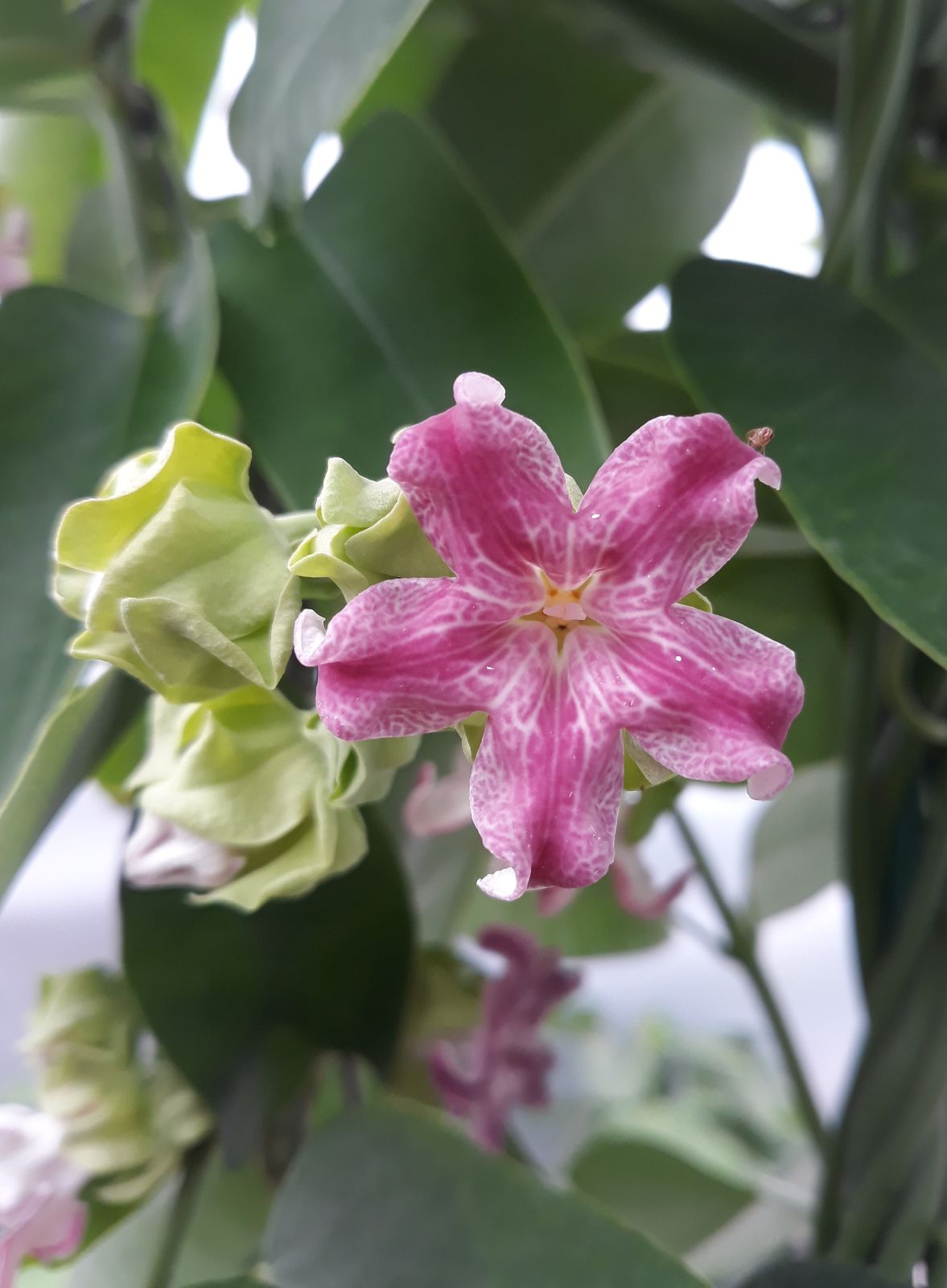
An evergreen climber of very vigorous growth, the stems twining, covered with pale down when young. Leaves opposite, ovate-oblong, pointed, the base cut off squarely or broadly wedge-shaped; 2 to 4 in. long, 3⁄4 to 2 in. broad; pale green, and clothed beneath with a pale minute felt; stalk 1⁄2 to 11⁄4 in. long. Flowers fragrant, borne two to eight together on racemes about 2 in. long, produced at the joints of the stem, not in either of the leaf-axils, but at the side between the leaf-stalks (the inflorescence is terminal, becoming lateral by sympodial growth of the stem). Corolla white, swollen at the base, the tube 1⁄2 in. long, 1⁄3 in. wide; opening at the top into five spreading lobes, and there 1 to 11⁄4 in. across. Calyx with five ovate lobes 1⁄3 in. long. Fruit a large grooved pod, 5 in. long, 2 to 3 in. wide at the base, tapering slightly towards the end; each seed with a tuft of silky hairs 1 in. or more long attached at the end. Bot. Mag., t. 3201.
Native of S. America; introduced by Tweedie from Buenos Aires in 1830. It is not hardy at Kew, and even against a wall does not long survive, but at Pendell Court in Surrey it used to grow and flower. Where it is warm enough, as in the Channel Islands, it flowers and produces its curious large fruits freely. It likes a good loamy soil, and can be increased by cuttings as well as by seed. Flowers in late summer.