
Ampelopsis aconitifolia
Credits
Article from Bean's Trees and Shrubs Hardy in the British Isles
Recommended citation
'Ampelopsis aconitifolia' from the website Trees and Shrubs Online (treesandshrubsonline.
Genus
Synonyms
- Vitis aconitifolia (Bunge) Hance

A slender-stemmed, luxuriantly leafy, deciduous climber; young shoots glabrous. Leaves very variable in shape and size, composed either of three or five stalkless leaflets radiating from the end of a common stalk which is 1⁄2 to 2 in. long. The leaflets are lanceolate or diamond-shaped in general outline, but always deeply and coarsely toothed, and often conspicuously three- or five-lobed, the lobes reaching sometimes to the midrib. The entire leaf is 2 to 5 in. across, the leaflets 1 to 3 in. long, deep glossy green above, pale beneath, and glabrous on both sides except for small tufts of down in the vein-axils beneath. Flowers produced in August and September in numerous forked cymes. Fruits scarcely 1⁄4 in. long, roundish-obovate, dull orange.
Native of China. Of the vines with compound leaves and deeply cut leaflets this is the hardiest and most luxuriant in growth. It can be trained up a tall post, which it will soon cover with a beautiful tangle. There has been some confusion in gardens between this species and A., japonica.
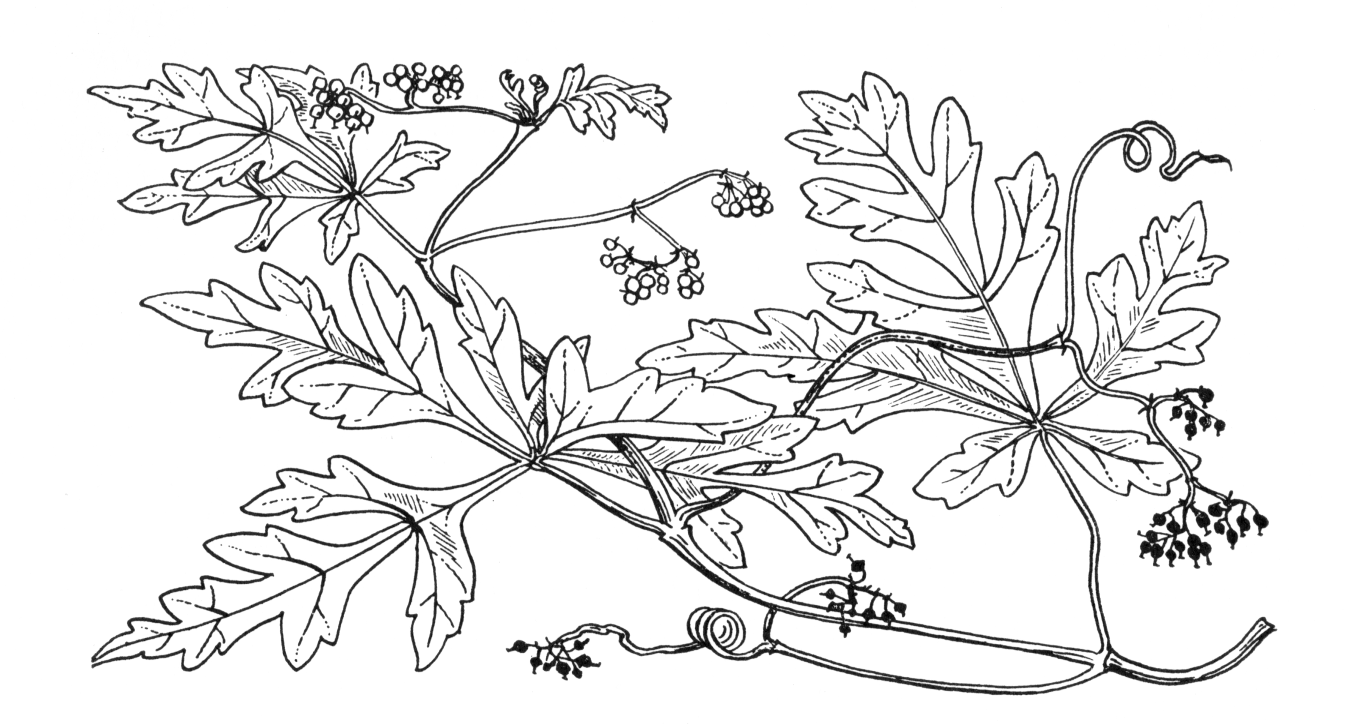
A japonica (Thunb.) Mak.
Synonyms
Paullinia japonica Thunb.
Vitis serjanaefolia (Bunge) K. Koch